
Strengths
- Gold posted its first weekly gain after two weeks of losses, and so did silver, as markets now see almost no chance of a Federal Reserve rate hike in October and only a 25% chance in December. Holdings in gold exchange-traded funds (ETFs) climbed to their highest level in more than four years. Gold-backed ETFs added 120,300 troy ounces in the latest session, their fourth straight day of increases, bringing total holdings to 101.2 million ounces, the most since August 2022. That shows investors are still buying bullion despite recent price swings, according to Bloomberg.
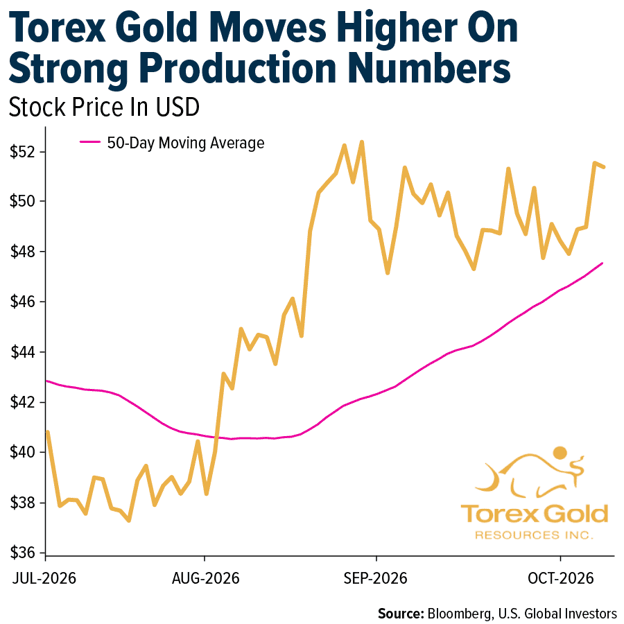
- Torex Gold Resources beats third-quarter production estimates. Torex reported preliminary third-quarter production of 131,900 gold equivalent ounces, about 38% above the Bloomberg consensus estimate of 95,791 ounces. The company kept its full-year production forecast of 420,000 to 470,000 gold equivalent ounces, according to Bloomberg.
- China’s central bank extends its gold-buying streak to 23 straight months. The People’s Bank of China (PBOC) added 740,000 ounces of gold to its reserves in September, its 23rd consecutive monthly purchase. China’s total gold holdings reached 77.47 million troy ounces, worth $323.52 billion at the end of September, a sign of steady central bank demand for the metal, according to Bloomberg.
Weaknesses
- Palladium was the weakest precious metal for the week, likely on signs of a slowing economy. Gold fell to a nine-week low on Wednesday, trading near $4,110 an ounce, its lowest level since early August, before rebounding later in the week. Rising real yields in the U.S., meaning bond yields after inflation, along with rebounding oil prices are weighing on gold’s near-term outlook, according to Bloomberg Markets.
- Aris Mining misses third-quarter production estimates. Aris Mining reported third-quarter gold production of 69,300 ounces, about 9% below Canaccord’s estimate of 76,200 ounces. The company kept its full-year 2026 forecast of 300,000 to 350,000 ounces but expects to come in near the low end. First production from its Lower Marmato project remains on track for the fourth quarter, according to Canaccord.
- Fortuna misses third-quarter gold production estimates after disruptions at its Séguéla mine. Fortuna reported third-quarter gold production of 69,700 ounces, about 6% below BMO’s forecast of 73,900 ounces. The shortfall came mainly from Séguéla in Ivory Coast, where a blockade by small-scale local miners, since resolved, and a shortage of contractor equipment led to lower ore quality, lower gold recovery and less ore processed, according to BMO.
Opportunities
- B2Gold’s Goose Mine offers growth potential as its ore-crushing capacity expands. After visiting B2Gold’s Back River Gold District in Nunavut, Canada, Scotiabank said it is confident the Goose Mine can meet its 2026 production forecast of 170,000 to 200,000 ounces. Crushing capacity is expected to rise from 800 tons per day in the second quarter of 2026 to 4,000 tons per day by the end of the second quarter of 2027, supporting the mine’s ramp-up and future production growth.
- Franco-Nevada takes a stake in gold explorer Kenorland Minerals. Franco-Nevada bought 10 million common shares of Kenorland Minerals, giving it a 12.42% ownership stake. The investment shows growing interest in gold exploration companies and could make it easier for Kenorland to raise money for future exploration.
- Gold remains the world’s second-largest reserve asset after the U.S. dollar. Valued at $4,008 an ounce, gold made up 26.4% of global central bank reserves at the end of the second quarter of 2026. That was down from 29.6% the previous quarter but well above its 2015 low of 9.3%. Meanwhile, the U.S. dollar’s share rose to 41.7% from 40.2% but remains far below its 2001 level of 61.9%, according to Canaccord.
Threats
- Recent gold ETF buyers are sitting on losses, which could put pressure on prices. JPMorgan estimates the average price paid by investors who have poured money into gold ETFs since late July is $4,365 an ounce, leaving much of that recent buying more than 5% underwater. These newer buyers may increasingly be individual investors, who often hold longer and can tolerate losses better. But if prices stay weak, more of them could sell, adding further pressure on gold.
- Rising diesel prices threaten Australian gold miners’ profit margins despite the sector’s strong stock performance. Australian gold miner shares have recently done better than their profit margins alone would suggest, but operating costs remain high in the near term. Diesel prices are near the top of the range the companies assumed in their fiscal 2027 forecasts. That could add to an estimated 10% to 15% year-over-year rise in all-in sustaining costs (AISC), the industry’s main measure of what it costs to produce an ounce of gold. Goldman Sachs expects margins to recover and expand in calendar 2027.
- India’s new import tax could weigh on demand for physical gold. India ended an exemption from its Integrated Goods and Services Tax (IGST) for gold, silver and platinum imported by banks and government-approved agencies, putting a 3% tax on those purchases. The move raises costs for the main channels that bring bullion into the country and could dampen physical gold demand in one of the world’s largest gold markets, according to Bloomberg.
