
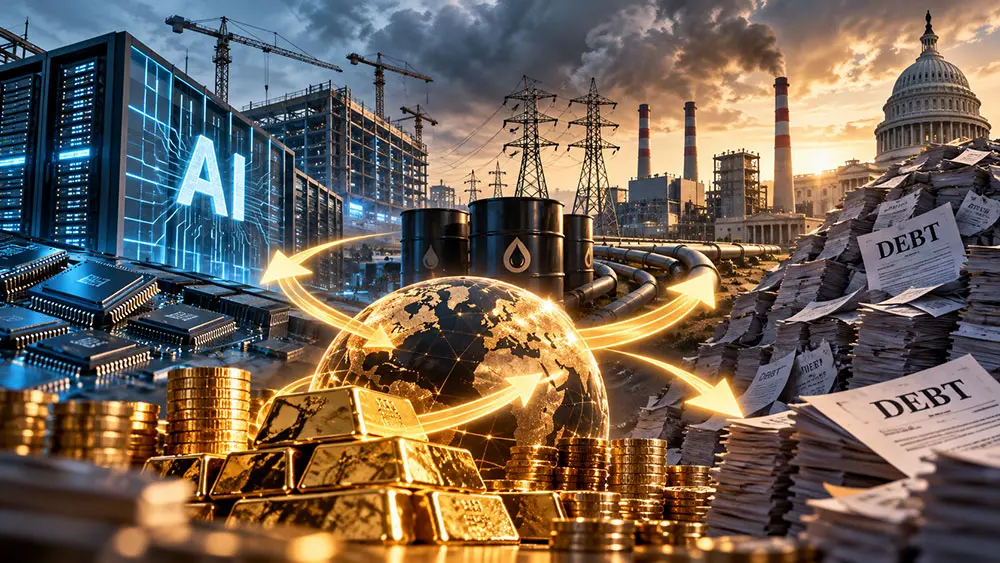
A technological revolution, an energy shock and a mountain of debt. Each presents a challenge on its own, but together they create a harder question. What happens when the response to one problem makes another worse?
In remarks reported on 7 October, IMF Managing Director Kristalina Georgieva warned that AI investment, persistent energy pressures and heavy debt burdens are confronting policymakers simultaneously and urged greater monetary caution and difficult decisions on government finances[i] .
The significance is in the combination. Energy disruption can push prices higher, AI construction adds demand for power and infrastructure, and interest rates intended to contain inflation then increase the cost of servicing debt. For households trying to preserve what they have built, that interaction deserves attention.
The future needs electricity today
AI is often presented as a route to greater productivity and lower costs, and that potential matters. But the infrastructure must be built before its promised benefits can be fully realised. Data centres, chips, electricity connections and cooling systems require substantial investment, and the IMF has identified this spending as a source of near-term demand and inflationary pressure, particularly when energy supplies are already constrained.[ii]
That leaves a timing problem, since the construction bill arrives before the productivity dividend, and a distribution problem alongside it, since strong profits for technology companies would not by themselves establish that workers, households and public finances were benefiting equally. If increasingly capable systems reduce demand for human labour, the consequences could extend beyond employment, with weaker earnings restraining consumer spending while a smaller wage-tax base puts additional pressure on government finances. That is a risk scenario rather than an established outcome, and neither the scale of displacement nor the balance between new opportunities and lost employment is settled. Historical experience with earlier technologies cannot guarantee that general-purpose AI will follow the same path, so it could eventually relieve some economic pressures even as it creates new ones during the transition.
Energy reaches far beyond the petrol pump
Energy costs work their way through transport, manufacturing, agriculture and household bills, so an extended disruption can squeeze both businesses and consumers. Companies must decide how much of the increase to absorb and how much to pass on, and households have less money available for other spending. A diplomatic breakthrough would be welcome, but restoring supply chains, damaged infrastructure and depleted reserves can take longer than announcing a ceasefire, and the IMF's September assessment highlighted reserve replenishment and winter demand as continuing vulnerabilities.[iii] Energy pressures can therefore outlast the event that first created them.
Central banks face an awkward choice as a result. Higher rates cannot produce more fuel, but they can restrain spending and help prevent an initial price shock from becoming persistent inflation, and that restraint has a cost of its own.
Debt makes the choices harder
A large debt burden is easier to carry when financing is cheap and incomes are growing, and more demanding when borrowing costs rise. The adjustment is gradual for debt issued at fixed rates, since yesterday's borrowing does not all become more expensive overnight, but the pressure builds as debt matures and must be refinanced alongside any new borrowing.
Consider a simplified example. Refinancing £100 billion at 6% rather than 3% adds £3 billion to annual interest costs on that amount, money unavailable for other purposes unless revenue increases or borrowing rises further. Governments then face competing demands in public services, defence, infrastructure, ageing populations and interest payments. Higher taxes can weaken private spending, spending cuts can create economic and political strain, and more borrowing deepens the financing problem, while inflation may reduce the real value of some existing fixed-rate debt but also damages purchasing power and can increase the cost of future borrowing. It offers no painless escape.
When the ingredients reinforce each other
This is the central danger of the cocktail. Energy pressures can prolong inflation, AI investment can add demand before productivity improves, higher rates can increase refinancing costs, and fiscal restraint can then weaken growth, making debt harder to manage relative to the economy. There is a more favourable path, in which energy supplies recover, AI delivers broad productivity gains and credible fiscal decisions rebuild confidence, and a less comfortable possibility, in which expensive energy, disappointing investment returns and tighter financing arrive together. These are scenarios rather than forecasts, but they illustrate why a plan built around rapidly falling rates and uninterrupted asset growth deserves another look.
Where physical gold fits
For wealth preservation, the practical question is how exposed a portfolio is to the same assumptions. Physical gold has a distinctive characteristic, in that the metal itself is not a promise by a company or government to repay its owner, and that can make it worth considering within a diversified approach.[iv]
Ownership still carries practical responsibilities, including secure custody, insurance and the terms of any storage arrangement, and buying premiums and selling spreads also affect the return an owner receives. Gold does not produce income and its price can fall, and higher real yields, a stronger dollar or improving confidence can create headwinds.[v] It does not reliably offset every inflation shock or market decline, so the case for considering it rests on its role within a broader plan, the costs involved and the owner's circumstances rather than an assumption that bad news guarantees a higher price.
The IMF's warning gives reason to examine how risks connect. For anyone protecting wealth intended to support retirement or the next generation, that is a useful place to begin, because a resilient plan needs room for more than one version of the future.
[ii] https://www.imf.org/en/news/articles/2026/09/20/sp091926-europe-and-global-ai-race
[iv] https://www.gold.org/goldhub/research/relevance-of-gold-as-a-strategic-asset/risks-challenges
[v] https://www.gold.org/goldhub/research/gold-mid-year-outlook-2026
