
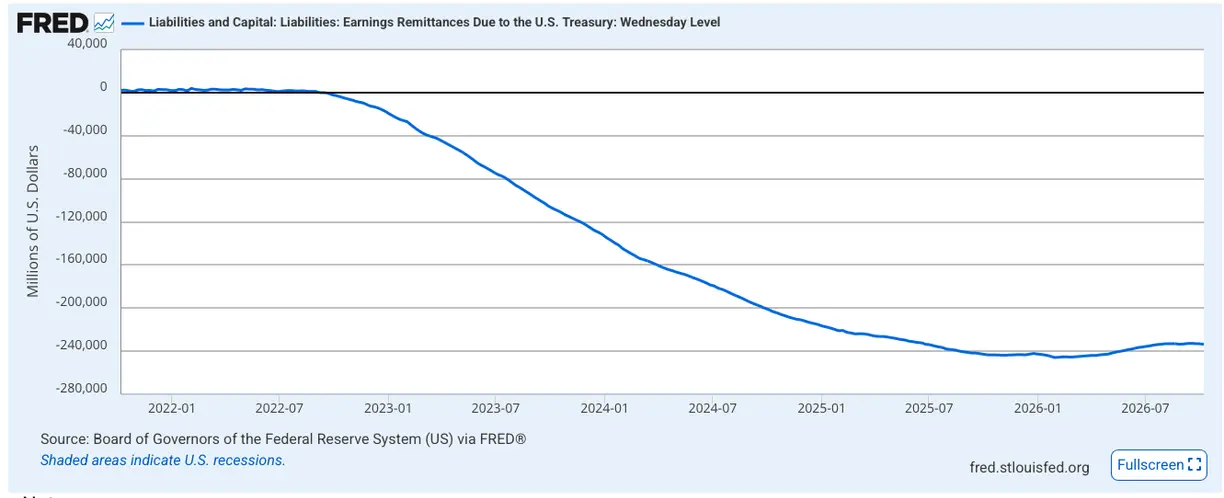
The recent moves in Treasury yields have again raised questions about the Fed’s losses. As a reminder, the Fed generated significant losses over 2023-2025 and became, in a sense, underwater, paying more on its liabilities than it earned on its assets.
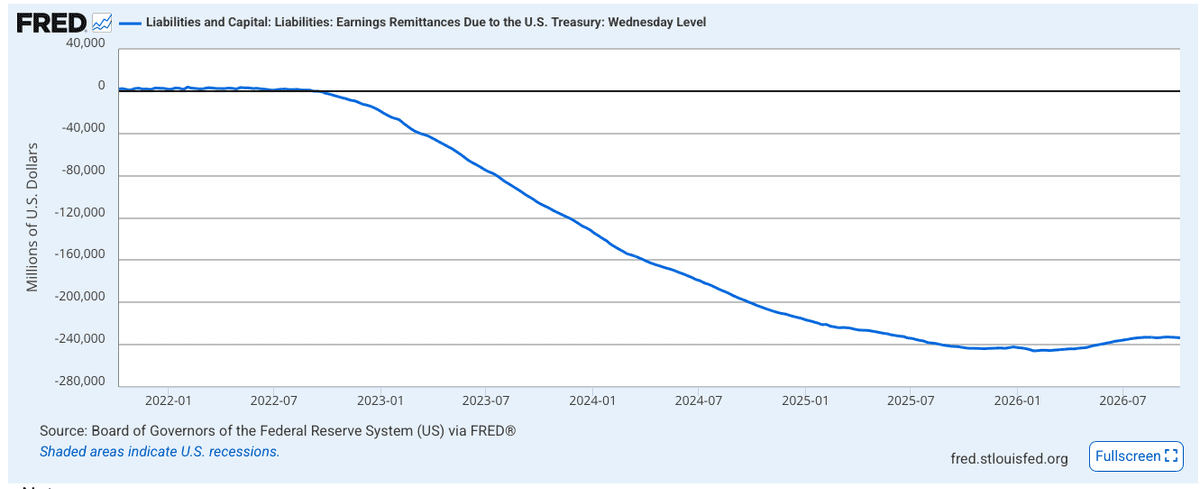
In contrast to the Fed’s own projections, the accumulated loss has shrunk by only around 5%, from its peak of roughly $246B to $234B. And, as shown below, it has even become somewhat larger in recent weeks.
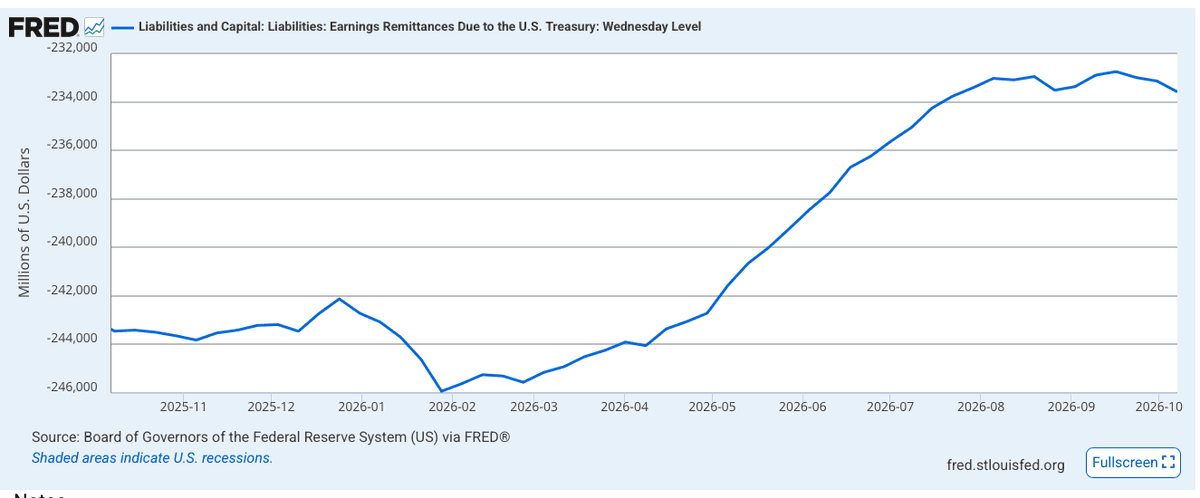
First and foremost, as we have already said in our previous articles, these losses should not be dismissed as “paper” losses. They are real operating losses, not just unrealized mark-to-market losses. Importantly, they also have budgetary consequences.
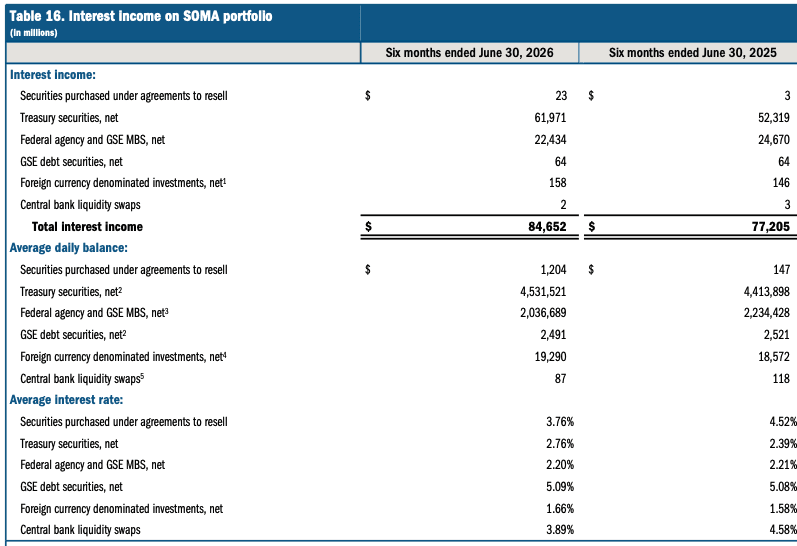
The reason for these large losses lies in the Fed’s balance sheet. Here is a breakdown of the Fed’s interest income on the SOMA (System Open Market Account) portfolio, with average daily balances and average interest rates. As shown, the Fed holds about $4.5T in Treasuries with an average yield of 2.76% and $2T in federal agency and GSE MBS, with an average yield of 2.20%. Needless to say, there is a big difference between those rates and current short-term funding costs. While the Fed has reduced its interest expenses compared with 2023-2025, it is still stuck with these low-yielding securities.
Notably, the Fed records these accumulated losses as a “deferred asset” under an accounting methodology introduced in 2010. This makes sense from the regulator’s perspective. With a deferred asset of $234B and reported capital of about $48B, treating these accumulated losses as a reduction in equity would imply negative equity of roughly $186B.
Of course, the $234B in accumulated losses are quite important. But for us, who are focusing on finding safe banks, it is especially interesting to see how far the Fed’s own projections of its balance sheet and earnings missed the mark.
In mid-2022, the Fed published an article titled “An Analysis of the Interest Rate Risk of the Federal Reserve’s Balance Sheet, Part 2: Projections under Alternative Interest Rate Paths.” In this paper, the Fed examined how changes in interest rates could affect its income, as well as the unrealized gain or loss position of the SOMA portfolio.
The Fed’s simulations included interest-rate paths in which the policy rate approached 6%, well above its baseline projection.
Surprisingly, even with these higher-rate outcomes included, the upper edge of the Fed’s 90% confidence band for the deferred asset was only around $180B.
“While the deferred asset reaches a peak of about $60 billion in the baseline projection, the tail risk in these projections, represented by the upper edge of the dark-blue area, indicates that the deferred asset could reach as high as about $180 billion.”
The Fed’s actual accumulated losses of more than $230B are now above the upper edge of its published 90% confidence band. And the fact that these losses have recently started growing again, rather than continuing to shrink, makes the gap between the Fed’s projection and reality even more striking. A 5% tail probability may sound small. But when analysts and mainstream financial media talk about tail risks, they often suggest ignoring them precisely because they seem so unlikely. Yet, here we are now.
So, when you hear analysts and financial media saying that large US banks are very safe because they have passed all the Fed’s stress tests, remember that even sophisticated Fed models can miss important outcomes.
Consider that even Fed Chairman’s have noted that the Fed is not reliable when it comes to forecasts and predictions. In fact, Alan Greenspan once publicly noted:
“We really can't forecast all that well, and yet we pretend that we can, but we really can't.”
Also, if a large US bank fails, would it make any difference to you to know that it was a “tail risk” or a “low-probability event”? The Fed’s own experience reminds us that low-probability outcomes can still happen, even in an environment that remains relatively benign.
Bottom line
Believe it or not, there are more major issues on the larger bank balance sheets as compared to smaller banks, which we have covered in past articles. Moreover, consider that there was one major issue which caused the GFC back in 2008, whereas today, we currently have many more large issues on bank balance sheets. These risk factors include major issues in commercial real estate, rising risks in consumer debt (approaching 2007 levels), underwater long-term securities, over-the-counter derivatives, high-risk shadow banking (the lending for which has exploded), and elevated default risk in commercial and industrial (C&I) lending. So, in our opinion, the current banking environment presents even greater risks than what we have seen during the 2008 GFC.
Almost all the banks that we have recommended to our clients are community banks, which do not have any of the issues we have been outlining over the last several years. Of course, we're not saying that all community banks are good. There are a lot of small community banks that are much weaker than larger banks. That’s why it's absolutely imperative to engage in a thorough due diligence to find a safer bank for your hard-earned money. And what we have found is that there are still some very solid and safe community banks with conservative business models.
So, I want to take this opportunity to remind you that we have reviewed many larger banks in our public articles. But I must warn you: The substance of that analysis is not looking too good for the future of the larger banks in the United States, and you can read about them in the prior articles we have written.
Moreover, if you believe that the banking issues have been addressed, I think that New York Community Bank is reminding us that we have likely only seen the tip of the iceberg. We were also able to identify the exact reasons in a public article which caused SVB to fail. And I can assure you that they have not been resolved. It's now only a matter of time before the rest of the market begins to take notice. By then, it will likely be too late for many bank deposit holders.
At the end of the day, we're speaking of protecting your hard-earned money. Therefore, it behooves you to engage in due diligence regarding the banks which currently house your money.
You have a responsibility to yourself and your family to make sure your money resides in only the safest of institutions. And if you're relying on the FDIC, I suggest you read our prior articles, which outline why such reliance will not be as prudent as you may believe in the coming years, with one of the main reasons being the banking industry’s desired move towards bail-ins. (And, if you do not know what a bail-in is, I suggest you read our prior articles.)
It's time for you to do a deep dive on the banks that house your hard-earned money in order to determine whether your bank is truly solid or not. You can feel free to review our due diligence methodology here.
