


THE MECHANICS OF A FED DAY
Why Gold Is the Cleanest Fed Trade
Every asset class reacts to a Federal Reserve decision, but gold reacts honestly. Equities can be carried higher by buybacks and passive flows, credit can be pinned by issuance calendars, and crypto has its own internal weather. Gold is a near-pure expression of two variables: the real yield on U.S. debt and the direction of the dollar.
That makes Fed day both the most dangerous and the most legible session of the quarter. There is no ambiguity about what is driving price. If gold rallies into the close, real yields fell. If gold flushes, they rose. The narrative writes itself in real time — which is precisely why so many traders lose money on it. Legibility and predictability are not the same thing.
The Three Transmission Channels
Gold carries no coupon and pays no dividend. Everything else follows from that single fact.
Real yields. The opportunity cost of holding bullion is what a risk-free inflation-protected bond would pay instead. When real yields fall, that cost shrinks and gold becomes competitive. This is the dominant channel and the one most consistently inverse to gold over multi-month horizons. Nominal yields alone are a weaker signal — a rise driven by inflation expectations is very different from a rise driven by tightening expectations.
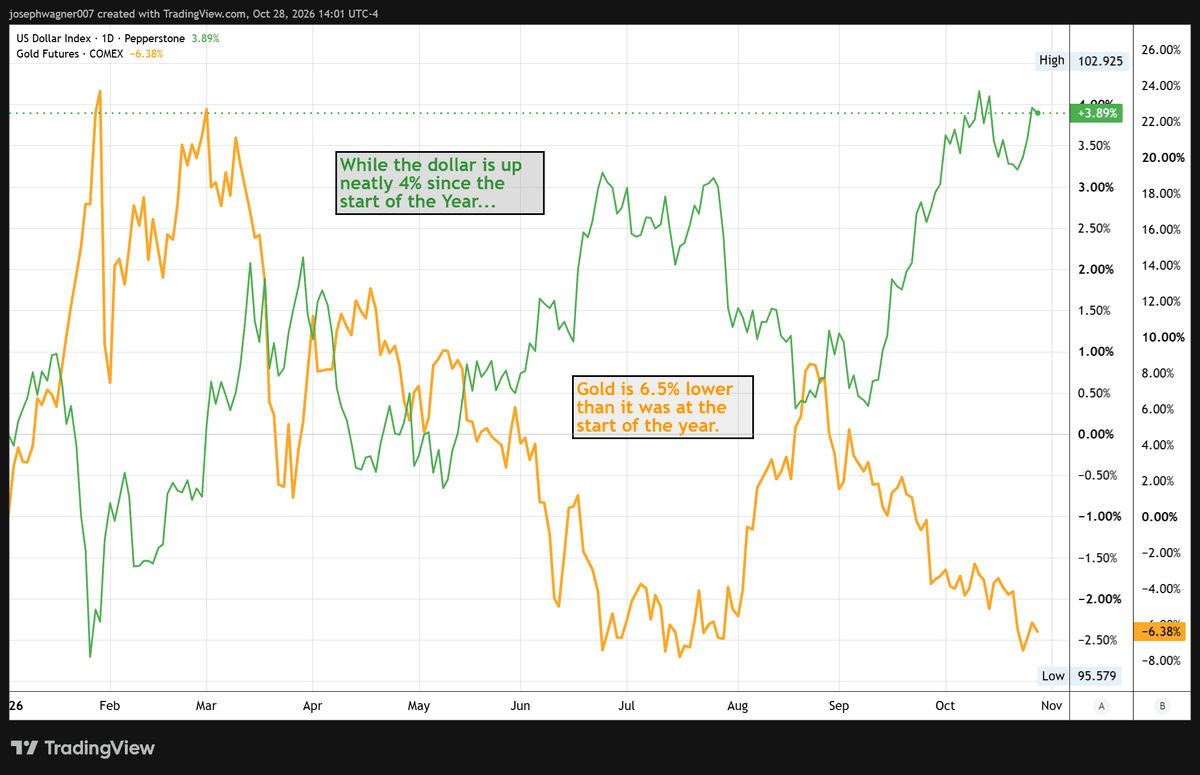
The dollar. Gold is quoted in dollars globally, so a stronger greenback mechanically raises the price for every non-U.S. buyer. Dollar strength is the second-order effect that turns a modest yield move into a violent gold move, particularly in Asia, where physical demand is price-sensitive.
Risk appetite. Gold's safe-haven bid is the least mechanical and the most overrated channel on Fed day. In a genuine risk-off shock, capital flows to Treasuries and the dollar first. Gold often follows after the initial dash for cash, not during it. Do not assume a bad tape automatically means a bid under gold.
The Current Regime
Markets are not debating whether the Fed will move tomorrow. They are debating the path after tomorrow. That distinction is where the money is made.
Three things will decide the reaction, in ascending order of importance:
- The statement. A hold or a cut is largely priced. What matters is whether the language around inflation, employment, and "data dependence" changes by even a clause. The market reads adjectives the way a hawk reads footprints.
- The projections. Any shift in the projected path for coming quarters moves the long end of the curve more reliably than the decision itself. A single participant shifting their dots can reprice the entire front end.
- The press conference. The most volatile twenty minutes of the session, and the one most likely to invalidate the initial move entirely. Markets routinely trade one direction on the statement, then reverse once the Chair takes questions.
The practical consequence: the first ten minutes after the release are frequently wrong. They are a liquidity event, not an information event.
PAGE 2 — SCENARIOS, LEVELS, AND EXECUTION
Scenario Matrix
Directional forecasting on Fed day is a coin flip dressed in a suit. Preparation beats prediction.
Scenario | Fed Tone | Likely Gold Reaction | What to Watch |
Dovish surprise | Cut, or hold paired with a softer projected path and explicit acknowledgment of labor-market cooling. | Bullish. Real yields and the dollar fall together — the most forceful combination gold can get. | Front-end yields collapsing faster than the long end; DXY breaking down through recent support. |
Base case | Hold, neutral statement, projections essentially unchanged. | Range-bound chop. Two-way whipsaw with a wider range than the daily average, most of it post-presser. | Whether the initial move holds the prior day's range or fades back inside it. |
Hawkish surprise | Hold with an upward revision to the projected path, or pushback on market easing expectations. | Bearish. A real-yield spike plus a dollar squeeze is the most reliable flush setup. | TIPS yields rising while the dollar breaks out; gold failing to reclaim the pre-announcement level. |
Genuine shock | An off-consensus decision or a fracture in the committee visible in the vote split. | Directionally violent, then unstable. Expect the largest range and the lowest reliability. | Dissents in the statement; funding-market stress; whether gold's move survives the next session. |
The Intraday Sequence
Volatility is not evenly distributed. It clusters.
- Pre-announcement (morning). Liquidity thins as desks reduce risk into the event. Moves are exaggerated relative to volume. Do not read intent into the drift — it is positioning, not opinion.
- The release. Algorithmic repricing in milliseconds. Spreads widen, stops get run. Any entry here is a lottery ticket with a commission attached.
- The press conference. Where the durable move is usually born. Listen for deviation from the prepared text, not the text itself.
- The close and the following session. The honest verdict. A move that survives overnight is a repricing. A move that reverses by the next open was noise.
Execution Notes
Watch the inputs, not the output. Keep the 10-year yield, the 10-year TIPS yield, and the dollar index visible alongside gold. If the drivers are not confirming the move in the metal, the move is a liquidity artifact and should be treated as such.
Assume false breakouts. Local highs and lows get swept on Fed day with near-mechanical regularity. Waiting for a close rather than a wick costs a few ticks of opportunity and saves entire accounts.
Size for the event, not the thesis. Volatility events demand smaller positions and wider invalidation. The correct question is not "where do I enter" but "how much can I be wrong by."
Take profit into liquidity. The best prices of the session usually occur when volume arrives, not when conviction does.
Closing Thought
Tomorrow is a guidance event wearing an action-event costume. The bar for a sustained gold rally is set high: it takes a material dovish repricing to break gold out of consolidation. The bar for a selloff is lower, because the same dollar and yield mechanics that lift gold in reverse can flush it quickly once easing hopes are extinguished.
But the direction is secondary. What separates a good Fed day from a bad one is whether risk was defined before the release rather than after the reversal. The traders who do well tomorrow will not be the ones who called the decision. They will be the ones who had a plan for all four outcomes and the discipline to execute only the one the market actually delivered. Most importantly expect volatility to spike sharply so if you DO trade a Fed day remember to keep stops loose and remain fluent in executing trades based on a per-determined game plan otherwise your entering a race with traders and algorithms much faster than you, don’t try to out run them, instead outsmart them. For more daily gold market analysis, visit us at thegoldforecast.com.
