
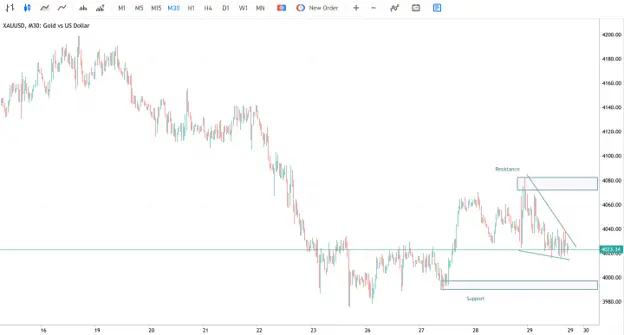
Spot gold slipped to the $4,020–$4,030 range per ounce on October 29, 2026, down roughly 1% on the day, after a stronger-than-expected US growth print handed the Federal Reserve the most uncomfortable kind of good news. Third-quarter GDP expanded at a 3.4% annualized pace, beating expectations, yet weaker personal income and spending suggest the American consumer is beginning to lose speed beneath the headline.
The sell-off reflects one simple reality: this is not a clean rate-cut signal. With core PCE holding at 0.3% and weekly jobless claims at an exceptionally low 194,000, the Fed has little reason to rush toward easing. That keeps real yields elevated and leaves gold caught in a painful cross-current between a still-solid labor market and a consumer that is quietly cooling.
Strong Headline Growth Masks a Slowing Consumer Engine
The important number is not just 3.4% GDP, infact, it is the gap inside it. Growth at that pace says the US economy is not rolling over, but softer income and consumption say the engine is no longer running at full throttle. Strong output alongside a fading household impulse suggests growth is being supported by forces that may not prove durable.
If that divergence widens, markets could move rapidly from fearing inflation to fearing a delayed growth slowdown. That shift would be the catalyst gold bulls are waiting for, but it has not arrived yet.
Cooling Price Index Fails to Change the Fed Narrative
The GDP price index cooling sharply to 2.3% is the figure gold bulls will point to, but it has not altered the market's central argument. Traders still see a resilient economy, sticky core inflation and a Federal Reserve with room to wait. Until that narrative breaks, rallies in gold are likely to be sold rather than chased.
ECB Hold Adds Another Layer of Pressure
Taking in account of the ECB’s rate decision impact on gold, the European Central Bank held rates, but the market is not selling the euro simply because of the decision. In fact, it is selling the ECB's lack of a painless next move which is a mover for the gold price. The Bank has warned that inflation risks are rising which is what gold traders are looking at, but the reaction was short lived because the ECB coud not sound too hawkish without worsening already fragile sovereign borrowing costs. That leaves the euro carrying both an energy-inflation premium and a policy-credibility discount and gold sits right in between this.
What to Watch: Key Triggers Ahead
Moving forward, gold traders should monitor:
- Personal income and spending trends for confirmation that the consumer is losing momentum
- Core PCE and jobless claims for any crack in the Fed's room-to-wait stance
- Real yield movements and Fed path pricing following the GDP beat
- ECB commentary on energy prices, sovereign spreads and euro credibility
- The US$4,000 level as the dividing line between base-building and broader deleveraging
Softer consumer data would revive the dovish case, while sticky core inflation keeps pressure on the metal.
Technical Analysis
On the daily timeframe, gold has slipped back toward the psychologically important $4,000 support zone after failing to sustain gains near $4,060–$4,070. Momentum has turned corrective, with sellers in control while price holds below near-term resistance. The US$4,000 area remains critical—hold it, and the market can rebuild a base; lose it, and the sell-off risks becoming a much broader deleveraging trade.
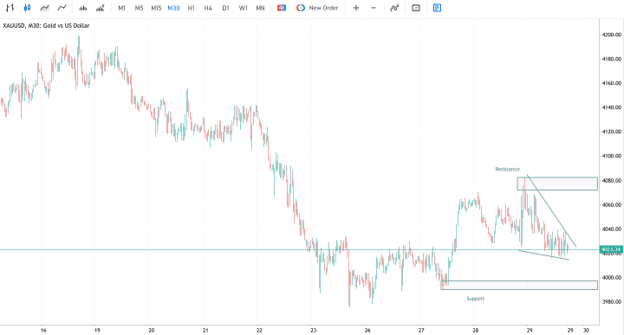
Gold trading chart: GivTrade
Final Word
Today's report is bearish for gold in the short term, but potentially bullish further out. The market is rewarding the strong GDP number now; in the coming months, it may have to confront whether that growth can survive if household income and spending continue to soften. With the Fed in no hurry, the ECB boxed in and real yields still elevated, volatility around $4,000 is likely to persist. In this environment, treat dips with discipline rather than conviction: respect the $4,000 floor, watch the consumer data closely, and let the yellow metal prove whether this growth story has staying power.