
The largest crypto theft in history hit while Bitcoin had already broken support, and the timing is right before the midterms. Here’s how I am positioning before the election.
On Thursday, Binance suffered the largest crypto theft in history. About $6.3 billion was drained from the exchange’s hot wallets in minutes, and Bitcoin dropped to a six-week low.
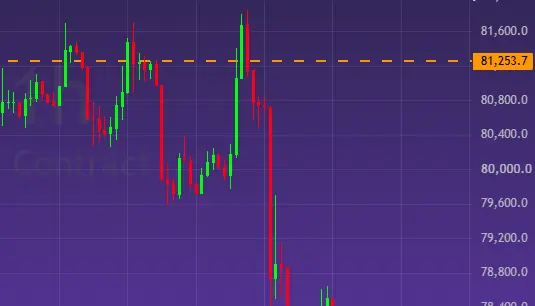
The hack worsened the drop, but Bitcoin was already weak before the news broke. In yesterday’s article, which I wrote first thing Thursday morning, I pointed out that old support had turned into resistance and that the momentum was pointing down. I waited until after the FOMC meeting and big tech earnings to write it so I could see how momentum played out, and that turned out to be a wise decision.
What happened
On Thursday afternoon, starting around 4:10 PM Eastern, billions of dollars began flowing out of Binance’s hot wallets. According to blockchain analytics firm TRM Labs, the attacker moved about $6.36 billion across 10 different blockchains, with most of it gone in roughly 20 minutes. That included 18,270 Bitcoin worth about $1.47 billion, more than 200,000 ETH, and billions in stablecoins.
That’s about four times bigger than the $1.5 billion Bybit hack in February 2025, the previous record. TRM Labs and Chainalysis both attribute the attack with high confidence to TraderTraitor, a North Korean hacking unit linked to the Lazarus Group. Binance itself hasn’t named anyone.
Binance says the breach may have started with a compromised DevOps engineer’s laptop, which gave the attacker access to a service container where they submitted unauthorized withdrawals. On Friday, the exchange said it found “additional points of breach,” so the full picture is still coming together.
Are user funds safe?
According to Binance, yes. Co-CEO Richard Teng posted on X: “Bottom line - your money is safe, and we’re covering every loss.”
https://x.com/_RichardTeng/status/2116072080525656150
Binance’s SAFU fund (Secure Asset Fund for Users) was set up in 2018 with $1 billion, and this hack is more than six times that size. Binance says it will cover the rest with company funds. Withdrawals are paused while the exchange rebuilds its withdrawal system, and Binance says it’s on track to reopen them within about 45 hours. Deposits are working again.
The bottom line is that users are covered only as long as Binance keeps that promise. Until withdrawals reopen, nobody can move their money off the exchange.
The price action
Big tech earnings had already let the market down before the hack. Alphabet closed down more than 12% Thursday, the Nasdaq fell 1.4%, and Amazon and Intel both dropped hard after hours. Then the hack news hit, and Bitcoin dumped to a six-week low of $76,368. Ethereum fell to a two-month low around $2,178, and over $1.5 billion in leveraged positions got liquidated, most of them longs.
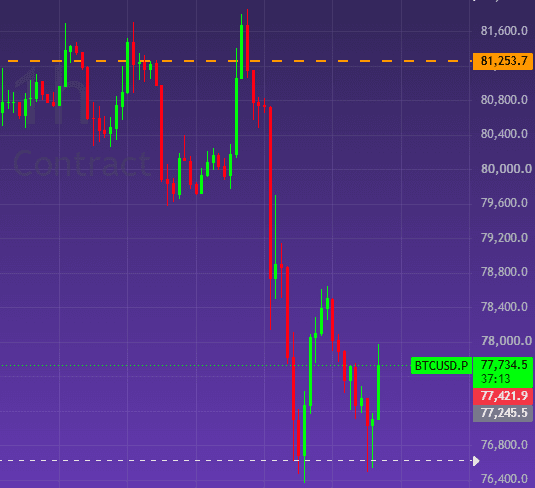
(Bitcoin 1hr chart showing $81,600 holding as resistance before the drop)
As I write this, Bitcoin is back above $77,000. The floor held.
Why the floor held
A few years ago, a $6 billion hack on the biggest exchange in the world could have taken the whole market down with it. This time Bitcoin dropped about 4% and stabilized. There are two big reasons for that.
First, the stablecoin issuers stepped in. Binance says about $3 billion has been frozen on-chain, including more than $2.3 billion by Tether and Circle. That stopped a big chunk of the stolen money from being dumped on the market.
Second, Binance’s promise to cover every loss kept a lot of people from panic selling.
The centralization problem
Here’s the part that should bother every crypto investor: The Bitcoin network wasn’t hacked. An exchange was. One compromised laptop at one company was enough to move billions of dollars and shake the whole market.
The thing that stopped a total freefall was centralized companies freezing tokens. That saved prices this time, but it also proves stablecoins can be frozen whenever the issuer decides to. That’s not decentralization.
If you’re holding crypto long term, this is your reminder. Not your keys, not your coins. Exchanges are for trading. Self custody is for holding.
What I did
I closed my shorts right at the bottom. I got such a quick win, so fast, that I wasn’t going to sit around and try to squeeze out a few extra bucks. You can see my specific positions inside The Profit Circle.
Next week is uncertain. Apple reports Monday after the bell, and the midterms are Tuesday. Historically, markets like to pump after the midterms. According to Yardeni Research, the S&P 500 has been higher 12 months after every midterm election since 1954. I can’t promise that happens this time, because I still see a lot of downward momentum, but midterms can certainly be a catalyst for a reversal.
The fear is a "scam wick" or liquidity sweep (there's more than one name for it). That’s when price dips hard, like a buoy being pushed below the water, and then bounces up really fast. That kind of move can start momentum in the opposite direction and wipe out shorts that got overextended. I’m not sure that’s going to happen this time, but considering the timing and how far we dropped in such a short amount of time, it was wise to take profit on my shorts.
You can also sit on your hands right here. There’s no rule that says you have to be in a trade going into an election.
If you believe in Bitcoin for the long term, I still think it’s a good idea to dollar cost average, like I mentioned in my article last Friday. A dip caused by an exchange getting hacked doesn’t change anything about Bitcoin itself.
I’ll be posting what I’m seeing in real time in The Profit Circle, my private Discord community. If you want to learn how I read moves like these, that’s what I teach at CassiusCuvee.com, and Swell Point is built to help you spot when momentum actually shifts after the noise. GetSwellPoint.com
General chat in The Profit Circle is free! 🌊
CassiusCuvee.com → https://cassiuscuvee.com
GetSwellPoint.com → https://getswellpoint.com
The Profit Circle → https://discord.gg/3vUGp3ycRq
