
Strengths
- The best-performing precious metal for the week was gold, although it was still down 2.82%. According to RBC, Greatland Resources got off to a strong start to FY27, with first-quarter (Q1) gold production of 70,000 ounces, 5% above the consensus estimate of 67,000 ounces. All-in sustaining costs (AISC) of A$2,925 per ounce were also 9% below expectations (consensus: A$3,216 per ounce) and at the lower end of FY27 guidance. The company maintained its FY27 guidance of 260,000–300,000 ounces of production at an AISC of A$2,900–A$3,330 per ounce, assuming a slightly stronger second half due to open-pit scheduling.
- The People’s Bank of China (PBoC) added 740,000 ounces of gold in September, up from 650,000 ounces in August. This marked its largest monthly purchase since October 2023 and its 23rd consecutive month of buying. China’s gold holdings now total 2,410 tons, with 3.32 million ounces added year to date (YTD)—nearly four times the 860,000 ounces purchased in all of 2025. At $4,000 per ounce, China’s gold reserves are worth approximately $310 billion, according to Canaccord.
- Chinese households are buying the dip in gold as prices test $4,000, with demand growing over the past two months. Trading volume in the Shanghai Gold Exchange’s Au99.99 contract jumped to 43 million lots (about 430 tons) last week, the highest level since April, according to Bloomberg.
Weaknesses
- The worst-performing precious metal for the week was silver, down 8.52%. Silver is testing the key $50-per-ounce level for the second time in just over a year. Its higher beta makes it particularly vulnerable to further declines. The near-term outlook remains weak, with additional downside expected before a potential rebound, while the medium-term outlook remains bearish.
- Russia’s central bank sold 6.2 metric tons of gold in September, marking its 10th consecutive month of sales and reducing official holdings to their lowest level since late 2019. The sales come amid mounting fiscal pressure and elevated war-related spending. Kazakhstan’s central bank also plans to reduce gold’s share of reserves from roughly 78% to 75% by year-end, citing attractive U.S. Treasury yields. The adjustment is expected to involve a combination of physical gold sales and options.
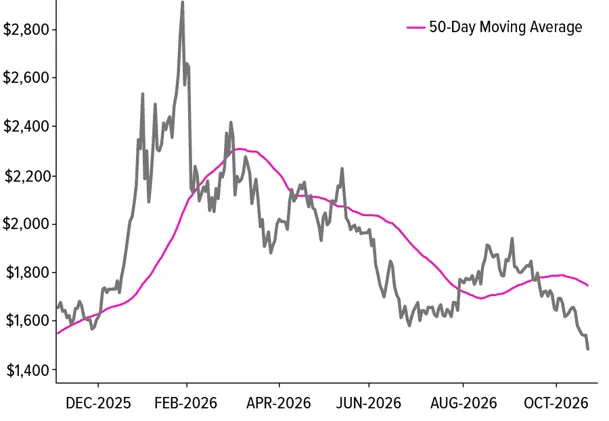
- Platinum fell below $1,500 per ounce, its lowest level since September 2025, pressured by investment outflows, elevated interest rates and a weakening demand outlook. Automotive demand is expected to decline 4%, while the World Platinum Investment Council forecasts a 265,000-ounce surplus in 2026, reflecting weaker investment and jewelry demand despite a projected 5% increase in industrial demand.
Opportunities
- Canaccord raised its 2026 gold price forecast to $4,451 per ounce from $4,374 previously, an increase of 1.8%. The firm expects producers across its coverage universe to generate record all-in sustaining cost (AISC) margins this year, averaging $2,475 per ounce—up 41% from last year’s record of $1,759 per ounce—as higher gold prices more than offset rising costs. Despite record margins and free cash flow (FCF), Canaccord believes the sector remains largely disciplined, focusing on executing organic growth plans, maintaining production, reducing debt, modestly increasing dividends and expanding share buybacks.
- BMO believes lower gold prices are beginning to attract physical buyers, with stronger premiums in India and a sharp pickup in Chinese trading signaling renewed demand. According to Bloomberg, gold ETFs added 29,500 ounces in the latest session, bringing year-to-date (YTD) net purchases to 2.07 million ounces. Official-sector activity remains mixed, with continued selling by Russia contrasting with further accumulation by China.
- The Federal Reserve (Fed) held interest rates steady while leaving a potential year-end hike on the table, adding uncertainty to the monetary policy outlook. Plans to reduce the number of annual rate decisions from eight to six could add to that uncertainty, potentially supporting safe-haven demand for gold.
Threats
- According to Scotiabank, third-quarter 2026 (Q3/26) production is expected to decline 2% quarter-over-quarter (QoQ) to 5.2 million ounces. Total cash costs (TCC) and all-in sustaining costs (AISC) are forecast at $1,450 and $1,990 per ounce, respectively. AISC margins are expected to fall to 54%, compared with 58% in Q2 and 55% a year earlier, reflecting a 6% QoQ decline in gold prices and 3%–5% higher costs. Overall, margins could be lower QoQ but roughly flat year-over-year (YoY).
- Rising diesel prices pose a growing cost risk for gold miners, potentially squeezing margins despite elevated gold prices. Agnico Eagle expects diesel to add $50–$60 per ounce to costs in Q4, up from roughly $30 per ounce in Q3. The company warned the impact could reach as much as $80 per ounce in 2027, with full-year AISC already tracking toward the high end of guidance.
- Bank of America reports that assets under management (AUM) in physically backed silver ETFs have remained steady, while market participants have continued to liquidate net-long futures positions. Precious metals refiner Heraeus commented, “If the move below $55/ounce is sustained, it would mark a further deterioration in the price trend. Below this, the $50/ounce psychological level provides the next obvious support band.”
