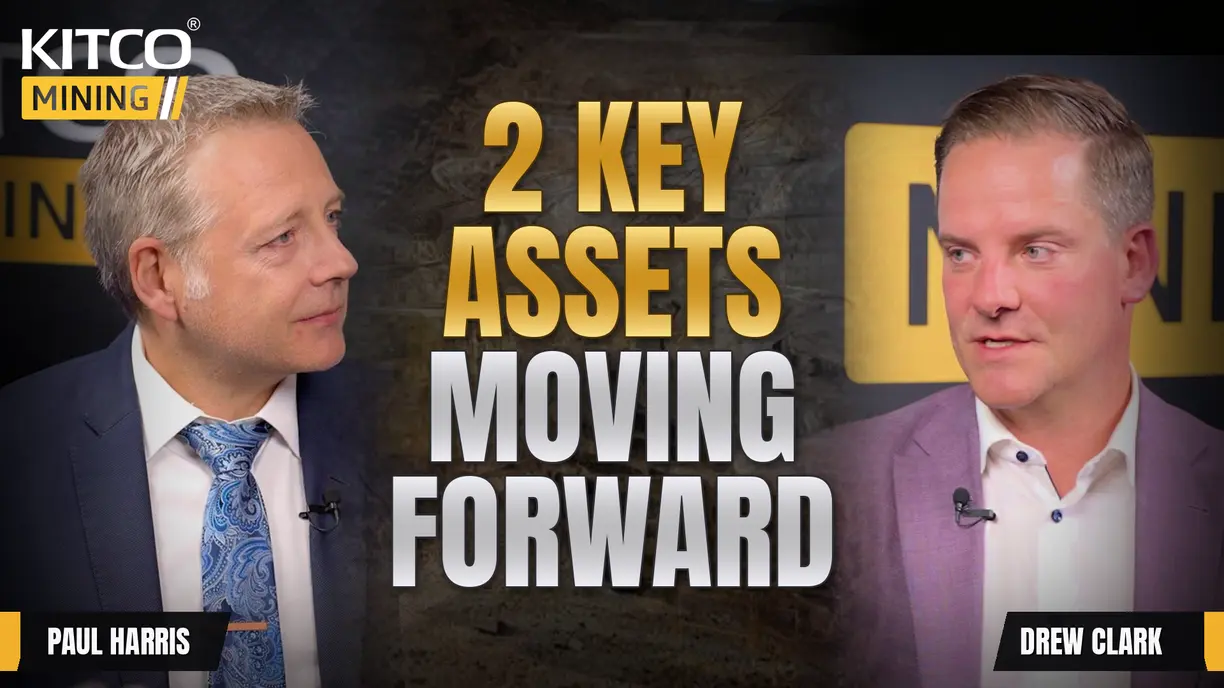
(Kitco News) Summit Royalties plans to put its new credit facility to work on cash-flowing royalties in the $20 million to $50 million range. In that range, President and CEO Drew Clark says, the largest royalty companies are focused elsewhere, and returns can beat those on bigger transactions.
Clark spoke with Kitco Mining on Sept. 22 at the 2026 Precious Metals Summit in Beaver Creek. Summit began trading on the TSX Venture Exchange in November 2025. It closed a 1% royalty on Newmont’s Saddle North deposit in June and completed its acquisition of Star Royalties in July. In late July, it secured a US$25 million revolving credit facility with National Bank of Canada, expandable to US$50 million.
“We’ve gone from zero to nearly 50 royalties in 18 months,” Clark said.
He calls the approach “professional aggression.” On the royalty covering West Red Lake’s Madsen mine, Summit moved before a formal sale got underway. “We knew a process was coming and we front-ran it,” Clark said. “It’s professional aggression; it’s working hard and just relying on our network and what we’re known for doing, using our experience to do it.”
“It is extremely competitive though,” he added.
Summit’s size is part of its pitch. “There’s not a lot of guys our size, to be blunt,” Clark said. With the biggest royalty companies chasing larger targets, he sees room in the middle. “The $20 to $50 million deals are not being overlooked, but I think we have an edge on those because, quite frankly, these larger companies are trying to do much larger deals,” he said. “And the rates of return can sometimes be superior to what you see in a larger transaction.”
Clark measures success on a per-share basis. “Growing the cash flow per share and the net asset value per share is probably the easiest deliverable that we control,” he said. “The gold price, the sentiment in the market, we don’t.”
The credit facility is built around that goal. Summit funded its early growth mostly with equity, and Clark said debt is now the cheaper option. “If you could buy a portfolio or an asset that generates $5 million a year in revenue and your interest costs on that are somewhere between two and three [percent], it grows your cash flow per share right away,” he said.
“Management and directors own 12% of this business, so we’re very cognizant of when we dilute our shares.”
Shares may still play a role in some deals, with large miners holding royalty portfolios generating strong cash flow, Clark said, and “a lot of the balance sheets of these big companies that have these portfolios are not looking for cash.” Equity does not replace a fair price, though. “No one’s going to sell something that they think is worth $1 to 80 cents because they like your equity. You still have to be competitive on pricing.”
The existing portfolio has a busy stretch ahead. “About two-thirds of our net asset value will have a meaningful catalyst in the next, call it, four to six months,” Clark said. At Copperstone in Arizona, where Summit holds a 4% gold stream acquired with Star, operator Mining Americas plans a maiden open-pit resource estimate in the second half of 2026. Banyan Gold has said it expects to complete the first preliminary economic assessment for its AurMac project in Yukon in the fourth quarter.
Across the sector, Clark expects more royalty companies to combine. “I think inevitably the consolidation theme within the royalty space is here to stay,” he said. “I’ve acquired two companies in less than 12 months, so I like to remind people that I’m a net -1 in this space, because everyone’s complaining that there are too many royalty companies.”
For shareholders, he sees “really two doors you can walk through.” In the first, Summit keeps executing, earns a higher valuation, and eventually moves to the New York Stock Exchange or Nasdaq. In the second, “we’re not as good at our job, and we continue to trade at a discount, and it’s going to be appealing for someone else to come along.”
Watch the full video on the Kitco Mining YouTube channel.
This article/video was produced with support from a Kitco sponsor. The views expressed in this content do not necessarily reflect the views of Kitco Metals Inc. Kitco does not endorse or recommend any company, security, investment product, or investment strategy. This content is for informational purposes only and should not be considered investment advice.
Learn more about Summit Royalties here

Kitco Spotlight Editorial
Kitco Spotlight Editorial is sponsored content, articles and announcements paid for by our advertisers that support our journalism. Our sponsored messages are targeted and hand-curated, highlighting the best of what's happening in the mining sector.
