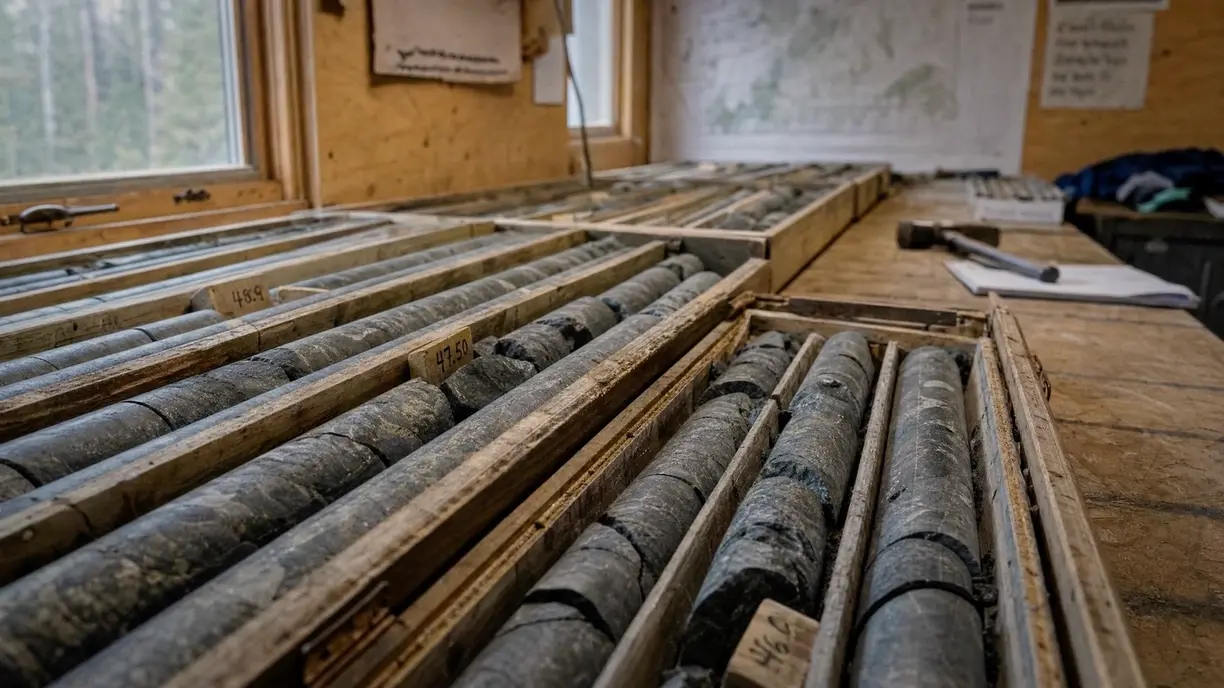
Visionary Copper and Gold Mines Inc. drill core stored in labelled core boxes.
- Visionary is reactivating its 100%-owned Kismet copper-zinc deposit in Saskatchewan, untouched since 2004 and carrying a non-NI 43-101 historical estimate of 814,648 short tons at 2.15% copper, 1.77% zinc, 0.23 oz/ton Ag and 0.003 oz/ton Au*.
- Kismet sits about 12.5 kilometres from Eldorado Gold's McIlvenna Bay mine, which produced its first copper concentrate in June 2026.
- Kismet joins Rainbow in Manitoba and Point Leamington in Newfoundland, giving Visionary just over 24 million shares to cover three live copper deposit assets.
Disseminated on Behalf of: Visionary Copper and Gold Mines Inc.
Copper is trading near record highs, and the world needs more of it. The easy deposits are largely gone, and what is left in the ground keeps getting lower grade, deeper and harder to reach. That is why a prospective high-grade copper deposit sitting next door to a brand-new mine gets investors' attention.
Visionary Copper and Gold Mines Inc. (TSXV: VCG | OTCQB: VCGMF) has owned Kismet for 15 years, and it is now putting that deposit back to work. The company is reactivating the deposit in east-central Saskatchewan, a high-grade copper-zinc system that has not seen a drill since 2004, located in the Flin Flon Greenstone belt that has produced copper for nearly a century.
Kismet joins two other Visionary copper assets. In Manitoba, the Rainbow deposit at the Pine Bay project hosts a high-grade copper resource 16 kilometres from the mining town of Flin Flon, while in Newfoundland, the Point Leamington deposit anchors a large gold, copper and zinc resource that Visionary is working to expand.
"Location is absolutely key," said President and CEO Max Porterfield. "With the metal markets where they are at, Kismet is an excellent opportunity to significantly grow our resource base."
A deposit the market forgot
When Market One last covered Visionary in September, the story centred on its copper growth strategy in Manitoba and Newfoundland. Since then, the company has also turned to a copper asset it has held for 15 years.
A prospector discovered the deposit in 1954, and more than 100 holes followed before Callinan Mines drilled the last five in 2004. It came to Visionary through Callinan's 2011 spinout and has sat idle ever since.
A historical estimate reported in the Canadian Mines Handbook 1989–90 outlined 814,648 short tons grading 2.15% copper and 1.77% zinc to a depth of approximately 335 metres. This estimate is not compliant with NI 43-101.
That figure is historical and cannot be relied upon, but it means Kismet starts with a substantial drilling record rather than a blank map.
Grade that does the heavy lifting
Grade is the amount of metal in each tonne of rock, and higher grade means a smaller deposit can still be worth building.
Kismet's historical grade of 2.15% copper is more than three times the global average grade of mined copper, which sits at around 0.6%.
The last drilling backs that up. Hole CK-1 cut a thick band of copper and zinc only 116 metres below surface: 11.2 metres grading 2.65% Cu and 3.35% Zn. Hole CK-5 added 7.3 metres grading 1.38% Cu at 111 metres vertical depth.
"In terms of copper grades, it's high-grade copper," Porterfield said. "It's typical of what you need for an underground mining situation."
A brand-new mine next door
Kismet's neighbour, about 12.5 kilometres to the south-southwest, is Eldorado Gold's McIlvenna Bay mine. This mine produced its first copper concentrate on June 7, 2026, and is rapidly ramping toward 4,900 tonnes per day.
Ottawa named the McIlvenna Bay mine one of its first five nation-building projects in September 2025, referring it to the new Major Projects Office for fast-tracking.
That proximity shows the belt can support a modern mine, and it puts roads, power, skilled crews and processing in the neighbourhood. Three concentrators operate or sit idle in the region, at McIlvenna Bay, Hudbay's Snow Lake operations and Flin Flon. Visionary has no processing agreement with any of them, but Porterfield sees options for future supplemental feed.
"When you're exploring somewhere remote, you have to take the people, the power and all the supplies out with you," Porterfield said. "Here it's already in place. Your exploration costs are compressed, and ultimately your upfront development costs are much lower too."
The upside sits underneath
Kismet is interpreted as a volcanogenic massive sulphide (VMS) deposit, formed where metal-rich fluids vented onto an ancient seafloor. In the Flin Flon belt, these deposits often run far deeper than their length at surface, or strike, would suggest. Hudbay's 777 mine in Flin Flon, which closed in 2022 after 18 years of production, is a textbook example.
“In the Flin Flon belt, VMS deposits commonly go much deeper than their surface footprint suggests,” Porterfield said. “Eldorado’s McIlvenna Bay, just 12.5 kilometres from Kismet, extends more than a kilometre below surface, and Hudbay’s 777 deposit was found by following the Callinan orebody down plunge to 900 to 1,600 metres. At Kismet, the main lens remains open in its plunge direction below the deepest historical drilling, and modelling of the borehole EM points the same way. Kismet has barely been tested below 300 metres, and that’s where we plan to drill.”
Kismet's main body is roughly 245 metres long, and the historical estimate stops at 335 metres. That is not where the deposit ends. The historical record shows two of Kismet’s seven zones remain open below that depth.
Visionary has since remodelled the borehole electromagnetic (EM) surveys from that program, which detect sulphides beyond the reach of the drill hole. Porterfield said the modelling supports the deposit continuing at depth.
Exploration permit applications for Kismet are with the Province of Saskatchewan.
"A successful first program would put us in a position to rapidly expand Kismet at depth," Porterfield said, "by testing the down-plunge potential of the deposit below the 335-metre level, as well as other targets nearby."
Three provinces, three live assets
Kismet sits about 70 kilometres from Visionary's Rainbow high grade copper deposit in Manitoba, giving Visionary a second high-grade copper source within the greater Flin Flon belt.
Visionary’s Rainbow deposit at the Pine Bay project hosts an NI 43-101 Indicated Mineral Resource Estimate of 3.44 million tonnes grading 3.59% copper equivalent and an Inferred Mineral Resource Estimate of 1.28 million tonnes at 2.95% copper equivalent. The estimate used a copper price of US$3.25 per pound, well below today's market.
On Oct. 20, Manitoba issued exploration permits for Pine Bay valid through Dec. 31, 2028. An advanced exploration permit, which would allow an access ramp and extraction of a 10,000-tonne bulk sample at the Rainbow deposit, remains under review.
“Kismet is a second high-grade copper opportunity we can move on quickly, alongside the existing resource at Rainbow, as we build toward a hub-and-spoke strategy in the Flin Flon belt,” Porterfield said.
In Newfoundland, 2026 drilling at Point Leamington led to the discovery of the Kraken copper zone alongside the existing NI 43-101 resource estimate, where the Company has also aggressively expanded its land holdings to capture compelling near surface exploration targets.
Visionary's technical bench includes Alan Vowles, a PDAC award winner for his role in discovering Hudbay's Lalor mine, and former Hudbay CEO Peter Jones, who led development of the 777 mine and initial development of the Lalor mine.
The case for a closer look
Visionary has just over 24 million shares outstanding and a market capitalization of roughly $26 million as of Oct. 30, 2026. Management and associates hold about 23%.
The next 12 months bring news flow on three fronts: Kismet exploration permitting and first drilling, a decision on Rainbow's advanced exploration permit to extract a bulk sample, and continued exploration and definition work at Point Leamington. Include in that the Kismet high-grade deposit revisited with modern geophysics, 12.5 kilometres from a producing mine, and that is a lot of copper optionality for a company valued at roughly $26 million.
The scientific and technical information contained within this article has been reviewed and approved by Jason Flight, P.Geo., Visionary Copper and Gold Mines Inc.'s Vice President of Exploration, who is a Qualified Person as defined under National Instrument 43-101. Mr. Flight is not independent of the Company. His review of the Kismet historical information included historical drill logs and related reports, mapping, 3D modelling and transcription of historical data. He has not visually verified drill core or mineralization in the field.
Historical estimate: The Kismet historical estimate of 814,648 short tons grading 2.15% Cu, 1.77% Zn, 0.23 oz/ton Ag and 0.003 oz/ton Au to a depth of approximately 335 metres, was reported in the Canadian Mines Handbook 1989–90 and is recorded in the Saskatchewan Mineral Deposit Index (SMDI 0182) and in federal and provincial mineral deposit compilations. Other historical estimates were reported between 1968 and 1989, including 800,000 short tons at 2.0% Cu and 1.8% Zn (1985) and 335,000 tonnes at 2.5% Cu and 2.0% Zn using a 1.5% Cu cut-off (1989). Visionary references the 814,648-ton estimate because it is the figure most widely cited in government records. The historical estimate does not use the mineral resource estimate categories under CIM Definition Standards. The key assumptions, parameters and methods used to prepare the historical estimates are unknown, and their reliability has not been confirmed. Nevertheless, Visionary considers the historical estimate relevant as it represents a key target for future exploration. To verify the historical estimate, Visionary would need to validate the historical data, complete confirmation drilling with modern QA/QC and prepare a new estimate. A qualified person has not done sufficient work to classify the historical estimate as current mineral resources or mineral reserves, and Visionary is not treating it as current mineral resources or mineral reserves. The Kismet 2004 drill results cited are historical, and true widths are unknown.
About Visionary Copper and Gold Mines Inc.
Visionary Copper and Gold Mines Inc. (TSXV: VCG | OTCQB: VCGMF) is advancing a portfolio of copper, gold and critical mineral deposits in established Canadian mining districts. Its projects include the 100%-owned Point Leamington deposit in Newfoundland, the high-grade Rainbow deposit at the Pine Bay project in Manitoba's Flin Flon Mining District, the Kismet copper-zinc deposit in Saskatchewan and the Nash Creek project in New Brunswick.
Learn more at visionarycoppergold.com
Follow Visionary Copper and Gold Mines on LinkedIn, X, and Facebook.

Market One
Market One is a collaborative content marketing, strategy and creation agency with a stable of award winning journalists and videographers focused on providing robust solutions for Canada's capital markets.
