(Kitco News) Aftermath Silver’s Berenguela project in Peru carries “Silver” in the company name, but its latest resource estimate puts most of the deposit’s tonnage in copper, and most of its value in manganese. Technical Director Michael Parker says the prefeasibility study due in the first quarter of 2027 will lay out how the company intends to develop all three metals.
“The PFS is progressing well. We’re 80% through there right now,” Parker told Kitco Mining on Nov. 16 at the Budapest Commodity Summit in Hungary. DRA Global is leading the study.
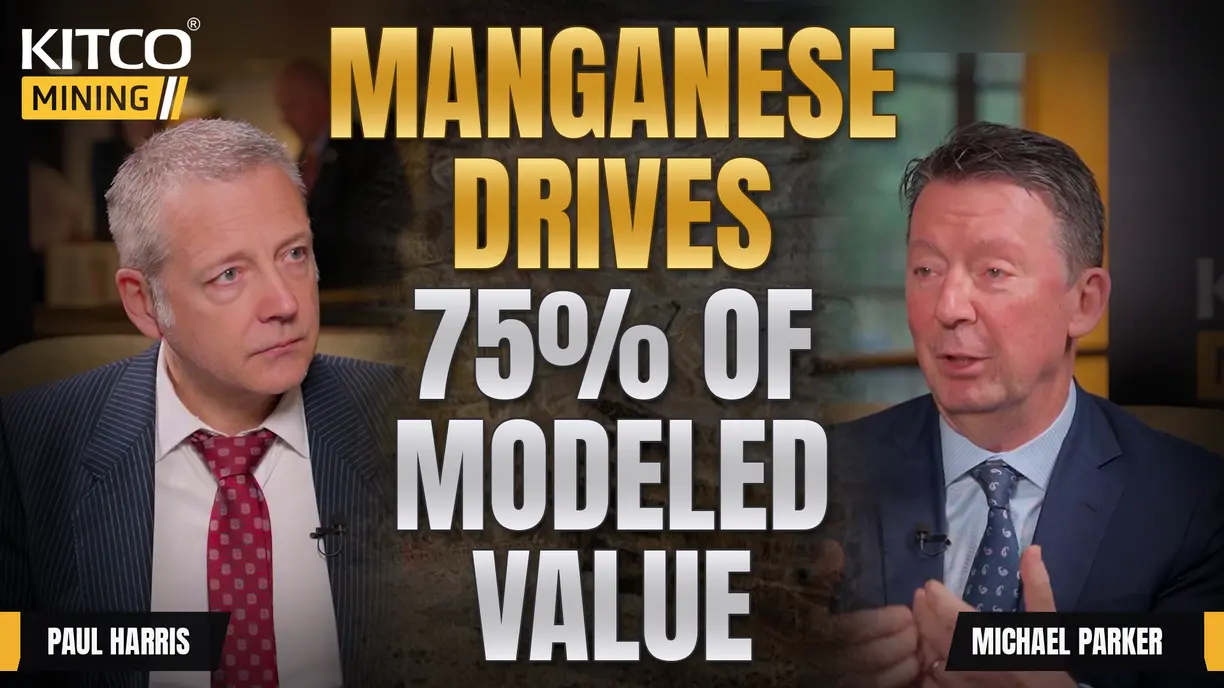
Aftermath completed its acquisition of 100% of Berenguela in January 2026. Its resource estimate, released on Dec. 4, 2025, put measured and indicated resources at 122.5 million ounces of silver, 717.1 million pounds of copper and 2.93 million tonnes of manganese. On the estimate’s price assumptions, manganese accounted for about 75% of the resource’s relative value, silver for 13% and copper for 11%. When asked whether Berenguela is really a manganese project first, Parker agreed. “Based on the resource statement, that’s true, yes.”
He traced that shift to electric vehicle batteries, which use manganese sulfate in their cathodes. “What’s changed the game a little bit is that manganese in the form that can be produced from Berenguela, specifically manganese sulfate for battery use, is a new market,” Parker said. “Every battery mix we see going into the future does incorporate some form of manganese as manganese sulfate.”
The deposit crops out at surface about six kilometers from a major road, yet it was never developed because its carbonate-replacement ore needs hydrometallurgy, a process that only became practical in recent decades. Leaching pulls copper, zinc and manganese into solution, while silver stays behind and is recovered separately. “Our recoveries are all reasonably good, either at 90 [percent] or higher than 90,” Parker said.
For battery makers, purity decides whether the product sells. “The market requires less than 50 ppm contaminants. Only some deposits can produce that level of pure manganese sulfate,” Parker said. Aftermath has reached that level three times in bench-scale testing and is repeating the work for the PFS, with larger-scale testing and possibly a pilot plant to come during a definitive feasibility study.
China’s dominance of the market has drawn attention to the project. “At the moment, we understand that 90 to 95% of manganese sulfate produced today comes from China,” Parker said. Aftermath has set up a U.S. subsidiary and engaged advisers to work with the U.S. government. “We’re looking at the possibility of actually refining a final product from Peru in the US for the US market,” he said, noting that U.S. refining could open the door to grants or subsidies. Finishing the product in Peru remains an option.
The early years of a mine could lean on silver. Aftermath is studying throughput of 1 million tonnes a year with selective mining to send higher-grade silver ore to the plant first. “It’s possible for us to campaign mine, have a very high silver start, maybe five to six million ounces for the first five to six years,” Parker said. “That would allow us to get a very good cash flow early doors.” Manganese output would then rise as demand for battery-grade product grows, a flexibility Parker said single-commodity manganese producers do not have.
Copper has stayed “sort of under the radar at Berenguela,” he said, and the share price mostly reflects silver for now. Parker expects the PFS to give investors their first clear look at what each metal contributes.
The study will also supply the throughput, power, water, and footprint data Aftermath needs to begin permitting in Peru in January 2027. A definitive feasibility study is planned from the second quarter of 2027. The company is funded through publication of the PFS and will probably return to the market in the second quarter, likely for at least C$20 million, Parker said. He estimates about a year and a half of baseline work and roughly a year for government approval. “So probably we’re looking at four to five years including construction before we can start production,” he said. “That’s probably the shortest timeframe.”
Parker described Peru as a long-established mining country, with the industry making up about 12% of GDP and 60% of exports. Drilling will continue alongside the studies, including a high-copper zone east of the resource, a new target on the property called the South West Intrusive, and Aftermath’s Challacollo silver project in Chile.
Watch the full video on the Kitco Mining YouTube channel.
This article/video was produced with support from a Kitco sponsor. The views expressed in this content do not necessarily reflect the views of Kitco Metals Inc. Kitco does not endorse or recommend any company, security, investment product, or investment strategy. This content is for informational purposes only and should not be considered investment advice.
Learn more about Aftermath Silver here

Kitco Spotlight Editorial
Kitco Spotlight Editorial is sponsored content, articles and announcements paid for by our advertisers that support our journalism. Our sponsored messages are targeted and hand-curated, highlighting the best of what's happening in the mining sector.
