
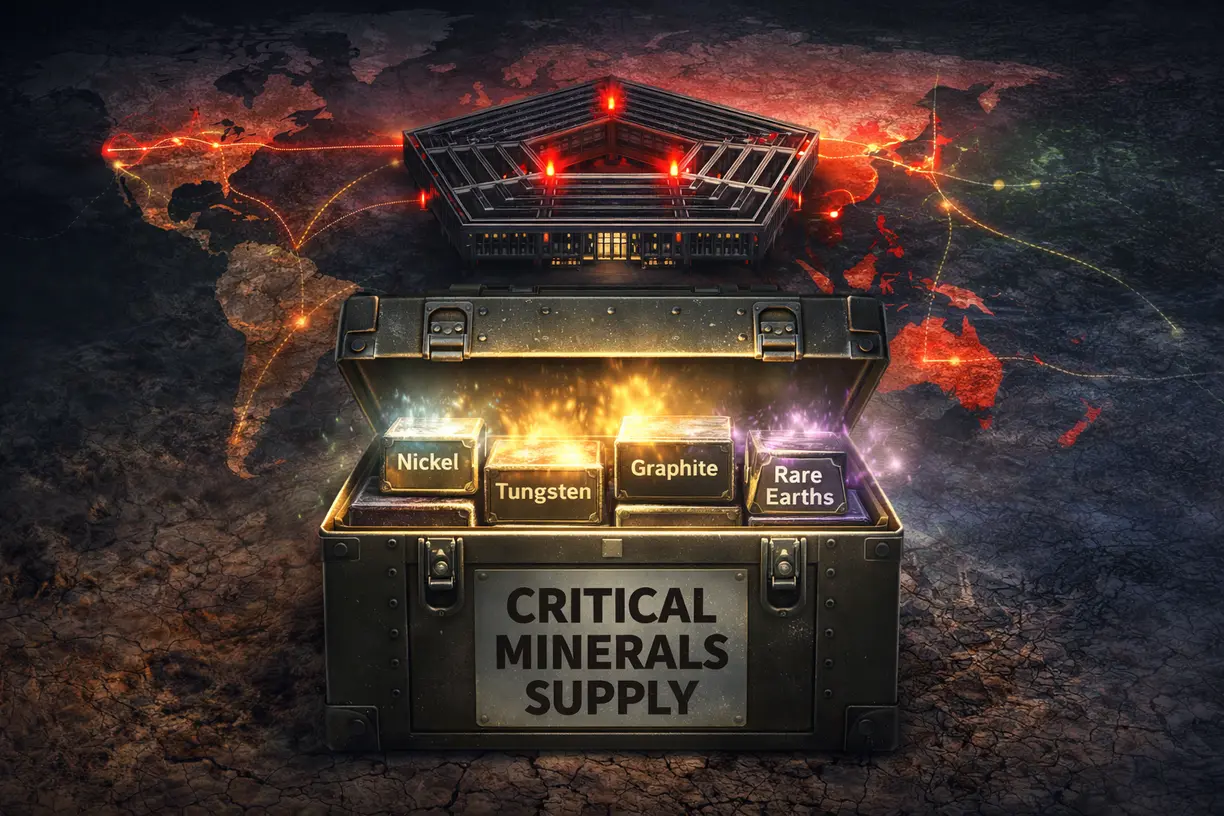
The US military asked mining companies on Friday to help boost domestic supplies of 13 critical minerals used to make semiconductors, weapons and other products, a document reviewed by Reuters showed.
The request, the day before the US and Israel launched strikes on Iran, is the latest example in recent weeks of Washington’s push for more access to the materials used widely in warfare.
The Pentagon asked members of the Defense Industrial Base Consortium (DIBC), a group of more than 1,500 companies, universities and others that supply the military, for proposals to be submitted by March 20 for projects that could mine, process or recycle select minerals, the document showed.
There was no immediate indication whether the timing was intentionally coordinated to coincide with the start of the strikes on Iran.
The list of 13 minerals sought includes arsenic, bismuth, gadolinium, germanium, graphite, hafnium, nickel, samarium, tungsten, vanadium, ytterbium, yttrium and zirconium.
The US is reliant on imports for most of the 13. China is a dominant global producer of all of them.
The Pentagon asked for detailed information on the costs, including labor and material, needed to build a mine or processing facility. Projects could be awarded development funds ranging from $100 million to over $500 million, according to the request.
The document did not specify why only those 13 minerals were chosen. Some — including germanium, graphite and yttrium — have been subject to export restrictions by China, the top global producer.
Yttrium shortages, especially, have set off alarm bells throughout the aerospace industry. One of the 17 rare earths, yttrium is used in coatings that keep engines and turbines from melting at high temperatures. Without regular application of these coatings, engines cannot be used.
Nickel is a widely traded metal and Indonesia is the top global producer. Yet Jakarta has been throttling exports of the metal used widely in stainless steel and battery production.
The White House, DIBC and Pentagon did not immediately respond to requests for comment.
Latest request
DIBC’s request is just the latest attempt by the Trump administration to increase US supply of key critical minerals. China has been using its market control as diplomatic leverage in ongoing trade disputes with Washington.
Last month, Trump officials launched a $12 billion minerals stockpile backed by the US Export-Import Bank and proposed a preferential minerals trading bloc with more than 50 allies.
That trading bloc would aim to use reference prices for minerals derived in part by a Pentagon-created artificial intelligence program, Reuters reported last week.
The administration has also taken equity stakes in rare earths miner MP Materials, Lithium Americas, and copper-and-cobalt developer Trilogy Metals.
Separately on Wednesday, the Defense Logistics Agency, which buys a range of goods for the US military, asked for information from miners on potentially acquiring lithium, chromium and tellurium for military stockpiles.
(By Ernest Scheyder, Jarrett Renshaw and Polina Devitt; Editing by Veronica Brown, Chizu Nomiyama, Peter Graff and Diane Craft)
