
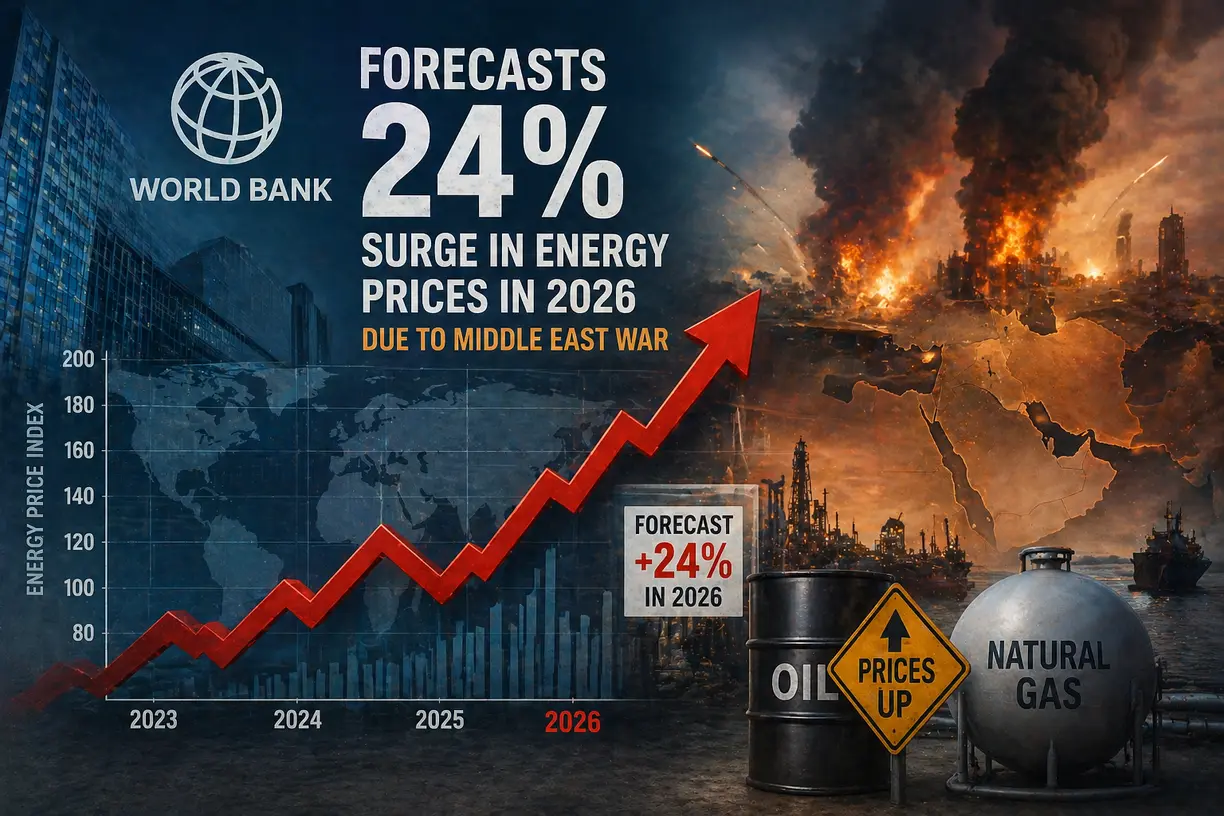
Energy prices are expected to surge by 24% in 2026 to their highest level since Russia’s full-scale invasion of Ukraine four years ago, if the most acute disruptions caused by the war in the Middle East end in May, the World Bank said on Tuesday.
Commodity prices could rise even further if hostilities in the region escalated and supply disruptions lasted longer than expected, the global development bank said in its latest Commodity Markets Outlook.
The bank said its baseline scenario assumed that shipping volumes through the crucial Strait of Hormuz waterway would gradually return to near pre-war levels by October, but said the risks were “markedly tilted” toward higher prices.
The bank’s baseline projects a 16% increase in overall commodity prices in 2026, given soaring energy and fertilizer prices and record-high prices for several key metals.
Oil prices continued to rise on Tuesday as efforts to end the US-Iran war stalled and the Strait of Hormuz remained largely shut, keeping energy supplies, fertilizer and other commodities from the key Middle East producing region out of the reach of global buyers.
Attacks on energy infrastructure and shipping disruptions in the strait, which before the war carried 35% of global seaborne crude oil trade, have triggered the largest oil supply shock on record, the World Bank said.
It said Brent crude oil prices remained more than 50% higher in mid-April than they were at the start of the year. Brent oil is forecast to average $86 a barrel in 2026, up sharply from $69 a barrel in 2025, the bank said.
Brent oil prices could average as high as $115 a barrel this year if critical oil and gas facilities suffered more war damage and export volumes were slow to recover, it said.
Brent crude futures for June were trading around $109 a barrel on Tuesday after hitting their highest close since April 7 on Monday.
“The war is hitting the global economy in cumulative waves: first through higher energy prices, then higher food prices, and finally, higher inflation, which will push up interest rates and make debt even more expensive,” World Bank chief economist Indermit Gill said. The shock would hit the poorest hardest, adding to the woes of highly indebted developing countries.
Pressure seen on food supply
Fertilizer prices were projected to increase by 31% in 2026, driven by a 60% jump in the price of urea, the most widely used solid nitrogen fertilizer, which is produced by converting natural gas to produce ammonia and carbon dioxide.
The surge in fertilizer prices would fuel pressures on food supply, eroding farmers’ incomes and threatening future crop yields. The World Food Programme estimates that 45 million more people could face acute food insecurity this year, if the war continues for a prolonged period.
The World Bank said inflation in developing economies was now projected to average 5.1% in 2026, under the baseline scenario, up from 4.7% last year and a full percentage point higher than pre-war forecasts. But inflation could rise as high as 5.8% in developing economies if the war was prolonged.
Growth would also take a big hit, the bank said. Developing economies were now projected to grow by just 3.6% in 2026, down from a pre-war forecast of 4% growth.
(By Andrea Shalal; Editing by Muralikumar Anantharaman)
