
The July non-farm payroll report released by the Bureau of Labor Statistics has sent shockwaves through financial markets, raising concerns about the U.S. economy's health and dramatically altering expectations for Federal Reserve policy. The report revealed a significant weakening in the labor market, with only 114,000 new jobs added in July, far below economists' forecasts. More alarmingly, the unemployment rate jumped to 4.3%, its highest level since October 2021, surpassing the anticipated 4.1%.
This unexpected deterioration in employment data has heightened recession fears. The "Sahm Rule," developed by former Fed economist Claudia Sahm, suggests that a recession may be underway when the three-month moving average of unemployment rises by half a percentage point from its lowest point in the past year. Today's surge in unemployment to 4.3% breaches this threshold, intensifying concerns about an economic downturn.
Financial markets reacted swiftly to the news, with U.S. equities experiencing substantial declines across major indices. The Dow Jones Industrial Average fell 1.5%, while the S&P 500 and NASDAQ Composite suffered losses of 1.84% and 2.43%, respectively. These drops inflicted significant technical damage, pushing the NASDAQ into correction territory, more than 10% below its July peak. The S&P 500 closed at its lowest level since June 4, and the Dow endured its most severe two-day correction since March 2023.
The U.S. dollar also felt the impact, declining by 1.08% - its steepest daily drop since November 14, 2023. The dollar index now stands at 103.01.

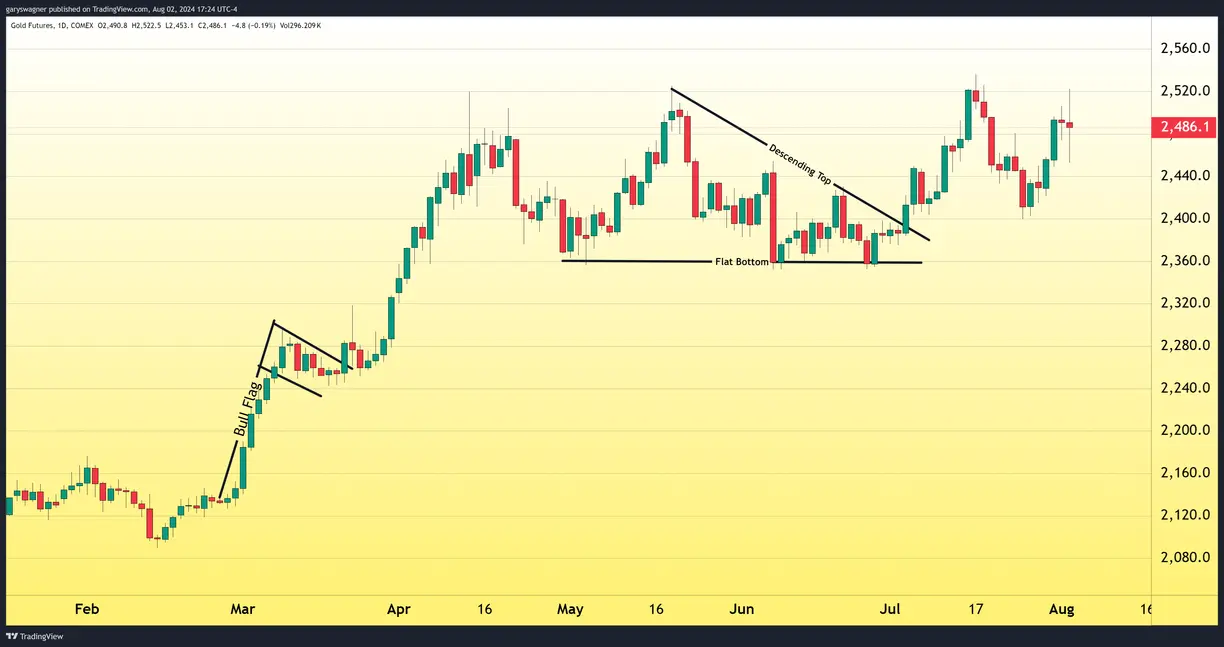
The gold market experienced heightened volatility in response to these developments. December gold futures traded in a wide range between $2,453 and $2,522.50, ultimately settling $4.80 lower at $2,484.40, as of 5:20 PM EDT.

The Fed is now likely to cut rates by 50 basis points in September
Perhaps most significantly, the jobs report has dramatically shifted expectations for the Federal Reserve's September meeting. While a rate cut was already anticipated, the probability of a more aggressive 50 basis point reduction has surged from 22% to 71.5%, according to the CME's FedWatch tool. This remarkable shift underscores the market's belief that the Fed will need to act decisively to support the economy in light of the weakening labor market.
As markets digest this new information, all eyes will be on the Federal Reserve for signals about its next move. The central bank faces a delicate balancing act: addressing the apparent economic slowdown while being mindful of still-elevated inflation levels. The coming weeks will be crucial in determining whether this jobs report represents a temporary blip or the beginning of a more significant economic downturn, with far-reaching implications for monetary policy and financial markets alike.
For those who wish to learn more about our service, please go to the links below:
Pricing, Track Record, Trading system, Endorsements of Confidence, FAQ
Wishing you as always good trading,
