
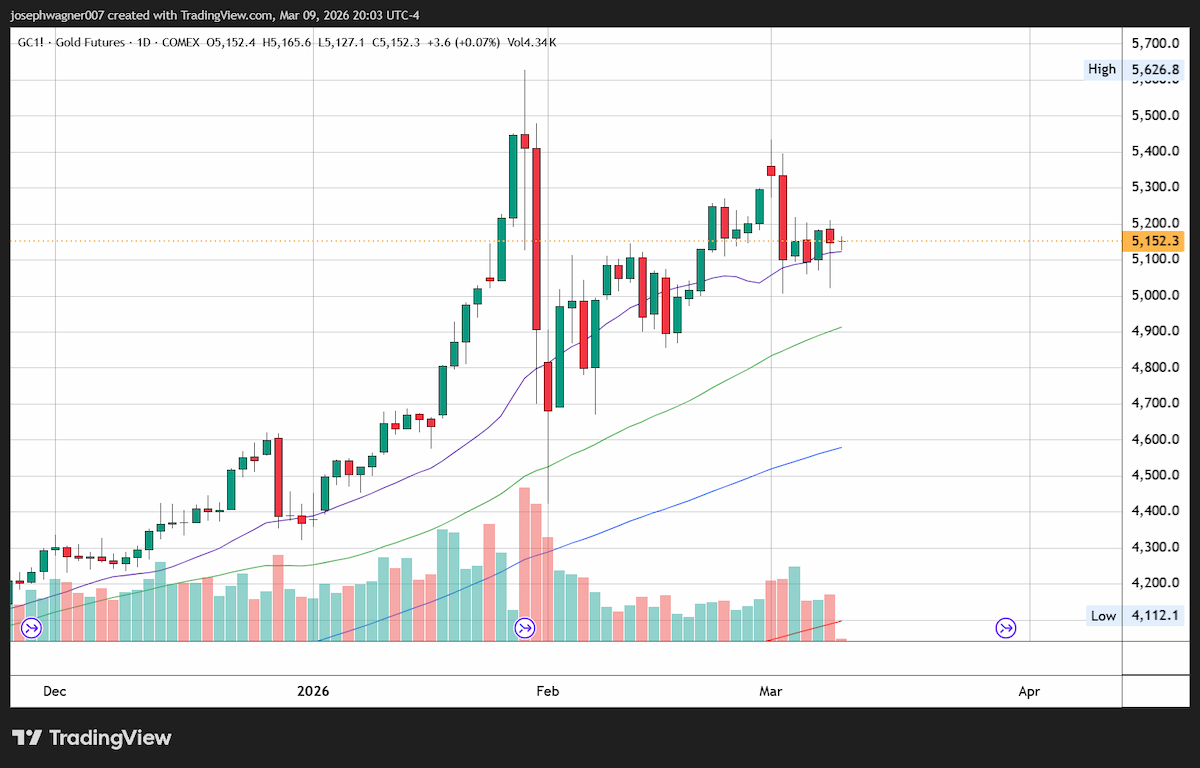
(Kitco Commentary) - Gold fell today as oil prices went on a wild ride, reaching $119 per barrel before selling off and settling at $94.70. Gold futures declined by $32.60 as of time of writing to trade at $5,148.70, well off the lows of the day which came in at $5,021.20.
The main driver impacting gold, oil, the dollar, as well as most other markets recently is the ongoing conflict between the US/Israel and Iran which began on February 28th with Israel and the United States launching joint airstrikes on Iran which killed the supreme leader of Iran and other Iranian officials, starting a war with the goal of regime change.
While the strikes did take out their primary target Ali Khamenei, the replacement was one of the targets from the original airstrike and has the likelihood of forcing this conflict to drag on. The newly appointed "Supreme Leader" of Iran was just announced on Sunday as Khamenei's own son, Mojtaba Khamenei. The selection is already controversial: The Israeli military warned on social media that he was a target before he was even chosen, while President Trump — who has expressed a desire to be involved in choosing Iran's new leader — called him "unacceptable."
In the immediate aftermath of the strike, the US dollar took charge as the preferred safe-haven asset, causing gold — which usually reacts positively to geopolitical conflict — to drop in value. The greenback's surge reflected investor confidence that US military dominance would lead to a swift resolution, dampening the typical flight-to-safety bid for bullion.
However, the calculus has since shifted. With Mojtaba Khamenei's appointment signaling that the Islamic Republic may prove more resilient than initially anticipated, market participants are now recalibrating for a protracted conflict. The prospect of a prolonged war in the Middle East has revived fears of sustained energy supply disruptions — oil's intraday spike to $119 being the clearest evidence of that anxiety — and with it, renewed inflation concerns.
Those inflation concerns are now flowing directly into expectations for Federal Reserve monetary policy, and that is increasingly the dominant force steering gold. Traders have dramatically repriced the path of rate cuts: Fed funds futures now reflect a higher-for-longer stance, with some desks pushing back their first expected cut from May to September. Higher rates traditionally weigh on gold by increasing the opportunity cost of holding a non-yielding asset, yet the yellow metal has shown unusual resilience, suggesting that inflation hedging demand is beginning to offset rate headwinds.
The dollar, meanwhile, has started to soften from its post-strike peaks. A weaker dollar makes gold cheaper for foreign buyers and typically provides a tailwind for prices. If the conflict deepens and energy inflation begins to feed through into the broader CPI print — the next reading is due in two weeks — the Fed may find itself in the uncomfortable position of weighing slowing growth against persistent price pressures, a stagflationary scenario historically favorable for gold.
For now, the market is in a tug-of-war. Dollar strength and the prospect of delayed rate cuts are capping gold's upside, while geopolitical uncertainty, oil-driven inflation fears, and growing doubts about a quick resolution to the Iran conflict are providing meaningful support. The $5,021 intraday low is likely to be watched closely as a near-term technical floor; a decisive break below that level could open the door to a test of $4,950, while a stabilization above $5,100 would suggest bulls are regaining control.
Investors will be closely monitoring any diplomatic signals from Washington, Tel Aviv, or Tehran, as well as this week's comments from Fed officials for clues on how the central bank views the intersection of geopolitical risk and inflation. Until there is greater clarity on both fronts, gold is likely to remain volatile, sensitive to every headline out of the Middle East and every data point that speaks to the trajectory of US prices.
For those who would like more information about our services, click here.
Wishing you as always good trading,
