
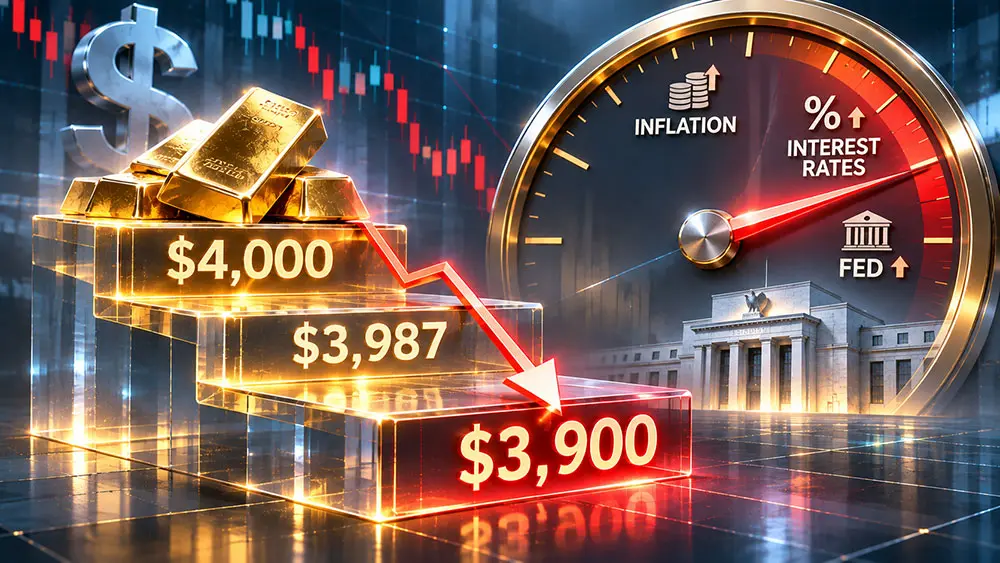
(Kitco News) - Gold prices have fallen below the critical $4,000-an-ounce level, and analysts warn that the precious metal could face further selling pressure as persistent inflation forces the Federal Reserve to maintain its tightening bias.
Although gold managed to hold support around $4,000 for the past two weeks, the latest selling pressure threatens to undermine the market's recent recovery. Analysts warn that a sustained break below this critical pivot point could trigger another wave of liquidation. Spot gold last traded at $3,987 an ounce, down more than 1% on the day.
In a report published Tuesday, Bark Melek, Head of Commodity Strategy at TD Securities, said he expects gold prices to retest support near $3,900 an ounce as higher interest rates and a stronger U.S. dollar continue to weigh on investment demand.
The bank's bearish outlook follows Tuesday's hotter-than-expected Consumer Price Index report, which showed headline inflation rising 0.4% in October, exceeding expectations for a 0.3% increase. Core inflation also rose more than expected, increasing 0.3% compared with forecasts for a 0.2% gain.
The inflation data has ignited expectations that the Federal Reserve will raise interest rates in December, potentially by 50 basis points. Gold prices dropped 2% Tuesday following the inflation data.
TD Securities noted that markets are now pricing in at least a 25-basis-point hike next month and nearly 75 basis points of additional tightening overall. According to the CME’s FedWatch Tool, markets see a 13.2% chance of a 50-basis-point rate hike.
The bank warned that rising Treasury yields, elevated carrying costs and renewed U.S. dollar strength are creating significant obstacles for gold. (Kitco Global Index shows how much of today's gold move is the dollar versus the gold market itself.)
On the bullish side, although central bank demand remains a significant pillar of support, TD Securities said it may not be enough to offset weakening investment demand.
The bank noted that central banks and the broader official sector have purchased 675 tonnes of gold so far this year, an increase of 6% compared with the same period in 2025.
However, weaker demand for physical bullion, exchange-traded funds and futures, along with sluggish jewelry consumption, could keep prices near the bottom of their recent trading range between $3,900 and $4,200 an ounce.
Meanwhile, Fawad Razaqzada, Market Analyst at FOREX.com, said that gold's failure to sustain its recent recovery highlights growing technical weakness.
Razaqzada identified the area between $3,942 and $4,000 an ounce as a critical support zone. A sustained move below this range would invalidate the recent short-term bullish momentum and open the door to further losses.
The first significant downside target is the recent low near $3,870 an ounce. Below that, Razaqzada sees additional technical support at $3,738, followed by the $3,476 level.
Gold's weakness is also being compounded by fading safe-haven demand as diplomatic efforts to end the conflict between the United States and Iran gain momentum.
Razaqzada said that improving risk sentiment and declining geopolitical uncertainty have reduced investors' appetite for defensive assets, leaving gold increasingly vulnerable to monetary policy developments.
On the upside, he said gold needs to break through resistance between $4,106 and $4,140 an ounce to restore bullish momentum. A sustained move above that range could eventually push prices toward $4,300.
See live precious metals prices for gold, silver, platinum and palladium — in USD, CAD and 12 more currencies.

