
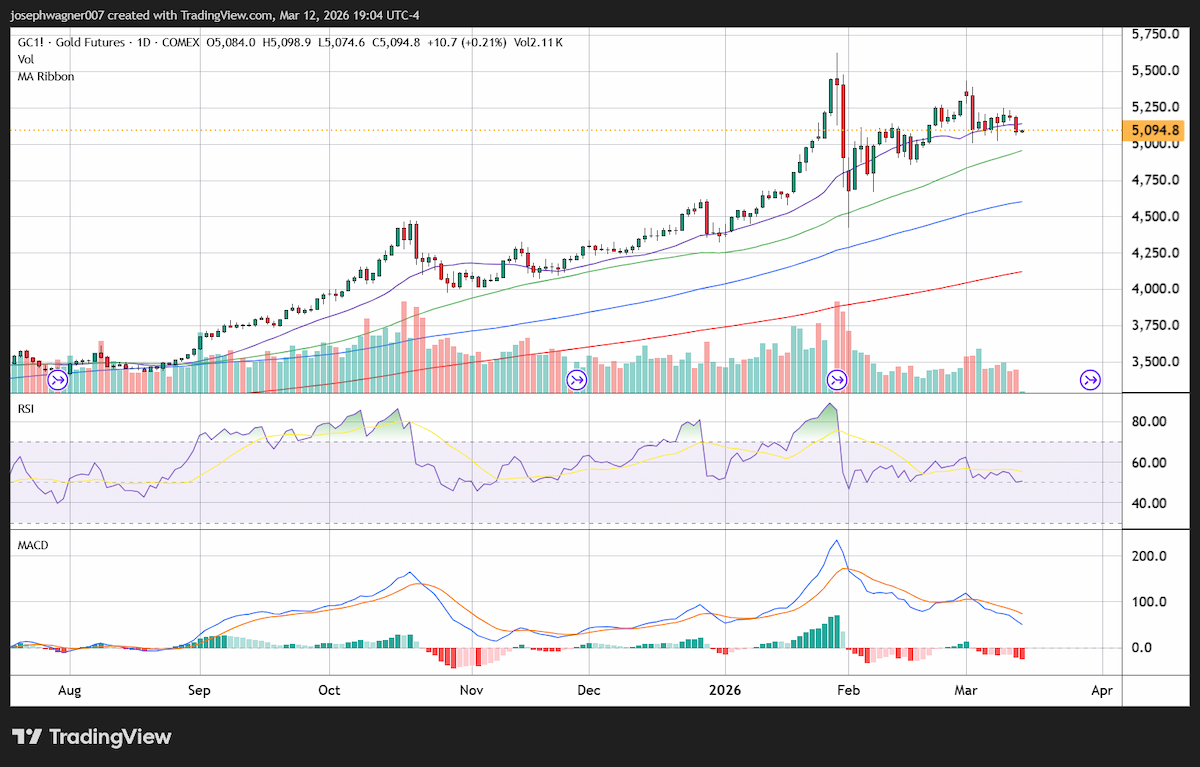
(Kitco Commentary) - Gold slipped on Thursday as a record coordinated oil reserve release from the International Energy Agency introduced a note of policy resolve into markets that had been pricing in unmitigated supply chaos. Gold futures declined by nearly $100 today and are now trading around $5,092. The pullback reflects a subtle but important shift: the narrative that geopolitical risk can only push precious metals higher is being tested, and for now, it is coming up short.
The Largest Emergency Release in IEA History
The IEA on Wednesday triggered the largest coordinated reserve release in its 50-year history — roughly 400 million barrels from strategic stockpiles across more than 30 member countries. The goal was to stabilize energy markets after the Iran conflict choked off commercial shipping through the Strait of Hormuz, the narrow chokepoint through which approximately one-fifth of the world's daily oil supply normally moves. Past releases of this kind have been reserved for the gravest disruptions: the Gulf War, Hurricane Katrina, Russia's invasion of Ukraine. This one is already in that company, and the conflict is not yet two weeks old.
The oil market's initial response was, to put it plainly, dismissive. WTI crude rose more than 4% on the day of the announcement. That is the market sending an unambiguous message: the disruption is larger than any emergency lever can quickly fix. When the biggest reserve release in history fails to move prices in the right direction, it tells you something about the scale of what policymakers are contending with.
Iran appeared to interpret the IEA announcement as provocation. Hours after the reserve release was disclosed, Iranian explosive-laden boats struck two fuel tankers carrying Iraqi crude near Basra, setting them ablaze and killing at least one crew member. Iraq's port authority suspended all oil operations in response. The strikes mark the first direct attacks on tankers in Iraqi territorial waters since the U.S.-Israeli military campaign began, and suggest Iran has no intention of allowing a diplomatic stabilization of energy markets.
Why Gold Is Struggling to Hold Its Gains
So why is gold declining into what looks like an intensifying crisis? Several dynamics are working against the metal today. First, the IEA action, however inadequate in practical terms, signals that coordinated policy intervention is on the table — and markets have historically faded gold rallies when institutional actors demonstrate a willingness and capacity to respond.
Second, the very severity of an oil shock at these levels is beginning to weigh on the demand outlook. Oxford Economics has identified $140 per barrel as the threshold at which the global economy tips into mild recession. Iran's military command spokesperson this week warned of $200 oil. At those extremes, the scenario shifts from inflationary shock to outright demand destruction — a deflationary outcome in which gold's inflation-hedge properties become far less relevant. A deep global recession would raise the likelihood of emergency rate cuts, a near-term positive for gold, but also trigger the kind of broad liquidity crunch in which all assets, including gold, can sell off sharply.
Investors who got into gold long before this conflict early are sitting on gains, and profit-taking in the face of heightened uncertainty is a rational response when the geopolitical playbook becomes difficult to read.
The Bearish Case Is Fragile, Not Conclusive
Today's decline should be interpreted as a consolidation, not a reversal. The structural conditions for higher gold remain if this conflict persists at its current intensity, and nothing in the IEA's reserve release addresses the underlying problem: a major oil-producing corridor is effectively closed, and Iran has demonstrated both the will and the capability to keep it that way. Shipping insurance remains unavailable at any practical premium, naval escorts are under discussion but unimplemented, and diplomatic channels appear frozen.
The more immediate trading signal is that gold is no longer simply tracking the headline conflict. It is now also tracking the policy response and the global growth outlook — which makes the next few sessions considerably more complex to navigate. For now, the bears have found their footing.
For those who would like more information about our services, click here.
Wishing you as always good trading,
