
The Pattern Most Investors Recognize
If you’ve been in the markets for any length of time, you’ve probably felt the sting of déjà vu.
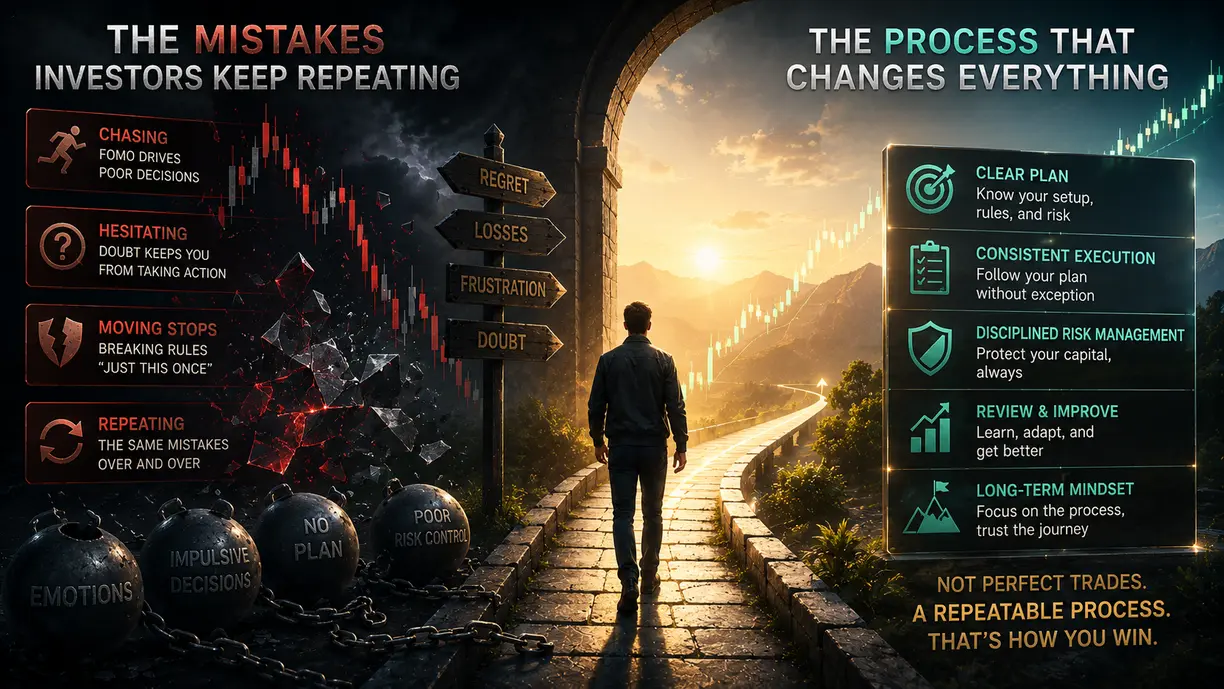
Chasing a move because you were sure you were missing out. Hesitating when your process said it was time to act. Moving a stop or changing a rule “just this once” because the market felt like it needed a little more room.
Then, when the dust settles, you realize you have repeated the same mistake you promised yourself you would stop making months or even years ago.
I know that feeling because I lived it early in my own career.
When I started trading in my late teens, I thought the solution was simple. I thought I needed more willpower. I kept telling myself, “Just be more disciplined, Chris.” But the harder I pushed, the more I realized I was not dealing with a simple lack of discipline. I was fighting the wrong battle entirely.
The mistake was not only in the trade itself.
The mistake was believing emotion could be controlled by willpower alone.
Why Willpower Is Not Enough
Most investors try to fix the visible behavior.
They tell themselves to stop chasing, stop hesitating, stop second-guessing, stop reacting to headlines, and stop making emotional decisions when the market gets uncomfortable.
Those intentions are good. I have had all of them myself. But intentions usually break down under pressure.
That is because the emotional reaction is often not the real problem. It is a symptom of something deeper. The real issue is usually that the strategy, the process, and the investor’s emotional conditioning are not aligned.
I think about it like a car that keeps pulling to one side.
The driver can grip the wheel harder and fight it for a while, but that does not solve the problem. The car needs an alignment. Until that happens, every mile requires extra effort, and the driver eventually gets tired.
Investing works much the same way.
If the same mistakes keep happening, the answer is rarely just “try harder.” It may mean the system itself is not aligned. The strategy may not fit the investor. The process may not be clear enough. Or past mistakes may have created emotional patterns that keep showing up whenever uncertainty returns.
That is why many investors end up back in the same loop.
They are not broken. Their process is incomplete.
The Real Cause Behind FOMO And Hesitation
Fear of missing out is not really about missing opportunities.
There are always moves happening somewhere in the market that you are not participating in. Most of the time, those do not bother you unless they create doubt about your own plan.
That is why FOMO is often less about the market and more about trust. Trust in your strategy. Trust in your process. Trust that you do not need to be in every move to be successful over time. When that trust is missing, every rally you are not part of starts to feel like a mistake. Every cash position feels uncomfortable. Every strong move elsewhere starts tugging at your emotions.
Hesitation works in a similar way.
Sometimes hesitation comes from a flawed process. Sometimes it comes from using a strategy that does not match how you think, your stage of life, or the amount of attention you want to give the market. And sometimes it comes from internal conflict, where part of you wants to follow the plan, but another part does not fully trust what the plan is asking you to do.
I experienced this personally when I was younger. I jumped from one hot system to the next, each one promising better results, faster returns, or less uncertainty. But many of those approaches did not fit me. I was forcing myself into methods that did not match my personality, my schedule, or the way I understood market behavior.
That created hesitation because deep down, I did not fully trust what I was doing.
Once I started building strategies around rules, market evidence, and a process I could actually follow, hesitation began to fade. I was no longer trying to force myself into decisions that felt unclear. I was following a structure I understood.
The Three Pieces That Have To Work Together
Over time, I learned that consistency requires three pieces working together.
The first is the right strategy. Not just a strategy that looks good on paper, but one that fits the investor’s objectives, time horizon, emotional tolerance, and stage of life. A strategy that constantly conflicts with the person following it will eventually create stress.
The second is a solid process. A strategy tells you what the approach is designed to do, but the process tells you how decisions are made the same way each time. This is where consistency is built, because the investor is no longer forced to interpret every market move emotionally.
The third is mental conditioning. I do not view this as “fixing yourself.” I view it as retraining the mind to trust a defined process after years of being pulled around by fear, greed, FOMO, and past mistakes.
If one of those pieces is missing, the same emotional walls tend to appear again. That is especially important when the capital involved represents more than trading activity.
For many investors approaching retirement or already living through it, mistakes are no longer just frustrating. They can affect time, confidence, flexibility, and the years ahead. A repeated pattern of chasing, hesitating, or reacting emotionally can lead to losses that take far longer to recover from than expected.
That is when the issue becomes bigger than trading discipline.
It becomes a question of protecting the capital and time that life plans depend on.
Why Process Protects More Than Capital
When I look at Asset Revesting through this lens, I do not see it only as a market strategy. I see it as a way to remove many of the emotional decision points that cause investors to repeat the same mistakes.
The philosophy is built around alignment. Capital, market conditions, risk, and time all need to be working together. When those pieces are misaligned, investors often feel it emotionally. They chase. They hesitate. They second-guess. They override rules because the process is not strong enough to carry the pressure.
That is why the ACS process matters in our work at The Technical Traders. It gives decision-making a defined structure. Conditions are measured. Exposure is adjusted. Cash, participation, and protection all have a role depending on what the market is showing.
The goal is not to remove human emotion from investing completely. That is not realistic. The goal is to stop emotion from being the steering wheel.
That matters because process protects more than the account balance.
It protects decision-making. It protects confidence. It protects the ability to stay patient when others are reacting. And for many investors, it helps protect the time that can otherwise be lost recovering from major setbacks.
One member described this shift well when he said:
“I sleep much better now knowing I have a plan in place that manages the downside risk while positioning me to enjoy high probability gains. My anxiety around investing is now in a manageable range!”
That kind of comment matters to me because it reflects more than performance.
It reflects what happens when the investor no longer has to carry every decision emotionally.
You Are Not Broken
One of the most liberating realizations in my own journey was this: there was nothing wrong with me.
My repeated mistakes were not proof that I was weak-willed or incapable. They were signs that my trading machine was missing pieces. The strategy, process, and mental framework were not yet working together.
I believe many investors need to hear that.
If results have been inconsistent, it does not automatically mean the person is the problem. It may mean the process is incomplete. It may mean the strategy does not fit. It may mean the investor has been relying too much on willpower in an environment designed to challenge it.
Fear and greed will never disappear completely. FOMO will still show up. Hesitation will still try to creep in. That is part of being human.
The difference is having a framework that keeps those emotions from controlling the decision.
When the right strategy, process, and mental conditioning begin working together, investing can start to feel different. It becomes less about fighting yourself and more about following evidence. Less about reacting to every market move and more about staying aligned with conditions. Less about trying to be perfect and more about protecting the progress that matters most.
That is when the cycle begins to break.
And for investors who are thinking seriously about retirement, time, and the years ahead, breaking that cycle can matter far more than avoiding one bad trade.
It can mean protecting the life that the money was built to support.
