

(Kitco Commentary) - Today gold futures gained a modest $14.30, or 0.35%, progress for the bulls attempting to keep prices above the near-term bottom near $4,000. Today's increase brings gold futures to $4,066, but beneath the surface, when accounting for dollar weakness, sellers actually outnumbered buyers today.
The U.S. dollar index declined by 0.41% today and 0.39% yesterday. The dollar is still above 100, however, at 100.49, not far from its highest value in over a year, which it reached when it hit 101.81 on June 25.
Today's moves in gold and the dollar were predicated on a weaker-than-expected producer price index report released this morning. Month-on-month, producer prices declined 0.30% in June, while year-on-year they increased 5.50%, according to the Bureau of Labor Statistics.
Core producer prices rose 0.20% in June from the previous month and were up 4.70% year-on-year. The reading followed Tuesday's consumer price index report, which showed headline CPI falling 0.4% in June — the first monthly decline since 2020 — pulling the annual inflation rate down to 3.5% from 4.2% in May.
Federal Reserve Chair Kevin Warsh testified before Congress this week, reiterating the central bank's commitment to price stability and stating that policymakers have "no tolerance" for persistently elevated inflation. Warsh stopped short of a more hawkish stance, but traders are still pricing in roughly a 49% probability of a rate hike, not a cut, at the Fed's September meeting, per CME Group's FedWatch tool — markets bracing for tighter policy even as prices cool, pointing to the other force weighing on trading today: oil.
Crude prices have climbed more than 9% over the past five days after the U.S. launched a fourth consecutive day of strikes on Iranian military targets and reinstated a naval blockade on Iranian ports near the Strait of Hormuz. Tehran responded with fresh attacks on shipping through the strait, reviving fears of broader disruption to global energy supplies.
The resulting rise in oil prices has kept inflation expectations elevated even as this week's data pointed the other way, helping to cap the dollar's decline and limit gold's advance despite back-to-back soft inflation prints.
Technically, gold remains capped below its 100-period moving average near $4,077 and continues to trade within the broader descending channel that has been in place since the metal's correction began. Resistance sits at $4,077 and then $4,090, with a sustained break above that level needed to open the path toward $4,140 and $4,200.
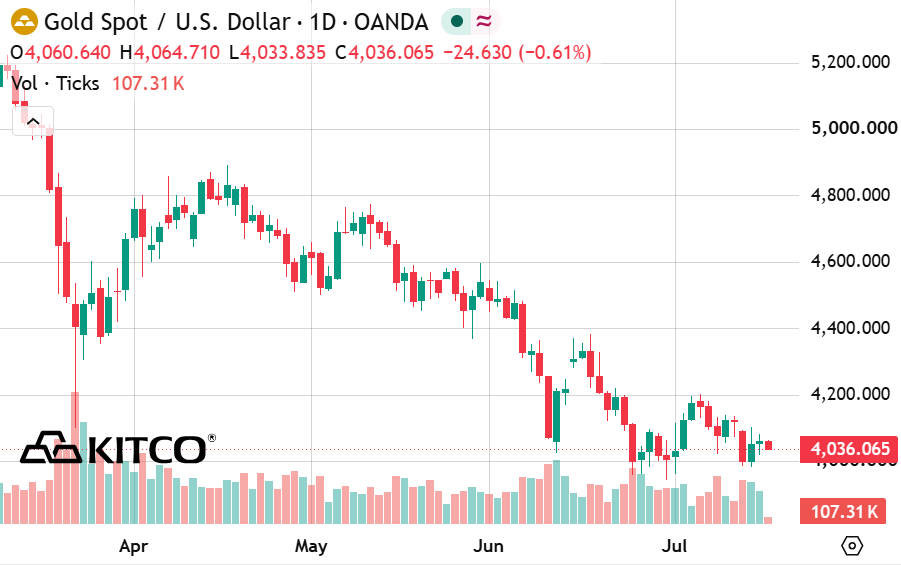
On the downside, a break below the psychologically important $4,000 level would expose deeper support at $3,962 and $3,950. Gold remains roughly 27% below the all-time high of $5,589.38 it set on January 28, having logged its worst quarterly performance in more than a decade during the second quarter as an initial Iran de-escalation and a firmer dollar weighed on the metal.
Longer term, most institutional forecasters remain constructive on gold, with J.P. Morgan targeting $6,000 an ounce by year-end on record central bank accumulation, led by China, India, Turkey and Poland.
Silver traded near $58 an ounce, down about 0.7% on the session, mirroring gold's inability to sustain Tuesday's rally.
For now, the market remains caught between disinflationary data at home and an inflationary supply shock abroad, with $4,000 the line traders on both sides are watching most closely.
