
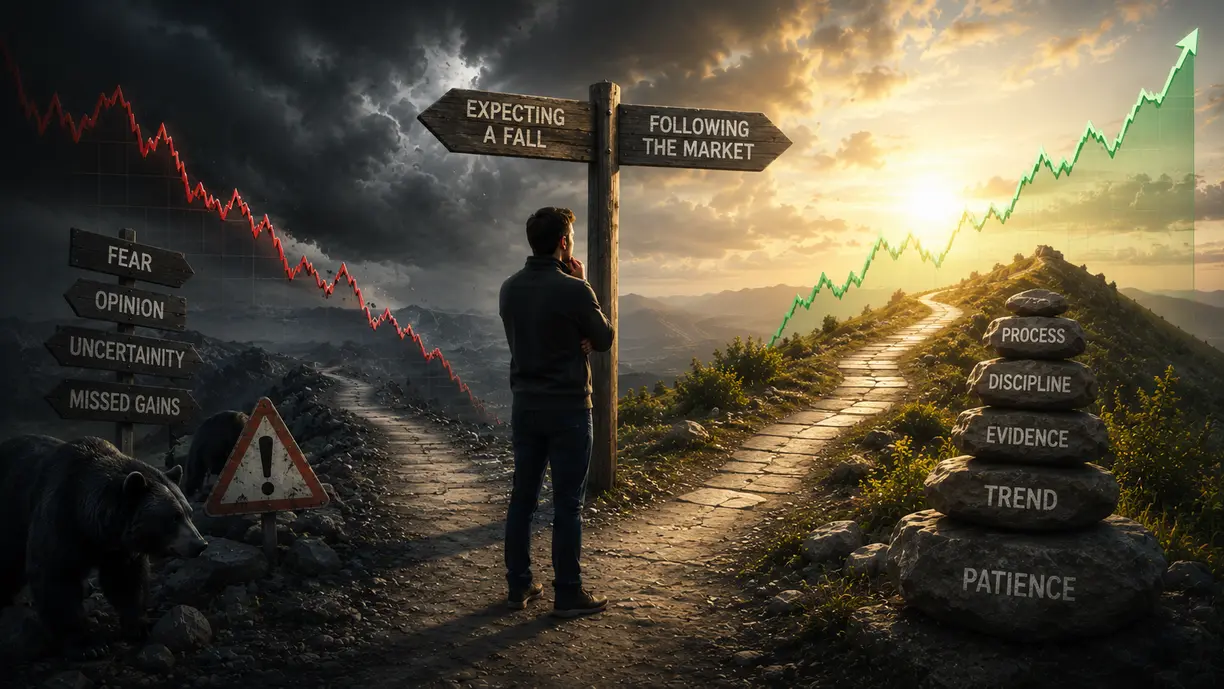
It usually starts quietly.
You see a headline. You hear a warning. You notice a shift in sentiment. Maybe inflation is rising, geopolitical tension is building, or a market commentator is warning that the next major decline is close.
You look at the charts. You look at the indicators. You look at the macro picture. The market feels stretched. Prices seem too high. The rally looks overdone. Everything inside you says the next move should be lower.
So you act.
You reduce exposure. You move to cash. You add protection. Maybe you even position against the market because the risk feels too obvious to ignore.
At first, it can feel responsible. It can feel disciplined. It can feel like you are doing the right thing by preparing for what seems likely to come next.
But then the market rises.
And keeps rising.
Each week, the 'against the market' position becomes harder to hold emotionally. The conviction that once felt strong begins to feel expensive. The account may be moving in the wrong direction, or the opportunity cost begins to grow. Now the decision becomes more difficult. Do you admit the market is not confirming your view, or do you keep waiting for the market to finally prove you right?
That is one of the hardest places to be as an investor.
I have seen many people land there, not because they were unintelligent, and not because they failed to notice risk, but because the decision was guided more by fear and opinion than by a defined process.
When Conviction Becomes Expensive
There is nothing wrong with being aware of risk. In fact, I believe risk awareness is essential. I talk about risk often because I know how much damage can happen when investors ignore it.
But risk awareness and fear-based positioning are not the same thing.
Risk awareness says, “Conditions may be changing, so I need to pay closer attention.”
Fear-based positioning says, “I know what should happen next, so I am going to act before the market confirms it.”
That difference matters.
The market does not always move the way it “should.” It can stay overbought longer than expected. It can climb through bad news. It can ignore the headlines that seem obvious. It can keep trending higher while investors who acted too early sit frustrated on the sidelines or are positioned the wrong way.
This is where conviction can become dangerous.
The stronger the opinion, the harder it can be to let go of it. Instead of asking what the market is actually showing, the investor starts looking for reasons to defend the original view. A pullback feels like confirmation. A rally feels irrational. Every headline becomes evidence that the market must eventually agree.
I understand that because I have been there myself.
There were times earlier in my career when I believed I had the market figured out before price confirmed it. I would see risk building and assume the decline was imminent. But markets do not operate on my timeline, or anyone else’s. The longer I traded, the more I learned that being early can feel a lot like being wrong when there is no process controlling the decision.
One member described this lesson in a way that stood out to me: “Honestly, it took me several times of thinking I knew better, that selling 50% of my position had to be the wrong move right now. And yes, several times I gave up gains I had made because I refused to follow directions.”
That is not a lack of intelligence. It is what happens when the desire to be right starts competing with the need to follow a process.
Opinion Is Not A Process
Most investors do not get into trouble because they are trying to make poor decisions. They get into trouble because emotion can disguise itself as logic.
A market that feels too high can make a defensive move feel logical. A scary headline can make cash feel urgent. A bearish forecast can make a hedge feel responsible. The danger comes when those decisions are made without a process that defines when risk has actually changed and what action is supported by the evidence.
Opinion can be useful as a starting point, but it cannot be the final decision-maker.
- Price matters.
- Trend matters.
- Risk conditions matter.
- Evidence matters.
If the market is still trending higher, fighting that trend can become costly, even if the concern behind the decision is reasonable. This is where many investors get trapped. They confuse being cautious with being positioned against the market.
Those are not the same.
Caution can mean watching more closely. It can mean reducing risk when a process calls for it. It can mean preparing for a possible shift. But when caution turns into prediction, and prediction turns into stubborn positioning, the investor can end up fighting the market instead of responding to it.
That is where damage can build.
Not just financial damage, but emotional damage as well. Frustration grows. Confidence weakens. The investor begins second-guessing every move. And eventually, the focus shifts away from making good decisions and toward trying to recover from a decision that should have been adjusted earlier.
The Shift From Fighting Price To Following Evidence
The market is going to do what it is going to do, with or without our approval. That is why I have learned to respect price.
I may have concerns about risk. I may see warning signs developing. I may believe a market is stretched or vulnerable. But if price, trend, and market conditions are still supporting participation, then the process has to respect that.
This does not mean ignoring risk. It means waiting for risk to be confirmed before allowing it to control the portfolio.
That is a very different way to think.
Fear-based positioning often starts with the question, “What if the market falls?”
Process-based positioning asks, “What is the market showing right now, and what does the evidence support?”
That shift can reduce a lot of emotional pressure.
It removes the need to predict every top. It reduces the temptation to act on every headline. It helps prevent the investor from becoming trapped in a position that depends on the market eventually validating an opinion.
This is where Asset Revesting fits naturally into the conversation. At its core, Asset Revesting is about respecting what the market is doing rather than fighting what we think it should do. In our work at The Technical Traders, ACS gives that idea a rules-based structure so exposure can increase when conditions support it and decrease when risk begins to rise.
That does not make the process perfect. Nothing does. But it gives the decision a framework.
The goal is not to chase every rally, predict every decline, or always be fully invested. The goal is to stay aligned with conditions and avoid allowing fear, hope, or ego to become the strategy.
Why This Matters More As Time Becomes More Valuable
For investors approaching retirement or already living through it, the cost of fear-based positioning can be larger than one missed trade or one bad hedge.
It can affect time.
Being positioned for the fall while the market continues higher can create more than frustration. It can create missed participation, emotional stress, and a growing sense of being out of sync with the market. If the position itself loses money, then the investor may also face the added burden of recovery.
That recovery can consume time that was meant for something else.
This is why the objective cannot simply be to avoid every possible decline. That is not realistic. The objective is to manage exposure in a way that respects both risk and opportunity, without allowing fear to dominate the process.
- A market can look risky and still rise.
- A market can feel uncomfortable and still trend higher.
- A market can have warning signs and still require patience before action is justified.
That is why structure matters.
Without structure, every uncomfortable market becomes a personal test. Do you trust the headline or the trend? Do you follow your fear or the evidence? Do you protect early or participate longer?
Without rules, those questions become emotional. With a process in place, they become manageable.
The Better Question To Ask
When the market feels stretched, the instinct is often to ask, “Is this the top?”
I have learned that it is usually not the most useful question.
A better question is, “What does the evidence support right now?”
That question changes everything. It does not require a perfect prediction. It does not require guessing the exact turning point. It does not require taking action simply because a market feels too high or a headline feels too serious.
It brings the decision back to the process.
There will always be reasons to worry. There will always be headlines that make risk feel urgent. There will always be someone calling for a crash, just as there will always be someone calling for another rally.
The market does not reward the strongest opinion. It rewards disciplined execution.
That is why I believe the shift from opinion to observation is so important. It helps investors stop fighting the market and start responding to it. It helps separate reasonable caution from fear-based positioning. And it helps protect the time that can otherwise be lost when conviction turns into a costly mistake.
- The goal is not to be bullish all the time.
- The goal is not to be bearish all the time.
- The goal is to stay aligned with what the market is actually showing.
Because when the market rises, and you are positioned for the fall, the lesson is not simply that you were wrong.
The deeper lesson is that no opinion, no matter how convincing it feels, should be allowed to replace a process.
Chris Vermeulen
Chief Investment Officer
TheTechnicalTraders.com
P.S. If this article hit a little too close to home — if you’re tired of riding an emotional rollercoaster with your trades — then I encourage you to grab a copy of my book, Technical Trading Mastery. It’s a step-by-step guide to removing emotion from trading and using logic, trend, and structure to make smarter decisions. Thousands of traders have used it to transition from reactive to repeatable — and build consistent success in both bull and bear markets.
If you want to learn more about what we do, book your free call with my team now! Pick a day and time here.
Disclaimer:
The content published on this website, including blog posts, videos, research articles, and commentary, is intended solely for informational and educational purposes and should not be construed as investment advice. Technical Traders Ltd. and its affiliates are not registered as investment advisers with the U.S. Securities and Exchange Commission or any state securities authority. The information provided is general in nature and is not tailored to the investment needs of any specific individual. Nothing published on this site constitutes a recommendation to buy, sell, or hold any particular security, commodity, or financial instrument. The views expressed represent the opinions of the authors and are subject to change at any time without notice. Performance results discussed may include live trading outcomes and/or backtested or hypothetical data. Hypothetical results are inherently limited and do not reflect actual trading performance. No representation is made that any account will or is likely to achieve profits or losses similar to those discussed. Past performance is not indicative of future results. All investments involve risk, including the potential loss of principal. Testimonials and user experiences presented may not be representative of others and do not guarantee future success. Some content may contain affiliate links or promotional material, from which we may earn compensation. This does not influence our content or editorial independence. By accessing this website or consuming its content, you acknowledge that you are solely responsible for your own financial decisions and agree to consult a licensed financial professional before acting on any information provided.
