
Strengths
- The Depository Trust & Clearing Corporation (DTCC), which safeguards more than $114 trillion in securities, processed its first live production trades involving tokenized securities. The initiative brought together more than two dozen major financial institutions, including JPMorgan, Goldman Sachs, BlackRock, and Vanguard, demonstrating that blockchain-based assets can integrate with Wall Street’s existing market infrastructure.
- Citadel Securities, one of the world’s largest market makers, invested $400 million in Crypto.com, valuing the exchange at $20 billion in its first institutional funding round. The investment will support expansion into tokenized securities and derivatives, highlighting growing confidence among traditional financial institutions in digital asset infrastructure.
- T. Rowe Price, a global asset manager overseeing nearly $1.9 trillion in assets, launched the industry’s first actively managed multi-token spot crypto exchange-traded fund (ETF). The fund invests across leading digital assets, including bitcoin, ether, BNB, Solana, XRP, and Hyperliquid, reflecting growing institutional demand for actively managed cryptocurrency investment products.
Weaknesses
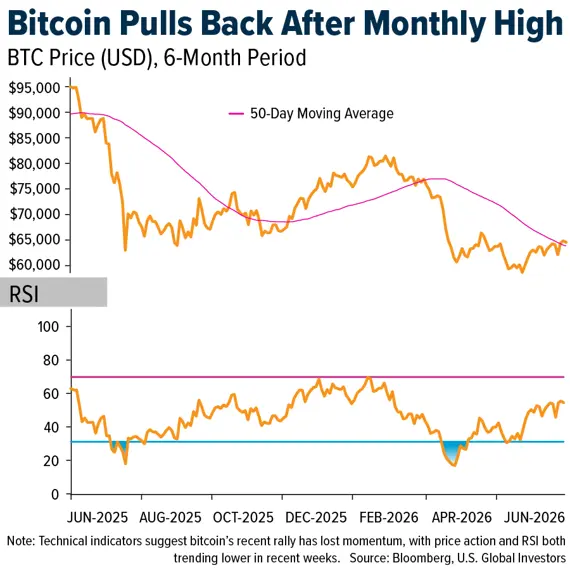
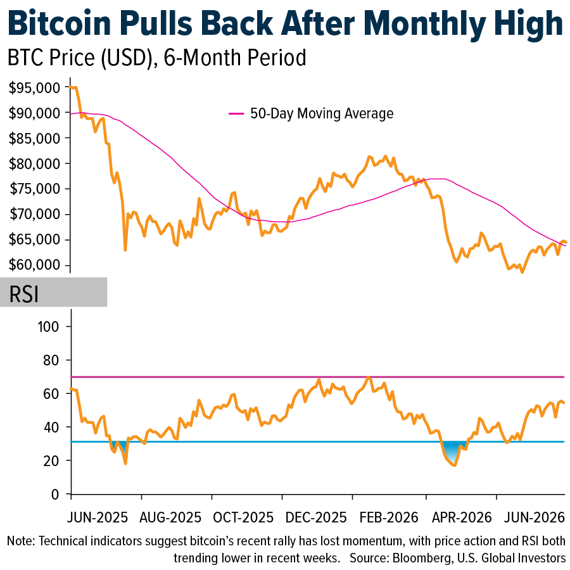
- Bitcoin retreated to around $64,000 after reaching a monthly high of $65,500, as profit-taking and renewed geopolitical tensions in the Middle East triggered broad selling across digital assets. Derivatives data also pointed to growing bearish sentiment, with most major cryptocurrencies showing negative open interest-adjusted volume, while bitcoin’s implied volatility rose to 38%, a level that has historically preceded periods of heightened market turbulence.
- Research by Dune Analytics found that approximately 85% of concentrated liquidity across major decentralized exchanges remains underutilized, with liquidity providers forgoing an estimated $150 million in annual fees. The findings highlight persistent capital efficiency challenges in DeFi despite the sector’s continued growth and innovation.
- Bitcoin’s latest rally toward $65,000 has been met with selling from both long-term and short-term holders, signaling weak investor conviction despite improving macroeconomic conditions. According to Glassnode, short-term holders are realizing profits at more than $4 million per day, while long-term holders are using the rebound to exit losing positions, creating additional selling pressure on the market.
Opportunities
- Galaxy Digital, a digital asset financial services firm, launched Galaxy Curator, a platform that enables institutions to earn yield on idle stablecoin balances through curated decentralized finance (DeFi) lending strategies. Available through Fireblocks, whose custody platform serves more than 2,400 institutional clients, the offering simplifies access to on-chain yield while maintaining institutional-grade risk management, highlighting the growing convergence between traditional finance and decentralized markets.
- The x402 Foundation, a Linux Foundation-backed initiative developing open technology standards, is building a payment protocol that enables artificial intelligence (AI) agents to make autonomous blockchain-based payments over the internet, addressing a key infrastructure gap as AI-driven commerce expands. The initiative is supported by major industry participants, including Coinbase, Visa, Mastercard, American Express, Stripe, Google, Amazon Web Services, Shopify, Circle, and the Solana Foundation, underscoring growing collaboration to build an open financial system for AI.
- Alpaca, a brokerage infrastructure provider for traditional and digital assets, raised $135 million to expand infrastructure supporting tokenized U.S. equities. The company currently clears or custodies approximately 94% of tokenized U.S. stocks and holds more than $1.5 billion in underlying equities, highlighting growing institutional investment in the infrastructure connecting traditional financial markets with blockchain-based trading.
Threats
- The U.S. expanded sanctions against Iran by blacklisting four cryptocurrency wallets linked to the Central Bank of Iran, prompting Tether to freeze $131 million in USDT held at those addresses. The action highlights how geopolitical tensions and sanctions continue to create compliance and operational risks for the digital asset industry, particularly for stablecoin issuers and cross-border transactions.
- Ostium, a decentralized perpetuals exchange, suffered an $18 million exploit after an attacker manipulated its oracle infrastructure to generate fraudulent trading profits and trigger unauthorized payouts. The incident follows a $6 million oracle-related exploit at Summer.fi the previous week, highlighting ongoing security risks for decentralized finance (DeFi) protocols that rely on automated price feeds.
- U.S. spot Bitcoin exchange-traded funds (ETFs) recorded $424.7 million in net outflows, marking the largest single-day withdrawal in July and reversing the previous week’s brief recovery in investor demand. The funds have now seen approximately $5.8 billion in net outflows this year, including a record $4.5 billion withdrawn in June, signaling that institutional demand for Bitcoin remains cautious despite recent market rebounds.
