
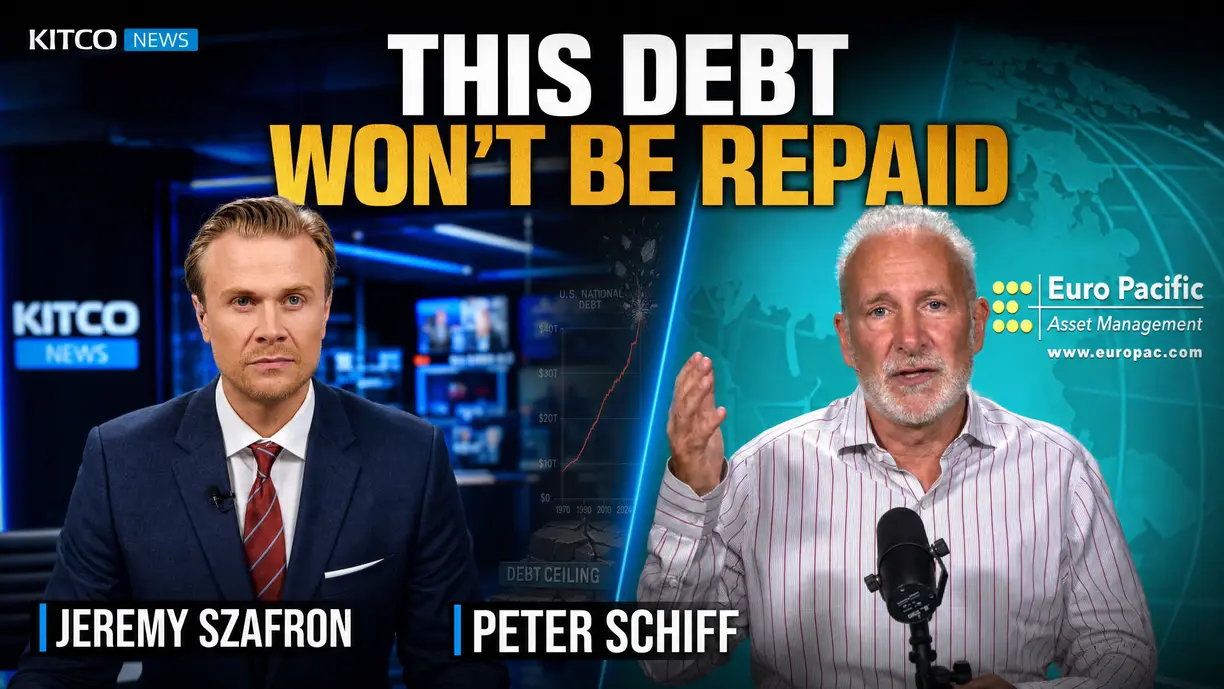
(Kitco News) - Schiff tells Kitco News anchor Jeremy Szafron that 9% mortgages and a 30% to 50% drop in home prices could be next, and why he holds more of his own money in gold miners than bullion.
The bond sell-off that just pushed U.S. borrowing costs to a 24-year high is only getting started, Peter Schiff told Kitco News anchor Jeremy Szafron, and it could end with Washington paying its lenders 50 cents on the dollar.
"It's not really about a bluff. It's the chickens finally coming home to roost," Schiff said Wednesday as the Treasury got ready to sell $39 billion of 10-year notes.
The 10-year yield touched 5.35% that day, its highest since 2002, before easing after the auction, CNBC reported. Mortgages have followed. The average 30-year rate hit 7.49% in the week ended Oct. 2, the highest since November 2023, according to the Mortgage Bankers Association. The Federal Reserve added to the pressure in September with its first rate hike since 2023.
Schiff, a longtime gold bull who made his name warning about the housing bubble before the 2008 financial crisis, says this time the borrower in trouble is Washington itself.
"This is not the end of this move. We're probably closer to the beginning," he said.
In 2008, the government bailed out everyone else. Next time, Schiff said, it'll be the one that needs help. "It won't be in a position to bail out anybody in this crisis because it's going to need a bailout," he said. "But of course, there's nobody big enough to bail out the U.S. government."
A 20-year bear market
Schiff believes the 40-year bull market in bonds ended in 2020 and 2021. Over those four decades, Freddie Mac's average 30-year mortgage rate fell from 18.63% in October 1981 to 2.65% in January 2021.
Now he expects the reverse: "a secular bear market that will last at least half as long as the bull market, so maybe 20 years." He thinks rates are "probably going to rise faster than they fell."
Housing is where people will feel it first.
"We could be looking at 9% mortgage rates maybe by the first quarter of next year," Schiff said. He sees home prices falling 30% to 50% nationwide, a drop "as big if not bigger" than the one in 2007 and 2008.
For decades, homeowners could refinance, pull out cash and spend it. Schiff says those days are gone. "The refi is dead. Home equity extractions are over," he said. "So there's no more lifeline."
'A stealth default'
Schiff describes the U.S. as stuck in what he calls the "fourth quadrant": high debt and high interest rates at the same time. For years, low rates made a big debt load manageable. That's no longer the case.
He sees two ways out. Washington can inflate, which he called "a stealth default," or it can restructure.
"I think there is a reasonable probability that the government will default," he said. "It's more likely to be a restructuring where they say, 'OK, you get 50 cents on the dollar.'"
Net interest on the federal debt already runs about $1 trillion a year, according to the Congressional Budget Office. Schiff thinks that could reach $3 trillion to $4 trillion "in a few years" as old debt gets refinanced at higher rates.
He's also critical of the Treasury's buybacks. The department plans to buy back up to $6 billion of bonds maturing between 2047 and 2056 on Thursday. Schiff calls it "an Operation Twist," retiring long-term debt while issuing short-term bills, and warns it could backfire.
"If I'm right about interest rates rising in the future, then the government is doing the worst thing you can possibly do," he said.

'The most bullish thing' for gold
Gold fell nearly $100 an ounce at its low Wednesday as yields climbed. Spot prices hovered near $4,100 during the interview, well off January's record above $5,500.
The usual thinking is simple: gold pays no interest, so when bonds pay more, gold looks less attractive. Schiff says traders have it backward.
"It's the most bullish thing that could happen to gold and silver because what these rising bond yields show is that bond prices are collapsing," he said. "Bond investors are losing money, and if they want to stop losing money, they have to sell their bonds. Well, what are they going to buy with the proceeds? Gold or silver."
He blames gold’s recent declines on trading algorithms that sell gold whenever rates rise. "Garbage in, garbage out," he said.
In the 1970s, he noted, rates and gold climbed together. What matters is whether rates keep up with inflation.
"What if interest rates go to 20% but inflation is 30%?" he asked. "I'd rather own gold and earn nothing, and avoid the 30% loss."
Central banks clearly haven't been scared off. China's central bank reported adding about 23 tonnes in September, its 23rd straight month of buying. Central banks worldwide bought a net 39 tonnes in August, according to the World Gold Council.
Some are selling. The council's data show Russia's central bank has sold 56 tonnes this year. Schiff says that's exactly what gold is for when a country at war needs cash: "It's a reserve you can actually tap into."
Eventually, he expects the sellers to run out. "Gold's going to be the last safe haven standing," he said.
Delegates at the London gold market's annual conference this week put gold near $5,000 a year from now. Schiff thinks it could happen faster. "The last time we moved up to 5,000, we went there very quickly. So we may go up there even quicker the next time," he said.
The spark, he said, may be a crisis like the 2023 collapses of Silicon Valley Bank and Signature Bank. "They tighten until something breaks, and then they stop," he said of the Fed.
Silver, Schiff said, has settled around $60. That's comfortably above the old double top near $50 that it couldn't clear in 1980 or 2011.
"I don't think $125 an ounce was the high. That was just the initial breakout point," he said. "We're going a lot higher next time, I think."

Every currency sinks
The dollar neared its high for the year this week as nervous investors bought it for safety, according to Bloomberg. Schiff isn't impressed.
"All fiat currencies sink," he said. “They just sink at different rates.” He expects the dollar to start losing value faster than many other currencies and, eventually, to lose its status as the world's reserve currency.
Where his money is
So where does he keep his own money?
"I have more of my own money, a lot more of my own money actually, in mining stocks than I do in physical bullion," said Schiff, whose businesses include a precious metals dealer and a gold equities fund. "I want to own the gold that's still in the ground."
He leans toward royalty companies and junior miners. He thinks the juniors will lead the next leg higher, which he says "hasn't really started yet."
For everyday savers, he called holding a U.S. bond fund "a mistake" and prefers money markets for cash. His most practical advice had nothing to do with markets: "What you should do is do next year's grocery shopping now."
He means non-perishables, stacked in the cupboard, the basement and the closet. "If the stuff that you are buying today costs 10% more or 20% more in a year … that's a 10% or a 20% tax-free return by buying it now," he said.
Americans expect 3.9% inflation over the next year, the highest since May 2023, according to a New York Fed survey released Wednesday. Schiff thinks they're lowballing it. "They're going to get something much higher than that."
AI: borrower, not lender
Schiff also sees the AI boom pushing rates higher, because the biggest tech companies have switched sides.
"These companies used to have cash, and they bought Treasuries with that cash. They were lending money to the government," he said. "Now they're borrowing in competition with the government."
It came up at the Fed, too. Minutes from its September meeting, released Wednesday, cited market commentary pointing to "competition for capital from heavy private debt issuance" to fund AI infrastructure as one reason Treasury yields have climbed.
Schiff does see one way out. "There is a chance that the result of this investment so dramatically increases productivity that we get a get out of jail free card," he said.
He just can't say whether the odds are 10% or 20%. "You've got a ticking time bomb here, and I don't know when it goes off."
Buyers still showed up
Not everything Wednesday looked like a buyers' strike. At the 10-year auction, primary dealers, the banks that absorb whatever other bidders don't take, were left with just 2.5% of the notes, well under the 9.4% average, CNBC reported. BMO called the sale "strong." Even so, the 5.3% auction yield was the highest since 2000.
The Fed minutes showed policymakers voted unanimously in September to raise rates to a range of 3.75% to 4%. "Most participants" said another increase would likely be appropriate by year-end, while longer-term inflation expectations stayed stable. Traders on the prediction market Kalshi this week put the odds of another hike before year-end near 78%.
Schiff's own fix is to deal with the debt now. Rather than promise bondholders 100 cents on the dollar and let inflation shrink it to 20 cents' worth, he'd rather restructure up front.
"How about if we say, 'We're not going to create any inflation, but we're going to give you 50 cents on the dollar instead'?" he said. "But that's a real 50 cents. That's better than getting a dollar that's worth 20 cents."
This interview is brought to you by Kalshi, offering the first CFTC-regulated gold and silver perpetuals in the U.S. Availability varies by jurisdiction. Not available in Canada. https://kalshi.com/p/KT2026
