
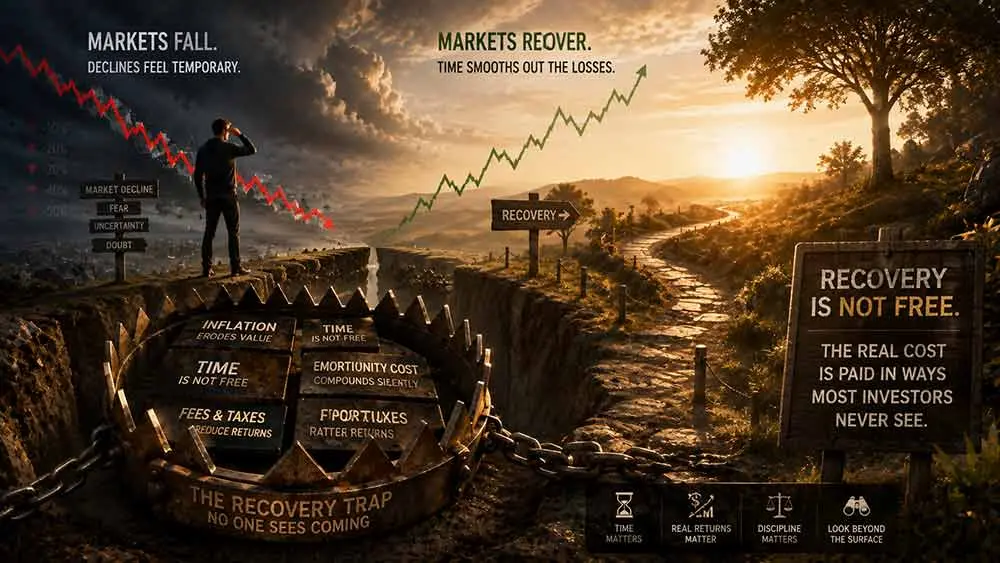
One of the most widely accepted beliefs in investing is that market declines are temporary.
Markets fall. Markets recover. Time smooths out the losses.
For decades, that idea shaped the foundation of long-term investing. And for many investors, especially during long periods of rising markets, it appeared to work well enough that very few people questioned it.
But there is another side to recovery that receives far less attention.
Recovery is not free.
When a portfolio experiences a major decline, the impact is not measured only in percentages. It is measured in time, in momentum, and in the years spent trying to regain what was already built once before.
A 50 percent decline does not require a 50 percent recovery to get back to even. It requires a full 100 percent gain just to get back to even.
Most investors understand that mathematically. What they often do not fully understand is what it feels like to live through that recovery process when it stretches far longer than expected.
Because at first, recovery feels manageable. You stay patient, remain invested, and trust the process because that is what responsible investors are taught to do.
That is what responsible investors are taught to do.
But when recovery turns into years instead of months, something begins to change psychologically.
The experience stops feeling temporary and starts to feel extended. What once felt manageable begins to feel limiting.
You are no longer building momentum.
You are no longer progressing toward new goals.
You are simply trying to get back to where you already were.
This is the recovery trap.
And what makes it difficult to recognize is that it rarely feels like a mistake while you are inside it. In fact, it often feels responsible because every surrounding voice reinforces the same message:
Stay invested.
Be patient.
Recovery always comes.
But the longer the recovery stretches on, the more it begins affecting things outside the portfolio itself. Plans become delayed, financial decisions become more cautious, and confidence begins to change quietly over time.
And eventually, the emotional weight of simply waiting begins replacing the sense of progress that investing was originally meant to create.
This is the part many investors never fully anticipate.
Because recovery assumes you have the time to wait.
But what if the recovery takes longer than expected? What if it takes longer than the time you had planned to give it? Or longer than the time you are comfortable allocating toward simply getting back to where you already were?
That is not a market question. It is a life question.
When recovery stretches into years, the cost is no longer just financial. It becomes a trade-off. Time spent waiting instead of progressing. Time spent repairing instead of building.
In my experience, this is where the old belief begins to feel incomplete. Not because it is entirely wrong, but because it does not account for what is being exchanged in the process.
It assumes time is always available. It assumes waiting is neutral.
And after living through one of these cycles personally, many investors begin to realize something important:
Waiting is not neutral.
It carries emotional weight.
It affects decisions.
And over time, it changes the way people experience investing altogether.
Losses do not just reduce capital.
They consume time.
And time is the one asset that cannot be replaced.
