
Strengths
- Funds tracking gold and Bitcoin drew a record $7 billion over five trading days, including $1.5 billion into BlackRock’s $60 billion iShares Bitcoin Trust ETF (IBIT). The surge pushed IBIT into the top 10 U.S. ETFs by weekly inflows, reinforcing Bitcoin’s growing role alongside gold as a hedge against fiscal and currency risks.
- More than a dozen financial institutions, including Bank of America, Wells Fargo and Santander, are advancing a global stablecoin venture, while 39 state banking associations representing roughly 3,000 banks are backing the BankChain Alliance. The shift highlights growing acceptance of blockchain-based payments as traditional banks move from resisting stablecoins to exploring direct participation in the market.
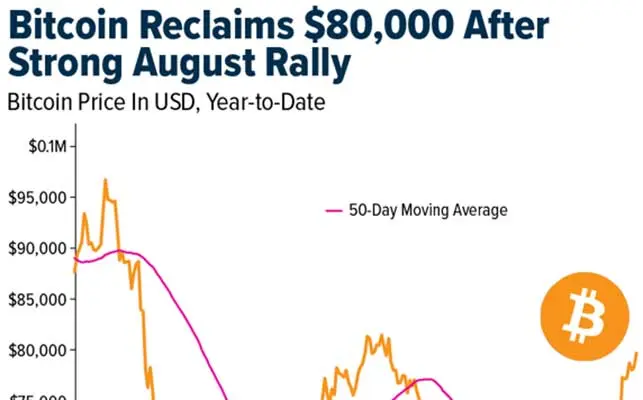
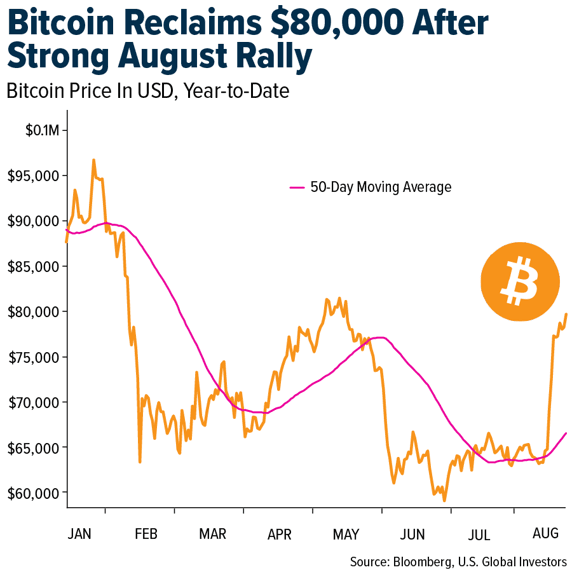
- Bitcoin has gained roughly 22% since August 20 and briefly topped $81,000 before profit-taking slowed momentum. U.S. spot Bitcoin ETFs have now recorded eight consecutive sessions of net inflows, attracting $2.8 billion in their longest streak since April, providing continued institutional support for the rally.
Weaknesses
- CryptoQuant said traders’ unrealized profit margins reached 20.5%, the highest since June 2025, while short-term holders realized $1.2 billion in profits between August 20 and 22. Bitcoin inflows to exchanges also rose to roughly 53,000 BTC, the highest since June 5, signaling increased potential for profit-taking after the recent rally.
- Glassnode data shows nearly 8% of Bitcoin’s total supply was acquired within this price range, including about 5% near $80,000 alone. As Bitcoin returns to these levels, investors who previously bought there may sell to recover their initial investment, potentially limiting further near-term gains.
- A pricing error involving Coinbase’s staked-ETH token (cbETH) caused roughly $1.8 million in user positions to be liquidated after the reported price deviated from the asset’s actual value. The incident highlights how DeFi lending platforms remain vulnerable to inaccurate price data used to value collateral.
Opportunities
- The SEC submitted a proposal to the White House that would clarify how investment advisers and investment companies can custody digital assets while eliminating certain requirements the SEC considers outdated. If adopted, the framework could reduce regulatory uncertainty and make it easier for investment firms to expand their participation in digital assets.
- Shinhan, one of South Korea’s five largest financial groups, with about $100B in assets under management, will use Visa’s platform to test stablecoin issuance, remittances and redemptions. The partnership will also pilot stablecoin settlement for card payments and business-to-business (B2B) and business-to-consumer (B2C) transactions, expanding real-world use cases for digital assets.
- The Bank of Japan, Ministry of Finance and Financial Services Agency are developing a system to settle stocks and government bonds using blockchain, potentially reducing the current two-day process to near real time. The initiative could improve the efficiency of Japan’s capital markets while expanding institutional use of tokenized financial infrastructure.
Threats
- Bitcoin is holding near $80,000 as investors await Fed Chair Kevin Warsh’s Jackson Hole speech, with July personal consumption expenditures (PCE) inflation at 3.7%, well above the Fed’s 2% target. A more restrictive policy outlook could push yields higher and tighten financial conditions, weakening the liquidity environment that has supported Bitcoin’s recent gains.
- Core Lightning, software used to operate Bitcoin’s Lightning Network, a layer designed for faster, lower-cost payments, issued an emergency warning after AI-assisted research uncovered multiple vulnerabilities. Operators unable to immediately patch were advised to temporarily take nodes offline, marking the second Lightning security emergency this month after an earlier BTCPay Server flaw allowed attackers to drain funds.
- Prediction markets face mounting legal uncertainty across the U.S. Connecticut sued Kalshi, a federally regulated prediction-market platform that allows users to trade contracts on the outcomes of real-world events, seeking to block its sports-related contracts as illegal gambling. Nearly half of U.S. states are now involved in prediction-market disputes, highlighting uncertainty over whether federal Commodity Futures Trading Commission (CFTC) oversight or state gambling laws should govern the industry.
