
Strengths
- Circle launched the public mainnet of Arc, a Layer 1 blockchain designed for stablecoin payments, financial markets and tokenized assets. Major institutions, including BlackRock, Visa, Mastercard, DTCC, ICE and Standard Chartered, are joining as validators, while more than 100 applications and institutional participants are already building on the network. The launch highlights the growing integration between blockchain infrastructure and traditional financial institutions.
- Deutsche Bank plans to introduce a regulated digital-asset custody service for institutional and corporate clients in Europe, subject to regulatory approval. The offering is expected to initially support Bitcoin, Ether and stablecoins, including USDC and EURC, with tokenized financial instruments potentially added later. The move highlights the growing integration of digital assets into traditional banking infrastructure and expanding institutional access to crypto markets.
- VIVA, one of Bolivia’s major telecommunications operators, is integrating stablecoins into parts of its financial operations using Avalanche, a blockchain network that supports digital-asset transactions and applications. The company plans to use the technology for settlement, dollar-denominated reserves and new financial services while connecting it with its existing systems. The initiative highlights growing corporate adoption of blockchain and stablecoins for real-world financial applications in Latin America.
Weaknesses
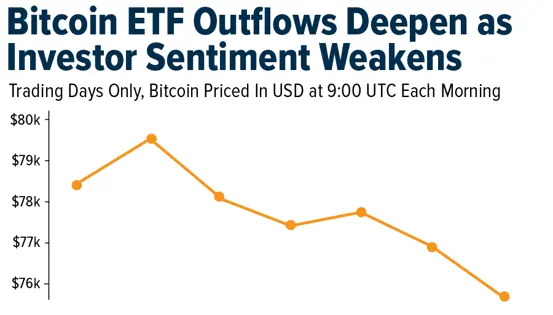
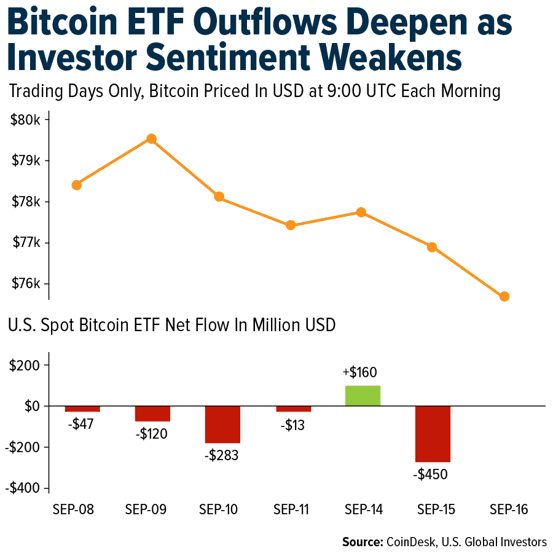
- U.S. spot Bitcoin ETFs recorded $450.3 million in net outflows on September 15, the largest single-day withdrawal since June 25, as the Digital Asset Market Clarity Act failed to advance in the Senate. The sharp reversal in ETF flows highlights softer investor sentiment and renewed caution among institutional investors amid regulatory uncertainty.
- Public companies added just 5,900 BTC on a net basis over the past three months, marking a sharp slowdown in corporate treasury accumulation. Other demand indicators, including stablecoin supply growth and ETF activity, have also shown signs of weakening. The slowdown suggests that some of the institutional and corporate demand that previously supported Bitcoin’s market momentum has lost strength.
- Ethereum developers warned that testing for Glamsterdam, an upcoming upgrade designed to improve how the Ethereum network processes transactions and operates, could be disrupted by malicious participants. Attackers could interfere with the Sepolia test network by gaining the right to build blocks and then failing to complete them, potentially slowing or temporarily stalling testing. The issue does not affect Ethereum’s mainnet or user funds, but it highlights technical challenges developers need to resolve before the upgrade is fully implemented.
Opportunities
- The House Ways and Means Committee advanced the Digital Asset Tax Certainty Act in a bipartisan 38–5 vote, addressing the tax treatment of stablecoins, staking, mining, lending and other digital-asset activities. The proposal seeks to reduce tax-related friction and align certain crypto rules more closely with those governing traditional financial assets. If enacted, greater tax clarity could support broader adoption and participation in the U.S. digital-asset market.
- Blockchain finance platform Theo launched SLVR, a tokenized product offering exposure to physical silver while generating yield through leases to institutional borrowers. The product launched with approximately $40 million in active silver leases, linking blockchain infrastructure with an established commodities market. The development highlights the expanding use of blockchain to tokenize traditional assets and create new investment and financing opportunities.
- Following the Clarity Act’s failure to advance, the SEC and Commodity Futures Trading Commission (CFTC) signaled plans to use their existing authority to provide greater regulatory clarity for digital assets. Potential areas of focus include token classification, decentralized finance (DeFi), self-custody and tokenized equities. Continued rulemaking could provide the industry with clearer operating frameworks even as broader crypto legislation remains stalled in Congress.
Threats
- The U.S. Department of Justice moved to seize approximately $61 million in cryptocurrency allegedly linked to sanctioned Iranian oil sales, while separate DOJ documents showed that Hamas’ military wing advised potential donors on the use of crypto platforms and stablecoins. The cases highlight the continued use of digital assets in sanctions evasion and illicit-finance networks. Such activity could intensify regulatory scrutiny of exchanges, stablecoins and anti-money-laundering controls.
- South Korea is preparing to introduce taxation on cryptocurrency investment gains in 2027 after multiple delays, while a recent survey found that more than half of surveyed crypto investors favor another postponement. Concerns remain over the tax burden and whether the regulatory infrastructure is ready for implementation. The planned tax could weigh on investor participation and trading activity in one of Asia’s major crypto markets.
- The Bank of Japan raised its benchmark interest rate from 1.00% to 1.25%, its highest level in 31 years, as policymakers continue to normalize monetary policy. Higher Japanese rates could increase pressure on yen-funded carry trades, where investors borrow at relatively low rates in Japan to invest in higher-yielding assets elsewhere. An unwind of these positions could reduce global liquidity and increase volatility across risk assets, including Bitcoin and the broader crypto market.
