
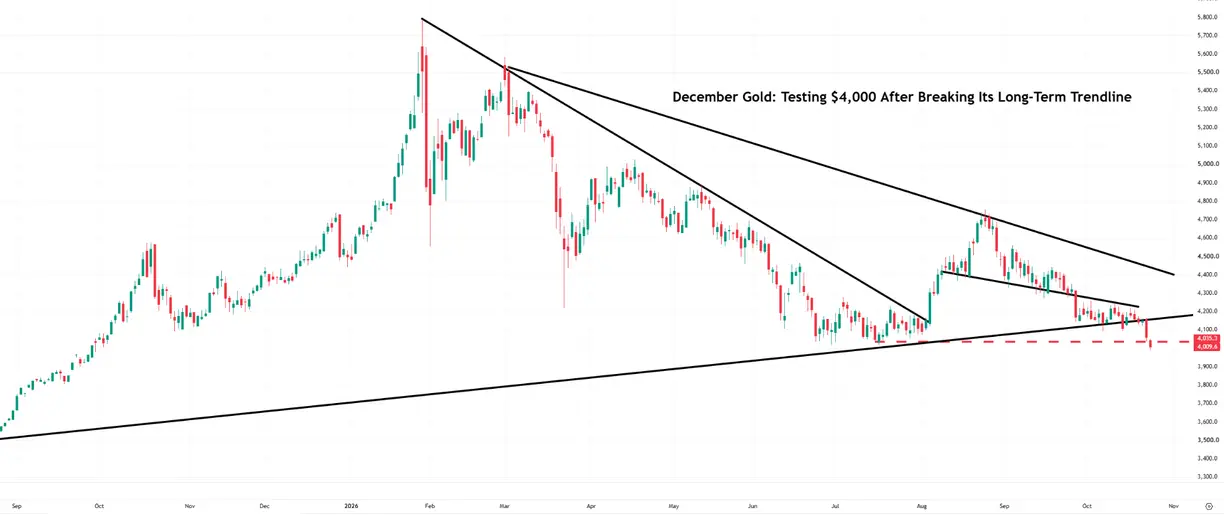
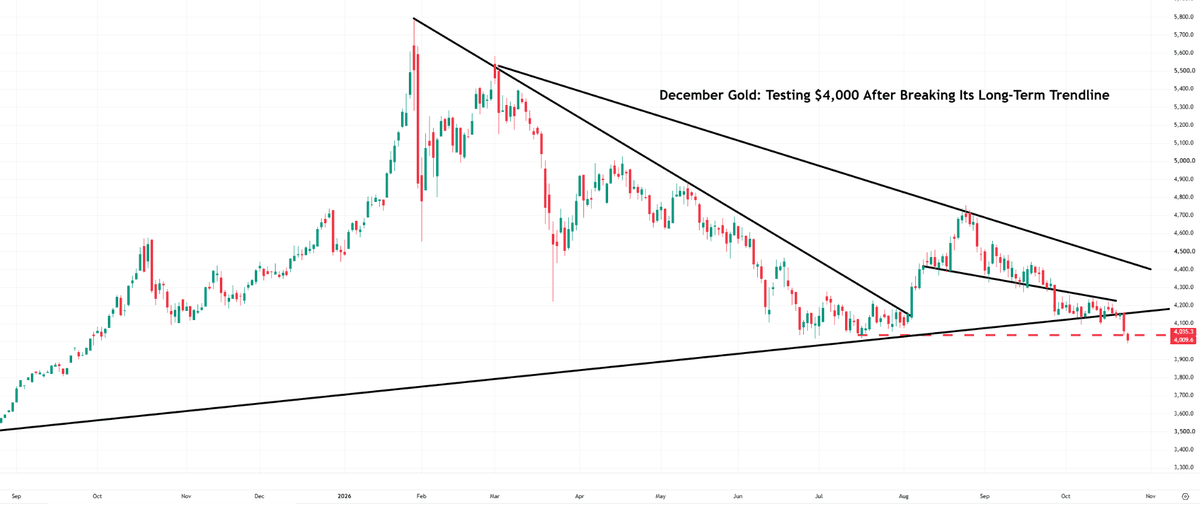
On October 22, tensions in the Middle East flared, oil touched $100, the dollar fell, Treasury yields fell, and rate-hike odds dropped. All of that usually helps gold. December gold fell $90 anyway, and by Friday dipped below $4,000, its lowest level since mid-July and roughly 30% below its January record.
So what actually turns this market around? It isn’t the next headline. It’s the moment the economy weakens enough that the Federal Reserve can no longer raise rates.
Why gold is struggling
Gold pays no interest. When the Fed is raising rates and the market expects more hikes, cash and Treasuries pay you to wait. September CPI rose 0.6%, the biggest gain since April, and futures still price close to an 80% chance of another hike by December.
The buyers haven’t disappeared. Gold ETFs have taken in metal for 14 straight weeks, and central banks are buying roughly 80 tonnes a month. That demand has cushioned the drop but hasn’t overpowered rates.To help you track what turns this market, sign up free for Navigating the Week Ahead, where every weekend I walk through the key levels, the calendar and the signals that matter for gold and silver Sign up here.
The sequence that turns gold
The pattern I watch plays out in three steps:
- Inflation runs hot and the Fed keeps hiking. Gold struggles.
- Growth starts to roll over. Hiring softens, credit tightens, and stocks priced for perfection break. Long-term yields fall even while the Fed talks tough.
- The market decides the Fed can’t follow through. Hike bets get priced out and the 2-year Treasury yield rolls over. That’s when gold has typically turned.
History lines up:
- December 2015: The Fed made its first hike in nearly a decade. Gold bottomed near $1,046 the next day and rallied about 30% over the next seven months.
- Late 2018: The Fed hiked into a falling stock market, then turned “patient” within weeks. Gold climbed from near $1,160 to above $1,550 by September 2019.
- 2022 to 2023: Gold bottomed near $1,620 as the market looked past the fastest hiking cycle in decades, then pushed above $2,000 after the March 2023 bank failures.
Gold didn’t wait for the Fed to cut. It turned when the market decided the hikes were ending.
Where we are now
Step two is here, and step three may be starting. Odds of a hike at next week’s Fed meeting have collapsed from about 50% after the CPI report to under 10%.
- Credit: High-yield spreads have widened to about 324 basis points, above the 300 level that often signals stress.
- Stocks: The Russell 2000 is roughly 11% off its peak, and institutional outflows this month are the largest of any October on record.
- Bonds: The 10-year yield has dropped from 5.29% after CPI to below 5%. That’s the bond market betting on slower growth.
What I’m watching
- December hike odds. Already down from about 90% to 78% in three days. Below 50% would tell me the market thinks the Fed is done.
- The 2-year yield. At about 4.69%, it’s well off its post-CPI high of 4.95%. A sustained move lower would suggest the turn is underway.
- Jobless claims. Still near 200,000. A steady climb toward 250,000 would change the Fed’s tone.
How I’m approaching it
Patience matters more than prediction. Gold tested $4,000 this week, and a close below it could open a move toward $3,900 before the turn arrives. The October lows at $4,085 to $4,100 are the first level gold needs to get back above. Silver, which tends to swing harder at these turns, has already broken its $55 contract low.
For traders who want to position early, Micro Gold futures (10 ounces) and 100-oz Silver futures allow smaller sizes and scaling in at levels, and defined-risk options such as deferred-month call spreads let you position for a turn while capping what you can lose. To receive more information on trading the 100-ounce Micro Silver futures, sign up here.
Performance Disclaimer
Hypothetical performance results have many inherent limitations, some of which are described below. No representation is being made that any account will or is likely to achieve profits or losses similar to those shown. In fact, there are frequently sharp differences between hypothetical performance results and the actual results subsequently achieved by any particular trading program.
One of the limitations of hypothetical performance results is that they are generally prepared with the benefit of hindsight. In addition, hypothetical trading does not involve financial risk, and no hypothetical trading record can completely account for the impact of financial risk in actual trading.
For example, the ability to withstand losses or to adhere to a particular trading program in spite of trading losses are material points that can also adversely affect actual trading results. There are numerous other factors related to the markets in general or to the implementation of any specific trading program that cannot be fully accounted for in the preparation of hypothetical performance results all of which can adversely affect actual trading results.
