

(Kitco Commentary) - Why Being Comfortable With Market Losses Doesn't Mean Your Retirement Can Afford Them
You Can Handle the Loss. But Can Your Retirement?
An investor who has spent thirty years in the stock market has experienced plenty of uncertainty. They've watched frightening declines, endured painful bear markets, and learned not to panic when financial headlines turn negative.
Ask how they would respond to a 30% portfolio loss, and the answer comes confidently: “I've been through worse. I know markets recover. I'd stay invested.”
That sounds like an experienced investor with a healthy attitude toward risk. Emotionally, they may be exactly that. They've developed the patience to withstand market fluctuations without allowing every decline to dictate their decisions.
But suppose this investor is now 67, recently retired, and relying on their savings to fund a meaningful portion of their living expenses. Their portfolio falls 30%, retirement withdrawals continue, and the financial consequences look very different from those they faced at 45.
Their emotional tolerance hasn't changed, but their financial circumstances have. The same willingness to endure losses now exists alongside different income needs, spending obligations, and opportunities to rebuild capital.
The question isn't simply whether you have the discipline to withstand a major loss. It's whether your retirement can afford the consequences of that loss.
Risk Tolerance and Risk Capacity Are Not the Same
Traditional conversations about investing frequently focus on risk tolerance. Financial questionnaires ask how investors would react to a substantial market decline, whether they prefer stability over growth, and how comfortable they are with fluctuations in their account values.
Those questions matter. Someone who becomes overwhelmed by market volatility may struggle to follow an investment plan, particularly during difficult periods. Understanding an investor's emotional response to risk is an important part of developing an appropriate approach.
But risk tolerance is only part of the picture. Another consideration is risk capacity: the financial ability to absorb investment losses without undermining essential goals or obligations.
An investor may be emotionally comfortable with a substantial decline but have limited flexibility if that loss occurs. Their retirement spending may depend heavily on portfolio withdrawals, their other income sources may be modest, or they may have financial responsibilities that cannot easily be postponed.
Another investor may feel uncomfortable with market fluctuations despite having ample financial reserves, dependable income, and considerable flexibility. Their emotional tolerance is lower, but their financial capacity to withstand a setback may be much greater.
These are very different situations, and neither can be understood by asking only how someone feels about losing money. One concerns the investor's temperament; the other concerns the financial consequences of taking risk.
Risk tolerance measures your willingness to experience a loss. Risk capacity examines whether your financial circumstances can withstand it.
A sound retirement investing plan needs to consider both.
When Experience Creates False Confidence
One of the less obvious challenges of approaching retirement is that investing experience and financial flexibility don't necessarily move in the same direction.
At 45, an investor may be earning a high income, regularly contributing to retirement accounts, and planning to work for another twenty years. A significant market decline would be disappointing, but future earnings and contributions may provide opportunities to rebuild.
Twenty years later, that same investor has accumulated considerably more wealth and developed greater confidence through multiple market cycles. They've learned that frightening headlines often accompany temporary setbacks, and they understand the dangers of emotional selling.
But their financial circumstances have also changed. Employment income may be ending, contributions may have stopped, and the investment portfolio may now be responsible for supporting decades of spending.
The investor has become more experienced, but that experience doesn't automatically increase their ability to absorb a substantial loss. Depending on their income sources, expenses, and other resources, their financial flexibility may actually have decreased.
Someone who comfortably endured major market declines during their working years may assume that the same response remains appropriate in retirement. They remember recovering from previous setbacks and conclude that patience is all they'll need again.
Yet those earlier recoveries occurred under different circumstances. They may have continued earning income, investing new savings, and postponing withdrawals until much later. Those advantages may no longer exist to the same degree.
This doesn't mean experienced investors should suddenly become fearful or abandon long-term investing. Experience remains valuable, especially when it helps prevent impulsive decisions during volatile markets.
The concern arises when confidence developed under one set of financial circumstances becomes the primary justification for taking similar risks under a very different set.
Surviving previous bear markets doesn't establish how much financial risk your retirement can afford today.
The Financial Reality Behind Your Risk Tolerance
Two investors can hold portfolios of identical value and still face very different financial consequences when markets decline.
Consider two retired households, each with $1 million invested. Both experience a 25% portfolio decline, reducing their investment balances to $750,000 before accounting for withdrawals, taxes, or other changes.
The dollar loss is identical: $250,000.
But the first household receives enough dependable retirement income to cover most essential expenses. Their portfolio helps fund discretionary spending, and they have considerable flexibility to adjust those expenses during difficult markets.
The second household depends on substantial investment withdrawals to cover everyday living costs. Their mortgage, healthcare expenses, household bills, and other commitments leave less room to reduce spending if markets remain weak.
The decline has the same immediate effect on their account balances, but it places very different demands on their finances.
The first household may be able to reduce discretionary withdrawals temporarily without significantly disrupting essential needs. The second may have to continue drawing money while investment values remain depressed, leaving fewer assets available to participate in a recovery.
This is why account size alone doesn't determine how much investment risk someone can afford. A larger portfolio isn't automatically a safer retirement if the investor's spending needs and financial obligations are also substantial.
Income sources, essential expenses, liquidity, withdrawal requirements, and spending flexibility all influence the consequences of a major decline.
The same principle applies to investors who haven't yet retired. Someone planning to leave full-time employment within a year may face different financial consequences from a person who can comfortably continue working for several more years.
A thoughtful assessment of risk capacity must consider those circumstances rather than rely entirely on the investor's past experience or comfort with market volatility.
The financial impact of a loss depends not only on how much capital disappears, but on how much responsibility the remaining capital must carry.
Five Questions Worth Asking Before the Next Decline
Understanding risk capacity requires more than estimating how calmly you'll react when markets weaken. It means examining what your investments are expected to accomplish and how much flexibility exists if conditions become unfavorable.
These five questions provide a useful starting point.
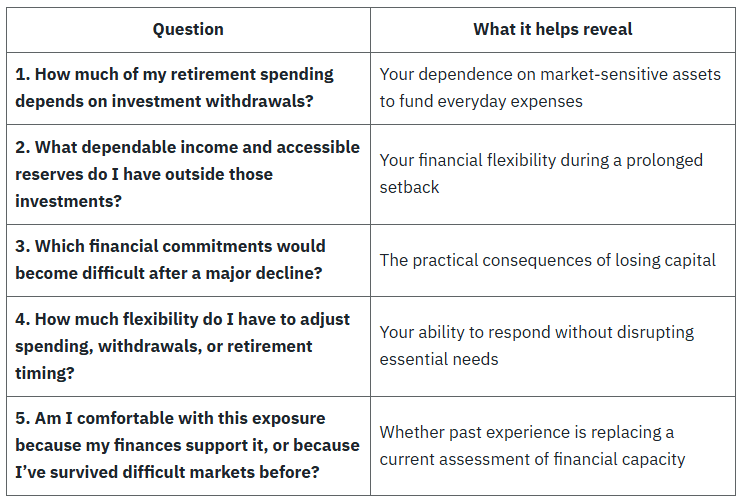
None of these questions produces a universal answer. Two investors with similar wealth may reach different conclusions because their spending needs, income sources, family responsibilities, and financial priorities differ.
The purpose isn't to make investors afraid of market losses. It's to prevent emotional confidence from being mistaken for financial preparedness.
There is an important difference between saying, “I know I can stay calm through a 30% decline,” and determining whether that same decline would leave retirement spending and essential obligations adequately supported.
The first statement describes temperament. The second requires an examination of financial circumstances, including what would happen if weak market conditions persisted.
Both deserve consideration before a major setback arrives, when decisions can be made without the added pressure of a falling portfolio.
A Better Standard for Evaluating Market Exposure
Once investors recognize that financial capacity matters alongside emotional tolerance, another question becomes relevant: should an investment continue receiving the same amount of capital simply because its owner is comfortable holding through declines?
Being able to tolerate volatility doesn't automatically establish that continued exposure is appropriate. An investor also needs a reasoned basis for assessing the investment, the risks involved, and the responsibilities the portfolio must fulfill.
This thinking is consistent with Asset Revesting, a protection-first retirement-investing category built around adaptive capital allocation.
Instead of treating permanent exposure as the only responsible form of discipline, Asset Revesting emphasizes evaluating whether current market conditions continue to justify an investment's place in the portfolio.
That doesn't mean adaptive investing eliminates losses or guarantees favorable outcomes. False signals, missed advances, and periods of underperformance remain possible, and the process itself must be evaluated against its objectives.
The value of the underlying principle is that an investor's willingness to endure losses doesn't have to become the sole justification for maintaining exposure. Market evidence and the financial responsibilities of the portfolio deserve consideration as well.
The relevant question isn't only whether you can emotionally withstand the risk. It's whether that risk remains appropriate for the financial responsibilities your capital must fulfill.

Read More: The Third Path on Amazon
Final Thoughts: Confidence Isn't the Same as Capacity
Years of investing experience can build valuable emotional discipline. Investors learn that markets fluctuate, frightening headlines don't always justify action, and panic often creates problems of its own.
But experience can also create a dangerous assumption: that because you've survived previous market declines, your retirement is financially prepared to withstand the next one.
Your temperament may be strong. Your investment knowledge may be substantial. Yet your income needs, spending obligations, and remaining opportunities to rebuild capital can change significantly over time.
The confidence that helped you accumulate wealth deserves respect, but it shouldn't prevent you from reassessing how much financial risk is appropriate for the years ahead.
Risk tolerance should be considered alongside risk capacity, not used as a substitute for it. Remaining calm during a market decline is valuable, but calmness alone doesn't pay expenses, replace withdrawn capital, or create financial flexibility.

Being strong enough to endure a loss doesn't mean your retirement should be required to absorb it.

