

Today, the October 2026 Producer Price Index report was released and came in slightly cooler than analyst expectations, while core inflation was in line with forecasts. Headline PPI rose 0.3% against a 0.4% forecast, and core matched expectations at 0.3%. Cooling energy costs helped temper the monthly headline reading, though annual wholesale inflation still climbed to 6.5%, its highest level since November 2022. This brought down the odds of a 50 basis point hike in December from 14.5% yesterday to 5% today. That offered a small amount of relief to the precious metals, as gold ended the Friday session essentially flat and silver gave up around 2.6%, settling at $48.48 in spot markets and $48.65 for December Comex futures. The outside markets driving this week’s decline held firm today, with the US dollar index making new 19-month highs at 103.38, 10-year yields holding above 5.1%, and Brent crude edging higher.
For gold futures this was their worst week since the start of June, giving up a total of $191.90, or 4.70%, from Monday’s opening price. The damage was done on Thursday, when a 3% slide took December futures to an intraday low of $3,857, the lowest level in 13 months. Friday’s flat finish left gold just under the October closing price of $3,898.90, which is why this week erased the entire early-November recovery and turned the month negative. Only last Thursday, November 5th, gold was trading above $4,130. Gold futures now sit roughly 31% below the January record high of $5,626.80, and silver’s steeper decline has pushed the gold-silver ratio out to roughly 80-to-1, up from about 74 in mid-October.
The catalyst came on Tuesday, when the October CPI rose 0.4%, beating forecasts. That same day Fed Governor Christopher Waller, speaking in London, said he was leaning toward a quarter-point hike in December but that “a 50 basis point hike in the policy rate should be considered” if inflation ran hot. The CPI report met that condition within hours, and Dallas Fed President Lorie Logan added that she supported at least two more quarter-point increases. The bond market repriced aggressively, with the 2-year Treasury yield jumping 35.2 basis points this week to 4.872%, its biggest weekly gain since September 2024, while the 10-year yield pushed through 5%. The dollar index gained about 1% on the week, its best performance in two months.
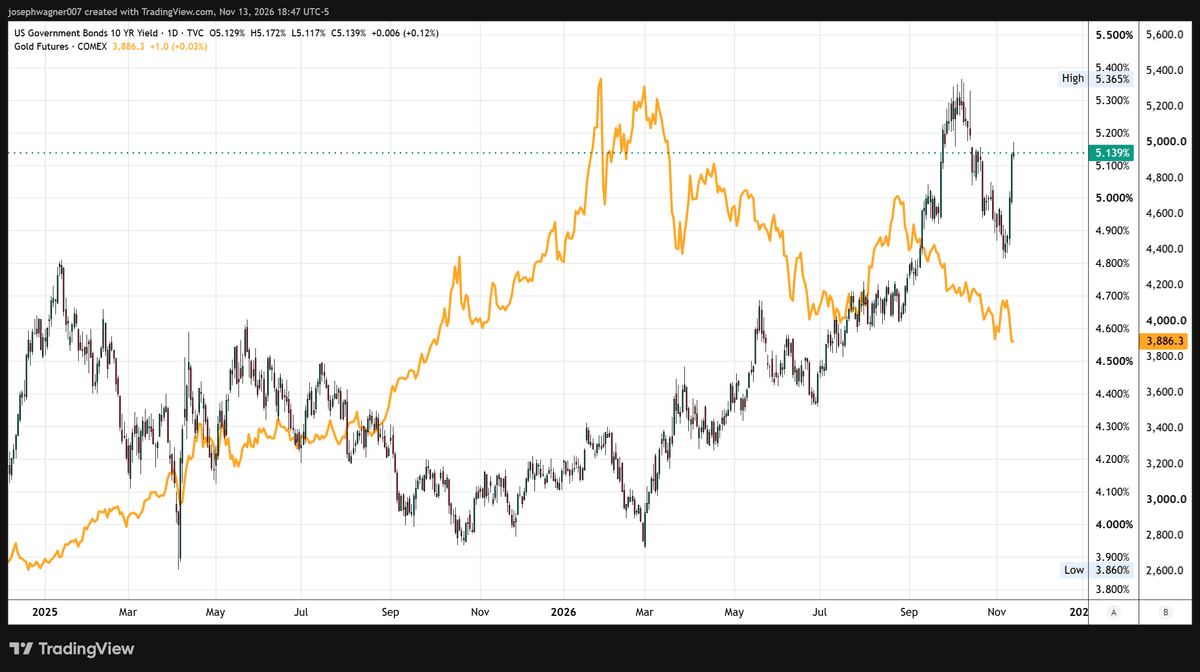
On the surface this is the textbook relationship at work. Gold pays no interest, so when yields rise the cost of holding it rises too. But that rule has been tested by two major shocks in less than two years, the tariff announcement of April 2025 and the war with Iran that began on February 28, 2026. In both cases the 10-year yield rose sharply. In the first, gold surged to record highs. In the second, it suffered its worst month since 2008 and has not stopped falling. The difference between the two explains this week’s decline better than any single inflation report.
Start with the tariffs. When the sweeping reciprocal tariffs were announced on April 2, 2025, the bond market initially did what it is supposed to do in a panic. Money moved into Treasuries and the 10-year yield dropped below 4%, touching roughly 3.8%. Then something unusual happened. During the week of April 7, with stocks still under pressure, Treasuries were sold aggressively. The 10-year yield climbed about half a percentage point in five sessions, its largest weekly increase since 2001, and reached 4.59% on April 11. The 30-year yield posted its biggest weekly jump since at least 1982.
What made that week different was the dollar. Instead of rising with yields, it fell, dropping to a ten-year low against the Swiss franc and taking the dollar index below 100. Stocks, bonds and the dollar were all falling together, something not seen since 1977. Yields were not rising because investors expected a tougher Federal Reserve. They were rising because investors, many of them foreign, were demanding more compensation to hold American assets at all. Traders called it the “Sell America” trade, and gold was the natural destination for that money. From a closing low of $2,983 early in the month, gold rallied to a record $3,243 on April 11, its best weekly gain since March 2020, and went on to touch $3,500 on April 22. Yields and gold rose together because both were expressing the same thing, a loss of confidence in the dollar.
The Iran war produced the same move in yields for an entirely different reason. When the first strikes were confirmed, the 10-year yield dipped briefly to 3.93% on a flight to safety that lasted less than 48 hours. Once oil began to climb, the bond market stopped trading fear and started trading inflation. The 10-year rose from 3.96% at the end of February to 4.26% within the first week of fighting, and with crude above $100 a barrel it reached eight-month highs near 4.35% by late March. It hit 4.71% in July, 4.80% in early September, and stands at 5.13% today.
This time the dollar went up with yields, and that is the critical distinction. Investors were not leaving the United States. They were repricing the Federal Reserve, first by removing the rate cuts they had expected and then by pricing in hikes, the first of which arrived in September. Real yields rose alongside nominal yields, and the safe-haven flow went into the dollar rather than into gold. Gold opened March 2026 at $5,321 and futures lost $582.90, or 11%, by month-end, while spot gold had its worst month since October 2008. From roughly $5,327 on the day the war began, gold has now fallen about 27%, while the 10-year yield has risen 117 basis points.
This week was that same mechanism in concentrated form. The Fed held its target range at 3.75%-4.00% in late October, with Governor Cook and Cleveland Fed President Hammack dissenting, and the CME FedWatch tool now prices roughly a 90% chance of a quarter-point increase at the December 8-9 meeting. Today’s PPI took the tail risk of a half-point move largely off the table, but it did nothing to remove the hike itself. Goods prices rose 10.2% from a year earlier, the largest gain since October 2022, and core PPI is running at 5% annually, a rate last seen in January 2023. The energy shock tied to the Iran conflict continues to work its way through the supply chain, and as long as it does, every inflation print adds to the case for tighter policy.
The lesson is that the level of the 10-year yield matters less to gold than the reason it is moving, and the dollar tells you the reason. When yields rise and the dollar falls, as in April 2025, the market is questioning the credibility of the United States, and gold benefits as the alternative reserve asset. When yields rise and the dollar rises with them, as they have since February, the market is pricing tighter policy and higher real returns on cash, and gold competes directly with a Treasury note that now pays more than 5%.
That framework also defines what a turn in gold would look like. The first path is the conventional one, where oil retreats, inflation cools, the Fed stops hiking, and yields and the dollar roll over together. The second is a return of the April 2025 condition, where yields stay high but the dollar begins to weaken beneath them. With the dollar index at 19-month highs and gold at 13-month lows, neither has appeared yet.
Next week brings more tests. Tuesday’s October retail sales report follows September’s 0.8% gain, which more than doubled forecasts, and Wednesday’s release of the October FOMC minutes will show how many officials were already leaning toward a hike. A strong consumer or hawkish minutes would likely keep the dollar and yields elevated. Technically, bulls first need a close above $3,898.90 to bring November back into the green, followed by a recovery of the psychologically important $4,000 level. Failing that, the focus turns to Thursday’s low at $3,857, where a decisive break would open the door to the $3,800 area. Until then, the 10-year yield remains the most important chart for gold traders to watch, with the dollar index sitting right beside it. For more daily gold market analysis, visit us at thegoldforecast.com.
Wishing you as always, good trading.
