
(Kitco Commentary) - Silver lost about 11% in a week while gold lost about 6%, and the main cause is the rising cost of money, not any sign that silver's shortage has ended.
The trigger was a hot US inflation report on November 10. Since then, markets have moved to treat a Federal Reserve rate rise at the December 8 to 9 meeting as close to certain. Silver pays no interest, so every rise in the return on cash and bonds makes holding it more costly. Higher rates also tend to lift the dollar, in which silver is priced. For silver, this is bearish into the December meeting. It says nothing about silver's supply and demand, though: Metals Focus and the Silver Institute still forecast a sixth annual shortfall in a row. And the same mechanism works in reverse. Silver rose about 4.6% in a day on November 4, when bond yields and the dollar fell together.
Silver traded near $47.24 an ounce on the morning of November 17. The gold-silver ratio stood at about 81.6, meaning one ounce of gold buys about 81.6 ounces of silver. Silver is down about 34% from its 2025 close. The latest premium issue at Golden Meadow® called the outlook for interest rates bearish for silver into the December meeting, and silver has fallen further since.
Why Rates Matter for Silver
An investor holding silver gives up the interest they could earn on cash or bonds. When that interest rises, silver becomes more expensive to hold, and some investors sell. A common measure of this is the real yield, the return on government bonds after inflation. In Silver Rising, I track the 10-year real yield on inflation-protected US Treasuries.
Rates also work through the dollar. Silver is priced in dollars, so a stronger dollar makes it dearer for buyers using other currencies.
What Changed in a Week
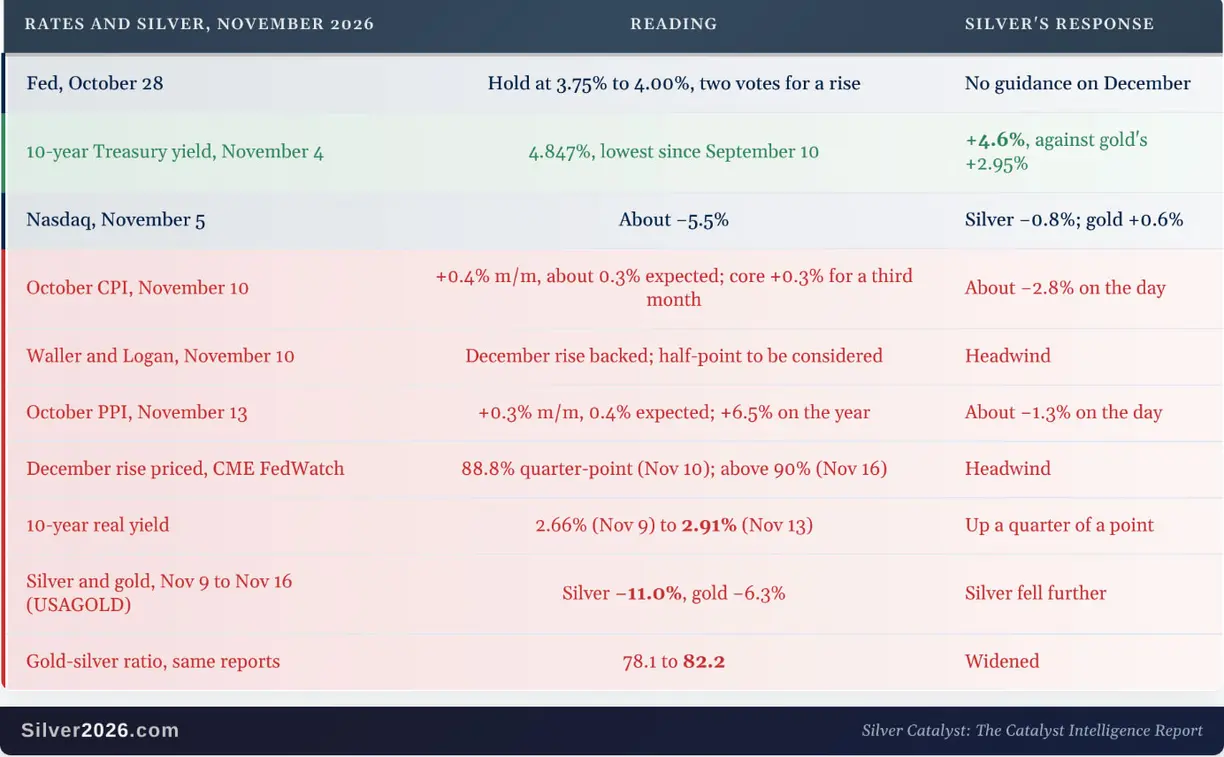
The Fed held rates on October 28, with two officials voting for an immediate rise. It gave no guidance on December. The data since then have pushed toward a rise.
The inflation report came out on November 10. October consumer prices rose 0.4% on the month, against about 0.3% expected. Core prices, which exclude food and energy, rose 0.3% for a third month in a row. Fed Governor Christopher Waller said the same day that he would support a December rise. He added that a half-point rise should be considered if core inflation stayed near 0.3%, which it did.
More signals followed. Producer prices, what businesses receive for their goods, rose 0.3% in October, slightly less than forecast. Over the past year, though, they were up 6.5%, the most since November 2022. Fed Chair Kevin Warsh spoke on November 16 but said nothing about rates.
Markets drew their own conclusion. CME FedWatch, which reads rate odds from futures prices, showed an 88.8% chance of a quarter-point rise in December after the inflation report. By November 16, the odds of a rise were above 90%. The dollar held near its strongest level since April 2025.
The real yield moved with them, rising sharply after the report. On the Treasury's daily table, it went from 2.66% to 2.91% between Monday and Friday of that week. That is a quarter of a percentage point in three trading sessions, since the bond market was closed on November 11.
Silver took the larger hit. In the daily reports of the bullion dealer USAGOLD, silver fell from $52.76 to $46.97 in the week starting the day before the report. That is a drop of about 11%, against about 6% for gold over the same week. The gold-silver ratio widened from 78.1 to 82.2.
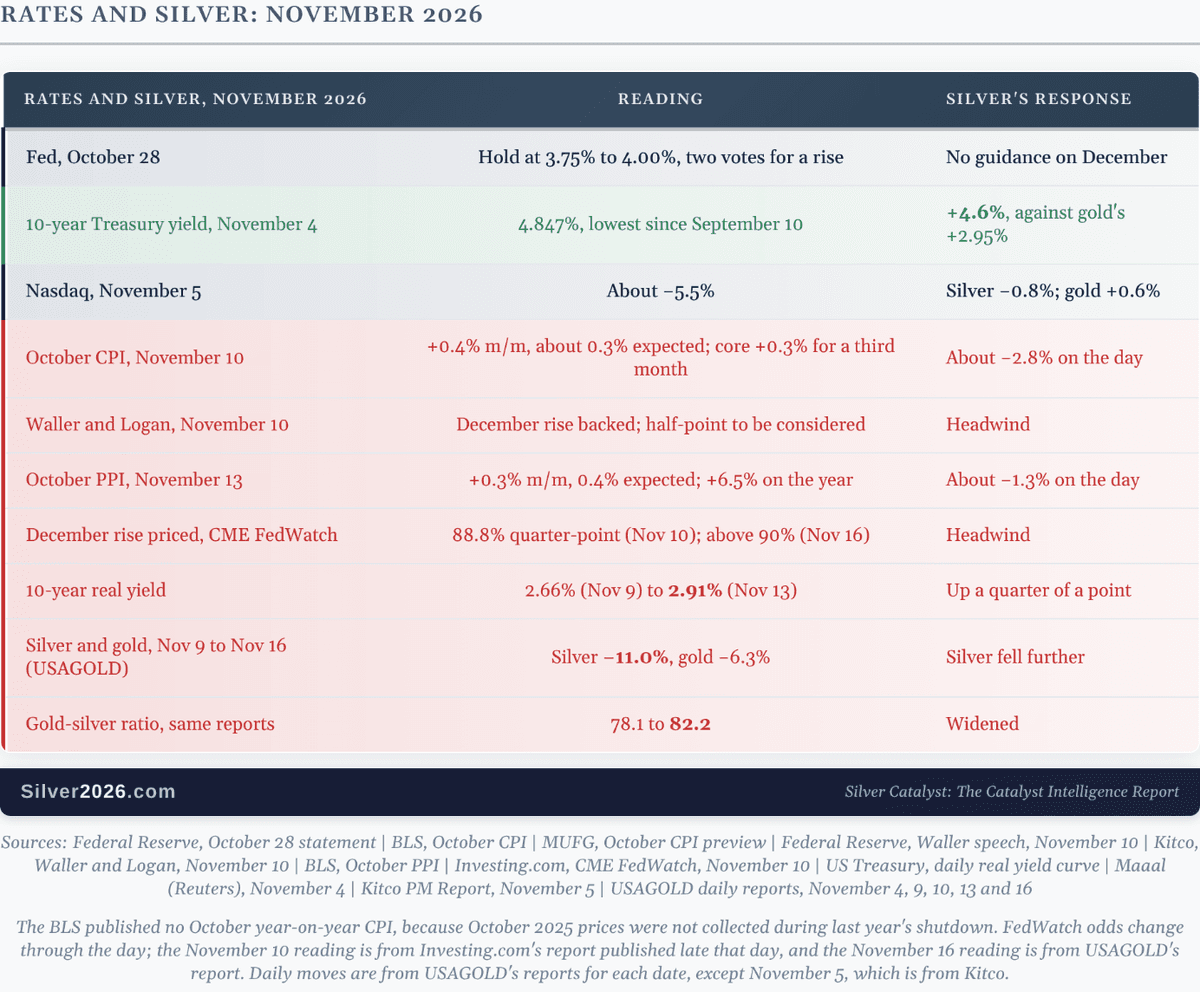
Sources: Federal Reserve, October 28 statement | BLS, October CPI | MUFG, October CPI preview | Federal Reserve, Waller speech, November 10 | Kitco, Waller and Logan, November 10 | BLS, October PPI | Investing.com, CME FedWatch, November 10 | US Treasury, daily real yield curve | Maaal (Reuters), November 4 | Kitco PM Report, November 5 | USAGOLD daily reports, November 4, 9, 10, 13 and 16
The BLS published no October year-on-year CPI, because October 2025 prices were not collected during last year's shutdown. FedWatch odds change through the day; the November 10 reading is from Investing.com's report published late that day, and the November 16 reading is from USAGOLD's report. Daily moves are from USAGOLD's reports for each date, except November 5, which is from Kitco.
The Day Silver Showed the Other Side
The week before the inflation report offered a contrast. Democrats won both chambers of Congress on November 3. The next day the dollar fell and the 10-year Treasury yield dropped to its lowest since September 10. Silver rose about 4.6% that day, while gold rose about 3%.
A day later the setting was different. The Nasdaq fell about 5.5% on worries about spending on artificial intelligence. Bond yields fell again, but this time alongside a sell-off in stocks. Silver slipped about 0.8% while gold gained.
The real yield fell on both days, and silver went opposite ways. One reading is that falling yields help silver when they come with a weaker dollar or easier policy, and less so when they come with a stock market sell-off. Two sessions cannot prove it. The real yield moved only slightly on November 4, so it cannot explain a 4.6% day on its own. The dollar and the election mattered too.
What This Means to Silver Investors
Silver's longer-term case rests on supply and demand: the world uses more silver than it produces. Nothing in the past week changed that. The interim review from Metals Focus and the Silver Institute, published on November 12, still forecasts a sixth deficit in a row.
What changed is the price of money. A December rate rise is now close to fully expected, and silver has fallen harder than gold as that expectation built. That is when the interest silver does not pay matters most. For now, the pressure on silver is coming from rates more than from its own market.
There are two ways this could turn. If the Fed raises rates and silver then holds up better than gold, that would suggest the rise was already in the price. If the Fed holds or signals a pause, real yields could fall, and that would work in silver's favour. On November 4, when yields and the dollar fell together, silver rose about 4.6% in a single day.
The longer-term case does not depend on the next Fed decision. The timing of any recovery does. Real interest rates are one of the forces I track in Silver Rising, and right now they are working against silver.
Interest rates are one dimension of the 100-catalyst framework I analyze in Silver Rising, alongside the five other Deep Dives in this issue of the Silver Catalyst newsletter. If you've at least considered investing in silver, I strongly encourage you to sign up, because it takes just $1 to get both. Get full Silver Catalyst Newsletter and Silver Rising book for $1 today.
