
(Kitco NewsWire) - Spot gold and silver prices were lower in late U.S. trading Monday, extending last week's sharp losses as a firmer dollar, expectations for additional Federal Reserve tightening and a broad technology-led equity selloff pressured precious metals. Gold struggled to hold the $3,850.00 level as investors reduced exposure to risk assets, while silver suffered heavier selling amid concerns about industrial demand and tighter financial conditions. Gold was trading near $3,855.50 an ounce, down $27.90, or 0.72%, while silver was trading near $46.860, down $1.771, or 3.64%, on the session. Gold traded as low as $3,832.20 during the day, while silver touched $46.430.
Monday's U.S. economic data showed a sharp slowdown in New York manufacturing activity, although the sector continued expanding. The Federal Reserve Bank of New York's November Empire State manufacturing index declined to 7.8 from 25.5 in October, substantially below expectations near 17.6. New orders and shipments continued increasing, while employment expanded at its fastest pace in more than four years. Input and selling price increases moderated but remained elevated. The report followed Friday's October producer price index, which increased 0.3% on the month, below expectations, while annual producer inflation reached 6.5%, its highest level since November 2022. The combination of slowing regional manufacturing growth and persistent inflation highlights the difficulties facing the Fed as it considers further monetary tightening.
Market positioning remained focused on the Fed's Dec. 8-9 meeting, with the latest published futures assessment indicating approximately a 90% probability of a 25-basis-point increase and a 10% probability of a 50-basis-point move. The benchmark 10-year Treasury yield eased to approximately 5.122% in late trading, while the two-year yield declined toward 4.825%, reflecting demand for government bonds during the equity selloff. However, the dollar index strengthened toward 103.52, maintaining pressure on precious metals. Fed Chair Kevin Warsh discussed productivity and technological change Monday but offered no clear signal about the December policy decision. Investors now turn to Tuesday's October retail sales and industrial production figures and Wednesday's minutes from the Fed's October meeting, scheduled for release at 2 p.m. EST. Weaker consumption or more cautious Fed commentary could reduce tightening expectations and support gold, while resilient demand and persistent inflation would reinforce the case for higher rates.
The Strait of Hormuz and U.S.-Iran situation remained unsettled Monday as fresh reports of tanker incidents highlighted continuing risks to Gulf shipping, despite evidence that petroleum exports through the strategic waterway have recovered substantially. Iranian military authorities reported additional vessels damaged by naval mines over the weekend, although those claims have not been independently confirmed in full. The U.S. naval blockade of Iranian ports remains in place, and no comprehensive diplomatic settlement has been announced. Maritime security reporting continues to identify significant risks to commercial vessels, even as regional petroleum shipments approach prewar levels. The improving supply outlook has reduced crude oil's geopolitical risk premium, but further attacks or renewed military escalation could reverse that decline. For gold, the unresolved conflict supports defensive demand, although higher energy costs could also reinforce inflation and expectations for restrictive Fed policy.
Crude oil prices fell sharply Monday as recovering Middle Eastern exports reinforced expectations for a global petroleum surplus. Brent crude futures declined $3.40, or 3.6%, to settle at $92.44 a barrel, while Nymex WTI fell $2.84, or 3.2%, to $85.72. The International Energy Agency expects the global oil market to move into surplus during the fourth quarter as supply recovers more quickly than demand. The decline in crude prices could help moderate energy-driven inflation, although Monday's weakness in precious metals indicated that dollar strength, monetary policy expectations and broader asset liquidation remained more immediate market influences.
North American equity markets finished sharply lower Monday as renewed selling in artificial intelligence-related companies and semiconductor shares weighed on Wall Street. The Dow Jones Industrial Average declined approximately 739 points, or 1.4%, to close at 51,608.17, while the S&P 500 lost 1.9% to 7,416.59. The Nasdaq Composite fell 2.5% to finish at 24,509.76, and the Russell 2000 declined 1.7% to 2,742.94. Nvidia and other chipmakers remained under pressure amid concerns about artificial intelligence investment, technology valuations and tighter U.S. export restrictions. The selloff encouraged demand for Treasury securities but offered little support to gold, suggesting that some investors were liquidating precious metals alongside equities.
Canada's S&P/TSX Composite Index also finished lower Monday, declining approximately 1.06% as weakness in materials, energy and clean technology shares weighed on the resource-heavy benchmark. Mining companies faced pressure from falling precious and base metals prices, while energy producers declined alongside crude oil. The Canadian market's losses reflected the broader deterioration in North American risk sentiment, although selected telecommunications and natural gas companies outperformed. The index's exact closing level remained inconsistent across available market feeds and has therefore been omitted.
European equity markets finished lower Monday as technology and mining shares declined amid renewed concerns about artificial intelligence investment and restrictive monetary policy. The pan-European Stoxx 600 fell 0.28% to close at 662.31, ending a five-session winning streak. Germany's DAX declined 0.57% to 26,598.64, while France's CAC 40 lost 0.20% to 8,352.00. The U.K.'s FTSE 100 also finished modestly lower near 10,892.93. Weakness in semiconductor equipment companies, including ASML, weighed on sentiment as investors assessed the implications of tightening U.S. technology export restrictions.
The key outside markets see Nymex WTI crude oil futures sharply lower after settling at $85.72 a barrel, while Brent crude finished at $92.44. The benchmark 10-year U.S. Treasury yield eased toward 5.12%, while the two-year yield declined near 4.83%. The dollar index strengthened toward 103.52, adding to pressure on gold and silver despite lower borrowing costs during the session. (Kitco Global Index shows how much of today's gold move is the dollar versus the gold market itself.)
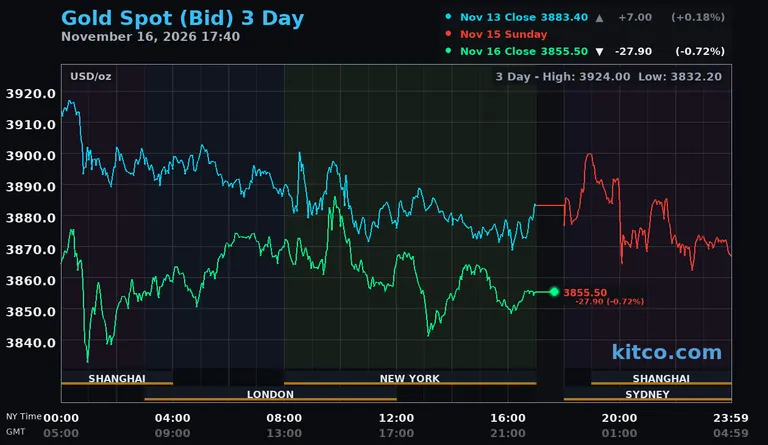
Technically, spot gold bulls' next upside price objective is to push prices back above the $3,891.82 to $3,903.00 resistance zone, with a sustained move targeting $3,915.96 and then $3,934.00. Bears' next near-term downside price objective is a break below $3,852.00, with deeper downside targets at $3,832.20 and then $3,823.00. First resistance is seen at $3,891.82 and then at $3,903.00. First support is seen at $3,852.00 and then at $3,832.20.
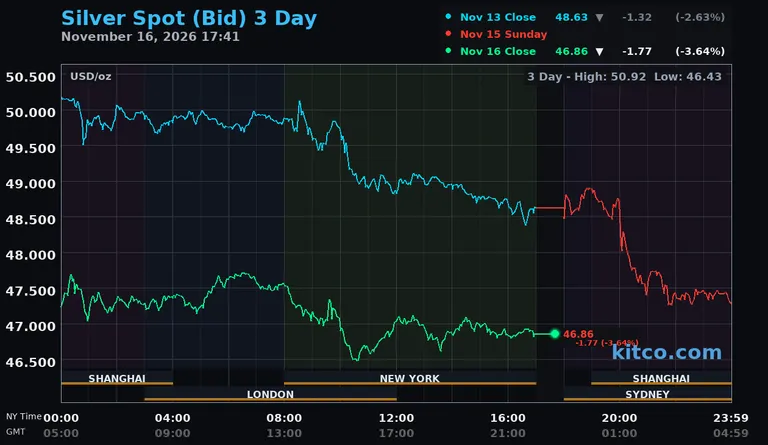
Spot silver bulls' next upside price objective is to drive prices back above the $47.000 to $47.500 resistance zone, with a sustained recovery targeting $47.908 and then $48.720. The next downside price objective for the bears is a break below $46.430, with deeper downside targets at $44.500 and then $44.000. First resistance is seen at $47.000 and then at $47.500. Next support is seen at $46.430 and then at $44.500.
See live precious metals prices for gold, silver, platinum and palladium — in USD, CAD and 12 more currencies.