

(Kitco NewsWire) – Spot gold and silver prices were lower in early U.S. trading Monday, extending last week's steep losses as a firm U.S. dollar, elevated Treasury yields and expectations for another Federal Reserve interest rate increase weighed on precious metals. Gold remained near its lowest level in more than a year, while silver experienced heavier selling amid concerns about industrial demand and restrictive financing conditions. Spot gold was trading near $3,872.70 an ounce, down $10.70, or 0.28%, while spot silver was trading near $47.260 an ounce, down $1.370, or 2.82%.
Friday's U.S. producer price index increased 0.3% in October, below expectations for a 0.4% gain, but annual producer inflation accelerated to 6.5%, its highest level since November 2022. The index excluding food, energy and trade services advanced 0.5%, indicating persistent underlying cost pressures. The report followed stronger-than-expected October consumer inflation and employment figures, which reinforced expectations that the Federal Reserve will maintain restrictive monetary policy. Investors were also awaiting Monday's November Empire State manufacturing survey, with consensus near 17.6 compared with October's 25.5 reading. The November survey's actual result had not been independently confirmed at the time of writing.
Market positioning remains focused on the Fed's Dec. 8-9 meeting, with the latest published CME FedWatch assessment indicating approximately a 90% probability of a 25-basis-point increase and a 10% probability of a 50-basis-point move. Elevated Treasury yields and dollar strength continue to pressure gold, which declined approximately 4.5% last week. Investors will scrutinize remarks from Fed Chair Kevin Warsh on Monday for indications about the December decision, followed by Tuesday's October retail sales and industrial production figures and Wednesday's minutes from the October Fed meeting. Stronger consumption or hawkish Fed commentary could reinforce expectations for further tightening, while weaker economic data could provide some relief to bullion through lower yields and a softer dollar.
The Strait of Hormuz and U.S.-Iran situation remains unsettled despite a substantial recovery in petroleum shipments through the strategic waterway. Iran's Revolutionary Guards claimed Monday that two additional tankers struck naval mines, following reports of several similar incidents over the weekend. The claims have not been independently confirmed in full, although separate maritime security reports indicate continuing attacks on commercial vessels. Gulf petroleum exports have reportedly recovered close to prewar levels, reducing some supply concerns, but shipping insurance costs and the risk of renewed disruption remain elevated. For gold, continuing regional instability supports defensive demand, although the inflationary consequences of another sustained oil-price increase could reinforce expectations for further Fed tightening.
Crude oil prices were little changed in early Monday trading as renewed tanker security concerns offset expectations for a global supply surplus. Brent crude futures traded near $95.89 a barrel, while Nymex WTI was around $88.65 in the latest verified morning market report. The International Energy Agency's assessment that global petroleum supply could exceed demand during the fourth quarter has placed downward pressure on crude prices as Middle Eastern exports recover. Lower energy costs could eventually moderate inflation expectations, but persistent underlying U.S. price pressures remain a more immediate influence on Federal Reserve policy.
Global equity markets faced another week of uncertainty surrounding artificial intelligence investment, corporate earnings and the outlook for U.S. interest rates. Investors were assessing last week's technology-sector volatility ahead of Nvidia's earnings and a busy schedule of economic releases and Fed commentary. European and Asian market sentiment remained sensitive to higher financing costs, while U.S. stock index futures reflected caution ahead of the New York session. The key questions for equities and precious metals are whether resilient economic activity will support earnings without requiring more aggressive monetary tightening and whether technology-sector investment can withstand elevated borrowing costs.
The key outside markets see Nymex WTI crude oil futures near $88.65 a barrel and Brent around $95.89 in early-morning trading. Treasury yields remained elevated following last week's inflation releases, while the U.S. dollar continued to benefit from expectations for further Fed tightening. (Kitco Global Index shows how much of today's gold move is the dollar versus the gold market itself.)
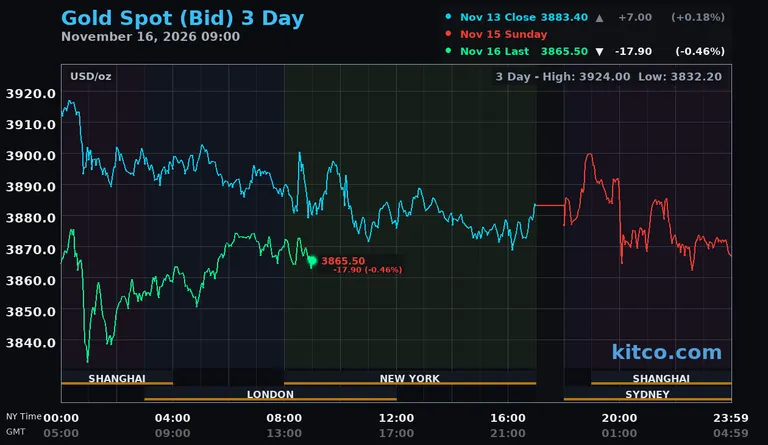
Technically, spot gold bulls' next upside price objective is to push prices back above the $3,903.00 to $3,934.00 resistance zone, with a sustained recovery needed to challenge higher resistance. Bears' next near-term downside price objective is a break below $3,852.00, with a deeper downside target at $3,823.00. First resistance is seen at $3,903.00 and then at $3,934.00. First support is seen at $3,852.00 and then at $3,823.00.
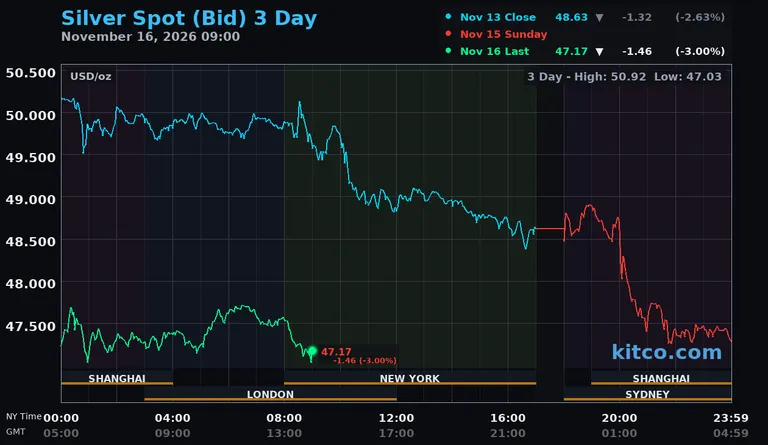
Spot silver bulls' next upside price objective is to drive prices back above the $48.720 to $49.780 resistance zone, with a sustained move through the upper boundary needed to improve the near-term technical outlook. The next downside price objective for the bears is a break below $46.920, with a deeper downside target at $45.580. First resistance is seen at $48.720 and then at $49.780. Next support is seen at $46.920 and then at $45.580.
See live precious metals prices for gold, silver, platinum and palladium — in USD, CAD and 12 more currencies.

