
(Kitco Commentary) - Strengths
- Eligible institutional clients will be able to mint and redeem USDC through DBS, with near-instant settlement between U.S. dollars and the stablecoin available around the clock. The partnership gives Circle a bank distribution channel for institutional payments in Asia.
- Wells Fargo disclosed 49.6 million shares of the iShares Bitcoin Trust worth $2.35 billion at the end of September, up from 24.4 million shares in June. The filing includes positions managed for clients and reflects holdings as of September 30.
- The Monetary Authority of Singapore issued S$100 million (US$77.5 million) in tokenized bills and settled the sale using a wholesale central bank digital currency. Five banks submitted bids totaling more than twice the amount offered, and the bills can serve as collateral for interbank borrowing.
Weaknesses
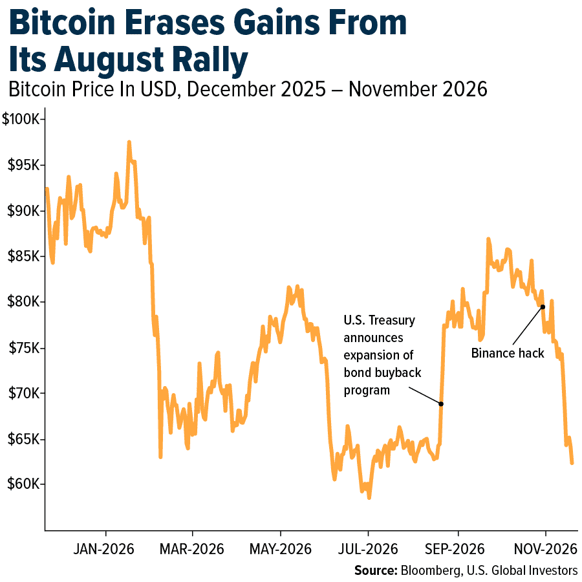
- Bitcoin fell below $64,000, roughly 49% below its record high, erasing gains from the rally that followed the U.S. Treasury’s announcement of expanded buybacks of long-dated debt. An AI-led equity selloff and a more hawkish Fed weakened risk appetite, while the Binance hack added pressure. According to trading technology provider Talos, the value of buy and sell orders within 1% of Bitcoin’s mid-price fell nearly 38% from its pre-hack peak, making large trades more likely to move prices sharply.
- U.S. spot Bitcoin ETFs recorded $582.2 million in net outflows on November 19, their third consecutive session of withdrawals. The latest redemptions brought November’s total to nearly $3.5 billion, compared with about $500 million in October.
- The former Bitcoin miner Hyperscaler Data raised roughly $74 million by selling its entire Bitcoin treasury and says it still needs another $74.8 million to complete its Michigan AI data center project. The company warned of substantial doubt about its ability to continue operating, highlighting the financing demands of converting mining sites into AI facilities.
Opportunities
- Hyundai Card and JPMorgan are testing AI-driven corporate payments on the blockchain. In a proof of concept on JPMorgan’s Kinexys platform, AI agents compared foreign exchange quotes and initiated simulated transfers between overseas subsidiaries. The test points to a potential use for blockchain in automating corporate treasury operations.
- The Hong Kong Monetary Authority and Swift are working with HSBC, Standard Chartered and Bank of China to connect Swift’s blockchain ledger with Hong Kong’s Project Ensemble. The initiative could give banks a way to settle cross-border payments in multiple currencies around the clock.
- The exchange aims to offer proprietary event contracts to U.S. retail and institutional traders, Bloomberg reported. Its existing Kalshi partnership topped $200 million in annualized net revenue in the third quarter, and listing its own contracts could allow Coinbase to retain more of the trading revenue.
Threats
- Brazilian lawmakers and industry groups called on the central bank to clarify its stance after an official reportedly linked stablecoin transactions to money laundering. Stablecoins accounted for roughly 80% of Brazil’s reported crypto transaction volume last year, according to the Finance Ministry. Broader restrictions could disrupt legitimate cross-border payments and raise compliance costs for fintechs.
- The Senate passed a bipartisan bill that would explicitly bar federally registered exchanges from listing contracts tied to war, terrorism, assassinations and individual deaths. The bill now heads to the House and would write restrictions already covered by federal regulations into commodities law.
- Inca Digital identified $518 million in transactions involving wallets linked to illicit actors through Sky’s stablecoin system, including about $102 million linked to North Korean actors. A court-ordered freeze of pooled USDC reserves could disrupt redemptions for legitimate holders of DAI and USDS, which together have more than $8 billion in market value.
