
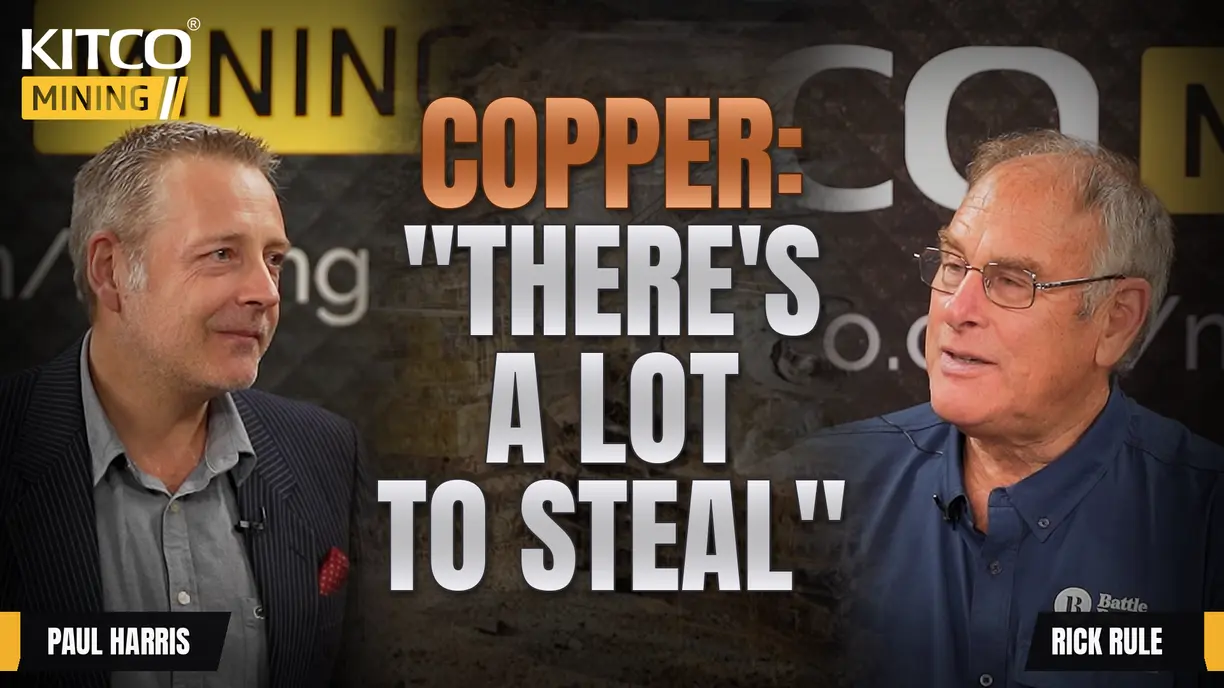
(Kitco News) - Rick Rule still sees value in gold stocks. He is less convinced that investors are doing enough work to separate that value from a rising market.
Speaking with Kitco Mining on Sept. 9, the President and CEO of Rule Investment Media said gold equities remain unusually cheap compared with the metal, even after a stronger bid returned to the mining sector.
Rule said that with gold prices moving higher, “gold companies are selling at the greatest discount to net present value relative to the gold price than they ever have.”
“Ergo, I think people should own more gold stocks,” he said.
The sector has already moved. According to global trade data, the world’s top 50 mining companies added an estimated $357 billion in value in August, pushing the group back above $2.5 trillion.
However, Rule’s point was not that investors should buy the sector blindly. It was the opposite. A higher share price is not the same thing as value.
“Money is made on the delta between price and value,” he said.
That distinction matters more as the mining trade broadens out. Physical gold remains a savings product, Rule said, while gold stocks are a leveraged bet on the metal. Copper and oil companies are different, and investors tend to look at them through yield, return on capital and total return.
Gold still has to deal with the rate market. Higher Treasury yields can make bonds more attractive and support the U.S. dollar. Longer term, Rule said U.S. debt and deficits point back toward lower real rates and more monetary expansion.
Silver could benefit if the gold move pulls generalist investors back into precious metals, but copper was the more important change in Rule’s outlook.
Rule said he underestimated copper’s strength this year, as demand proved more resilient than expected and supply problems became more visible.
Some of those problems are company-specific, with Rule pointing to pressure at Kamoa-Kakula, Grasberg and Codelco. The larger issue is that the copper industry has not invested enough for a long time, according to Rule.
“We’ve underinvested in exploration; we’ve underinvested in development. We’ve underinvested in all parts of the copper business, and you can’t make up for that systemic underinvestment quickly,” Rule said.
Ivanhoe Mines’ Western Forelands discovery in the Democratic Republic of Congo is one project he believes investors should watch. Ivanhoe announced on Sept. 8 that Western Forelands’ indicated mineral resources had increased to 42 million tonnes at 2.66% copper, with 612 million tonnes inferred at 1.80% copper.
Rule said the attraction is clear: grade, scale, 100% ownership and the potential to use existing Ivanhoe infrastructure. The discount is also clear. The project is in the DRC, a jurisdiction many investors still struggle to underwrite.
That is where higher metal prices create their own problem: they improve margins, but also attract governments, according to Rule.
He added that host countries can ultimately capture roughly half of a deposit’s economic value after capital is returned, through taxes, royalties, duties, equity stakes or other mechanisms. Copper gives a blunt example.
“When copper was selling for a dollar US a pound, there was much less to steal. At $6.75, there’s a lot to steal,” he said.
That does not only apply to emerging markets. Rule said investors should not assume the U.S. and Canada are immune from fiscal changes if resource rents rise.
“The probability of the fiscal regime in the United States and Canada changing to reflect higher resource rents is 100%,” Rule said.
His answer is not to avoid political risk altogether. It is to price it properly. A strong deposit in a difficult country may still be better than a weak deposit in a safer one.
The same discipline applies to exploration. Collective Mining announced a maiden resource for the Apollo deposit at its Guayabales project in Colombia on Sept. 8, after the interview, reporting 2.58 million oz AuEq indicated and 2.83 million oz AuEq inferred.
Rule called Apollo “a spectacular maiden resource,” but said investors still need to look beyond the gold-equivalent number. Metallurgy, capital intensity, mining method, recoveries and marketability of the byproducts all matter.
M&A is another place where valuation work matters. Ahead of the Beaver Creek Precious Metals Summit, Rule said he expects “a continuation of the orgy of M&A” and would be looking for takeover candidates.
The most attractive targets, he said, are companies trading below net asset value that can fill a strategic need for a larger producer. Assets near existing mills in established camps can be especially valuable because they can extend mine life without requiring a new build.
Rule pointed to Equinox Gold’s 2025 combination with Calibre Mining and its 2026 acquisition of Orla Mining as examples of companies using deals to build scale.
His preferred areas remain physical gold, gold stocks, oil and copper. But the interview was not a simple bullish call on higher metals prices.
The easier part of the trade is recognizing that gold stocks are still cheap. The harder part is deciding which companies can hold that value once governments, capital costs, project risk and takeover premiums take their share.