
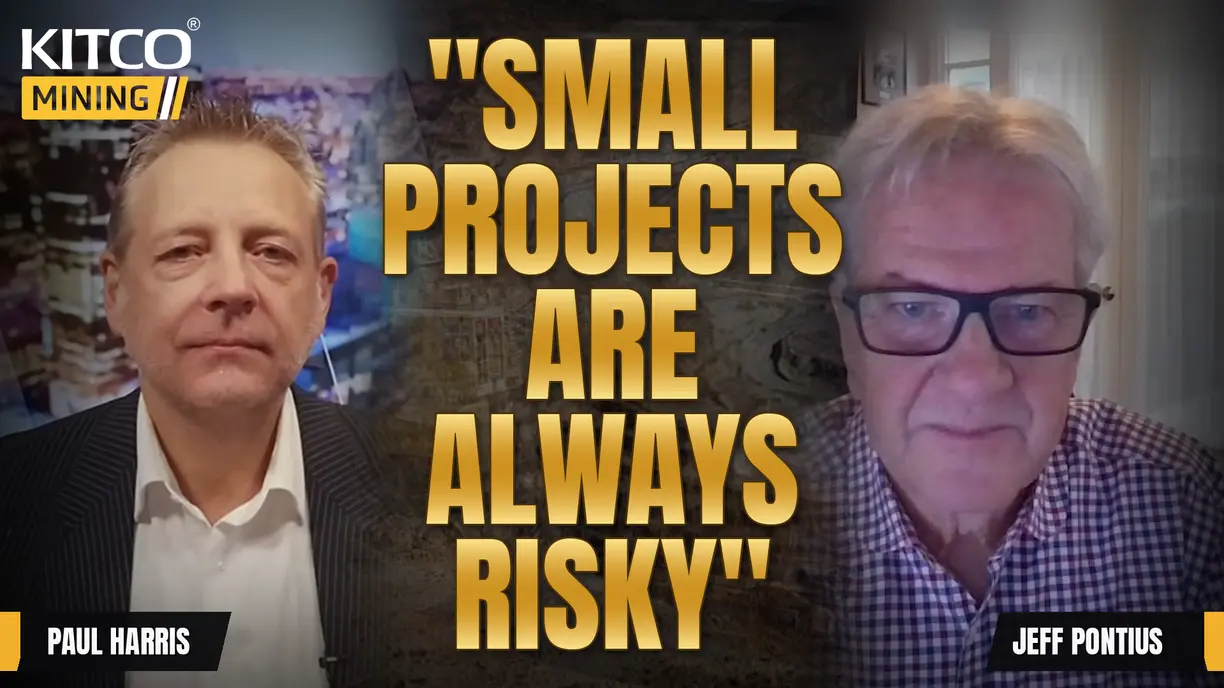
(Kitco News) The coming copper supply gap is putting more value on projects that already have infrastructure, clearer permitting paths and a realistic route to production, according to exploration geologist Jeff Pontius.
“There is going to be a copper gap here,” Pontius told Kitco Mining’s Digging Deep on Oct. 15.
He wants copper projects that are past discovery and already working through their development questions. “I’d like to see advanced projects that have gotten to the point [where] they’ve got the permitting questions out there in front of them, they’ve got solutions for those questions, and they can track their way into production,” he said. “Copper projects take a long time to get basically defined, permitted and built.”
AngloGold Ashanti’s Quebradona project in Colombia is one he is watching. “If permitting can move along and get done at the rate that people would like to see it, I think that project could come on to fill the gap a bit and it has a good gold credit that goes with it.”
Permitting timelines are the sticking point in North America. “The real problem I see with the permitting pathway is there’s no fixed time limits on the different stages of permit review and approval,” Pontius said. “I think if we can solve that, particularly here in the US, and limit the period of time that legal challenges go on, we’ll see projects move along more quickly.” Resolution Copper in Arizona has been around for about 20 years, he noted, “and we still aren’t there.”
In gold, Bonterra Resources released a preliminary economic assessment for its Barry Gold project in Quebec on Oct. 14. The study outlined initial capital of C$119 million and average annual production of about 87,000 ounces over a 7.2-year mine life. At a US$3,500 gold price, it estimated an after-tax NPV of C$665 million and an after-tax IRR of 53.5%.
Pontius sees little margin for error in projects of that size. “There isn’t a lot of room for things not to go perfect when you go forward, and small problems can turn into bigger problems, and all of a sudden the project is faced with not having enough runway to overcome those challenges,” he said. “These small projects are always very risky, in my opinion.”

Higher prices would help. “Gold prices go to $5,000, which I think they will, they’re going to be in a lot better shape in the future,” he said.
On Oct. 13, Hycroft Mining reported the highest-grade gold intercept in its history at the Vortex target in Nevada. The hole returned 19.6 meters grading 30.49 grams per tonne gold and 1,726.72 g/t silver, including 1.7 meters grading 347.07 g/t gold and 9,526.36 g/t silver.
“It was a vein intersection,” Pontius said of the narrow high-grade core. The bigger question is scale. “Hycroft is really a large, low-grade system, and it has a large capital demand because to make the economics work there, you’ve got to have a big system, you've got to produce a lot of gold.” He added: “You’re going to have to get the metallurgy right.”
Nevada also needs more places to process refractory ore as mines go deeper, he said.
“Right now it’s a bit of a monopoly that Nevada Gold Mines has,” Pontius said. “Because their facilities are going to be pretty much maxed out, and they’re going to be reluctant to be able to process extra mineralization through those facilities on a reliable, month-in, month-out basis.” That gives weight to i-80 Gold’s Lone Tree plant. Pontius said the company’s plan to start with oxide ore and existing infrastructure is a good first step before the larger Mineral Point development.

Also on Oct. 13, SSR Mining agreed to acquire Roxmore Resources in an all-cash deal valued at about US$464 million. The deal adds the Converse gold project, about six kilometers from SSR’s Marigold operation. “Converse was almost a captured project. It was right next to Marigold. There was really essentially only one buyer for that,” Pontius said.
Pontius, who chairs Mackay Gold & Silver, wants a different outcome at its Comstock project in Nevada. “I think our general target there is addressing a bulk tonnage deposit. Hopefully in the plus one gram range,” he said. “It’s amazing that there’s no drilling on that trend, given the magnitude of the Comstock district.”
Mackay sees its job as exploration and resource development rather than mine building. With most of the district consolidated, Pontius hopes the story becomes compelling enough to bring multiple buyers to the table.
For copper, he said, the projects that solve infrastructure and permitting first will be the best placed when supply tightens.
Watch the full video on the Kitco Mining YouTube channel.
This interview is brought to you by Kalshi, offering the first CFTC-regulated gold and silver perpetuals in the U.S. Availability varies by jurisdiction. Not available in Canada. https://kalshi.com/p/KT2026
