
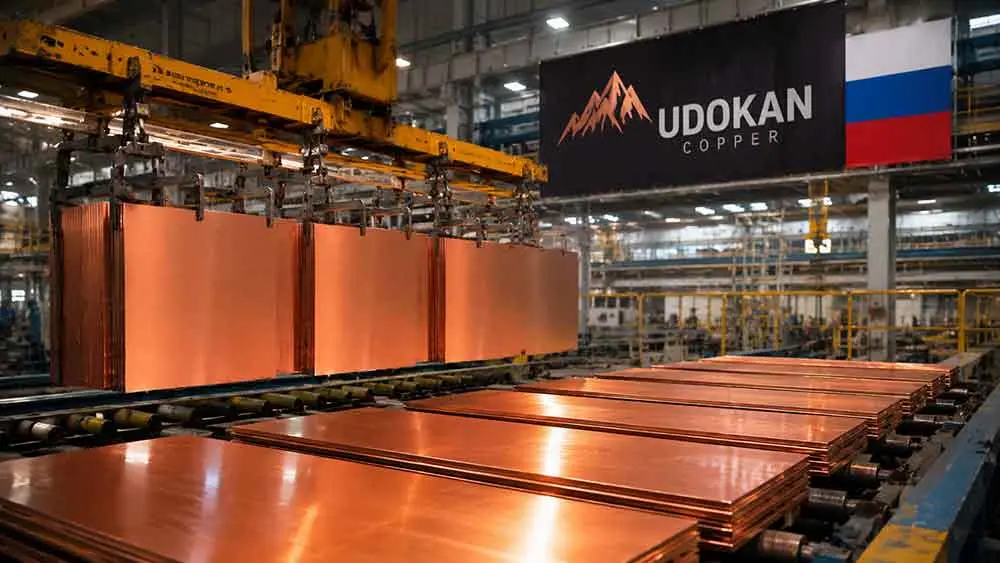
Russian mining company Udokan Copper said on Wednesday it had started producing copper cathodes at its plant in Russia’s Far East, nearly three years after a fire delayed the launch.
President Vladimir Putin joined the launch ceremony by video link from Vladivostok.
Udokan, Russia’s largest copper project, is currently under U.S. sanctions. It began producing copper concentrate in September 2023.
Its operator had planned to launch a hydrometallurgical plant in the second quarter of 2024 to produce up to 135,000 tons of copper per year in the form of either cathodes using the solvent extraction-electrowinning (SX-EW) process or concentrate.
Output from the project’s first phase is expected to rise to 150,000 tons annually from 2026, with supplies targeted at both the domestic market and export markets in China and elsewhere in Asia.
A fire in December 2023 damaged part of the cathode production facility before it was due to enter operation in the second quarter of 2024, although concentrate production was unaffected.
Western sanctions imposed on Moscow have complicated imports of mining and processing equipment needed to replace the damaged machinery.
Valery Kazikaev, chairman of the board of directors of Udokan Copper, said the hydrometallurgical plant relied on a patented Russian technology developed by the company’s specialists.
Established in 2008 to develop the Udokan deposit, Udokan Copper is a part of the diversified USM Group, with Russian billionaire Alisher Usmanov being its main shareholder.
Investment in the first phase of the project was estimated at $2.9 billion, including a syndicated loan provided by Sberbank, Gazprombank and VEB under a state-backed project finance scheme.
Once the second phase of the project, previously scheduled for launch in 2028, comes online, annual copper production is expected to reach about 550,000 tons, potentially making Udokan one of the world’s five largest copper producers.
The International Copper Study Group forecasts global refined copper demand of 28.66 million tons in 2026 and 29.24 million tons in 2027, with the market expected to remain in surplus.
(Reporting by Anastasia LyrchikovaEditing by Ros Russell)
