

(Kitco News) – Central bank gold purchases remained strong through July, and China appears to be buying far more bullion than official reports have disclosed, supporting a year-end price target of $4,900 per ounce, according to Goldman Sachs Research.
“Our GS nowcast estimates central bank purchases of 44 tonnes in July (vs. a pre-2022 average of 17 tonnes), with a large contribution from China,” wrote Lina Thomas and Daan Struyven in a recent research note. “On a 3-month seasonally adjusted basis, the trend stands at 91 tonnes/month.”
Goldman continues to see “net upside risk” to its $4,900 per ounce year-end gold forecast, but the analysts also warned of greater two-sided volatility along the way.
“Our fair-value forecast of $4,900/oz by end-2026 assumes continued strong central bank demand — with average purchases of 50 tonnes/month in 2026 and 40 tonnes/month in 2027 —alongside a recovery in private investor ETF demand as the Fed remains on hold in 2026,” Thomas and Struyven wrote. “It does not incorporate elevated demand for global macro-policy hedges through gold call options. If ETF investor inflows recover and the current elevated call option positioning persists, dealer hedging could mechanically amplify the rally and drive gold prices well above our forecast.”
“Conversely, a renewed increase in Fed-hike expectations could likewise trigger dealer hedge unwinds and produce a sharper-than-usual correction,” they added. “If the Fed were to hike, demand for gold as a macro policy hedge might (partially) unwind as market concerns about DM central bank independence ease. Combined with rate-sensitive ETF holders net selling into higher rates, gold prices could then reach $4,440/oz by end-2026 — materially below our base-case of $4,900, but slightly above today's levels, as continued central bank buying eventually more than offsets.”
Goldman Sach Research estimated that China purchased 35 tonnes of gold in July – nearly double the AA tonnes China reported in its official public disclosures – making it by far the largest buyer during the month.
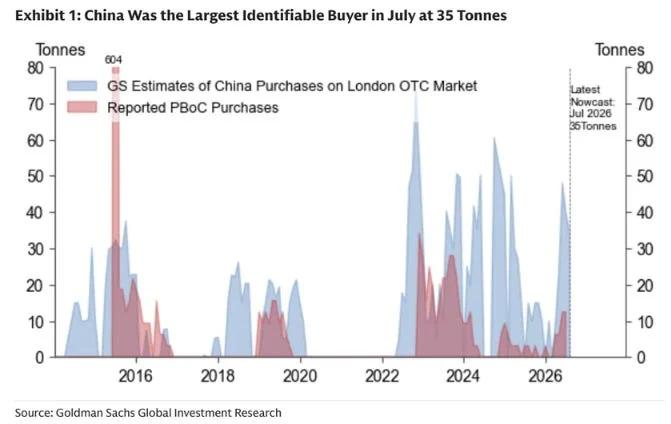
As official figures often understate the real amount of gold bullion purchased by central banks, Goldman Sachs Research’s nowcast model also tracks the volumes of gold moving through London’s over-the-counter (OTC) market into domestic vaults or third-party custodian firms, enabling the model to reflect buying that does not appear in official reserve data.
The Bank of England’s gold holdings on behalf of foreign central banks rose by 63 tonnes in July – an amount that far exceeded the decrease in the Federal Reserve’s New York vaults during the month.
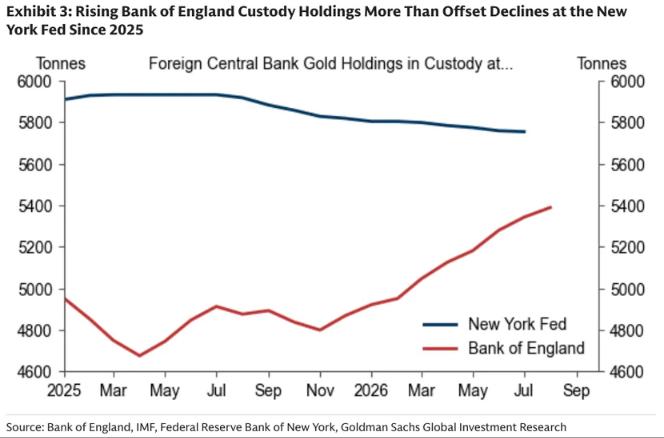
Based on this, the Goldman analysts concluded that “additional recent central bank purchases are not captured in our July nowcast estimate.”
Earlier this month, Thomas and Struyven wrote that gold prices will rise to $4,900 per ounce by the end of 2026 amid strong demand from central banks seeking to diversify their foreign currency reserves, while investors using gold derivatives to hedge may be making the yellow metal more volatile.
“Gold is projected to extend its recent gains in the second half of 2026, even as growing use of some derivatives tied to the metal could be making gold prices more volatile,” Thomas and Struyven wrote at the time.
The firm forecasts the precious metal’s price will rise to $4,900 per ounce by the end of the year as central banks continue diversifying their reserves and markets scale back expectations for U.S. rate hikes in 2026.
The analysts see central bank demand as a key structural factor underpinning gold’s rally.
“We continue to see elevated central bank gold accumulation as a multi-year trend, as central banks diversify their reserves to hedge geopolitical and financial risks, consistent with recent survey evidence,” Thomas and Struyven said.
Goldman Sachs Research forecasts central banks will buy an average of 50 tonnes of gold per month in 2026, up from an average of 17 tonnes per month in the years before 2022.
According to Goldman Sachs Research’s nowcast of central bank activity, sovereign purchases accelerated to 100 tonnes per month in June 2026 on a three-month seasonally adjusted basis, up from 66 tonnes the previous month, with China’s central bank the largest confirmed buyer in June.
Another key factor driving the recent gold price increase was interest rate expectations. “Demand from some investors is starting to recover from a slow first half of the year as markets scale back expectations of a Federal Reserve rate hike in 2026,” the report said.
“We expect the Fed-related headwind to abate further, as our economists expect a lower inflation trend to keep the Fed on hold this year,” the analysts wrote.
They also highlighted a number of medium-term factors that could drive the gold price above their 2026 forecast of $4,900. “Gold’s share in private portfolios remains low, and recent geopolitical developments—including Iran and broader tensions—may accelerate diversification beyond central banks to private investors, including by weighing on perceptions of Western fiscal sustainability,” the analysts said.
Thomas and Struyven explained that demand for gold call options is on the rise as investors use them to hedge their portfolios against large-scale changes in government policies – and this has the potential to amplify price swings in both directions.
“As gold rises, it is approaching key strike levels for some call options, forcing options dealers that sold these calls to buy gold in order to hedge their short exposure to the metal, accelerating the rally,” the report noted. “On the other hand, declines in the gold price could prompt dealers to reverse those hedges by selling their gold holdings, driving prices even lower.”
Goldman Sachs Research’s $4,900 forecast for 2026 does not take into account this elevated demand for hedges through gold derivatives, which increases the upside risk to their forecast, but also implies “greater two-sided volatility” to the gold rally.
See live precious metals prices for gold, silver, platinum and palladium — in USD, CAD and 12 more currencies.
