
(Kitco News) - Investment demand in gold-backed exchange-traded funds has been resilient in the face of persistent inflation, higher bond yields and a stronger U.S. dollar; however, one bank remains cautious on the precious metal as physical demand remains weak, particularly in key global markets. (Kitco Global Index shows how much of today's gold move is the dollar versus the gold market itself.)
In their latest precious metals note, commodity analysts at Bank of America said that despite steady investment demand, they are not ready to reassess their outlook for gold prices, as they expect prices will be unable to hold above $4,000 an ounce over the next three months.
“We remain cautious near-term as the macro environment remains challenging: we have an average 4Q26 forecast of $4,000/oz, but then expect prices to average $4,813 in CY27,” the analysts said in the report published Monday.
In a note published at the start of the month, BofA said that it sees gold prices falling to a low of $3,750 an ounce in the fourth quarter as elevated energy prices continue to fuel inflation fears. Spot gold last traded at $4,168.90 an ounce, down 0.59% on the day.
The analysts said that although ETF demand has been positive over the last two months, this could be seen as a negative, as weak prices could eventually prompt investors to liquidate their positions, adding to the selling pressure.
They added that ETF demand alone can't keep the market buoyant as the broader physical market remains weak.
“Our tracker suggests that other key market participants, including central banks, China and India, have, in aggregate, slowed gold buying. This goes a long way to explaining recent gold headwinds,” the analysts said.
At the same time, BofA said that central bank demand, which has been an essential pillar of strength for the global market, could become a source of weakness through year-end.
“With the Middle East conflict escalating again, there is a risk that central banks could resume sales, in our view. Holdings have dipped somewhat, but this is not necessarily surprising, given that around 90% of the increase in the value of gold holdings reflected valuation gains rather than actual purchases,” the analysts said.
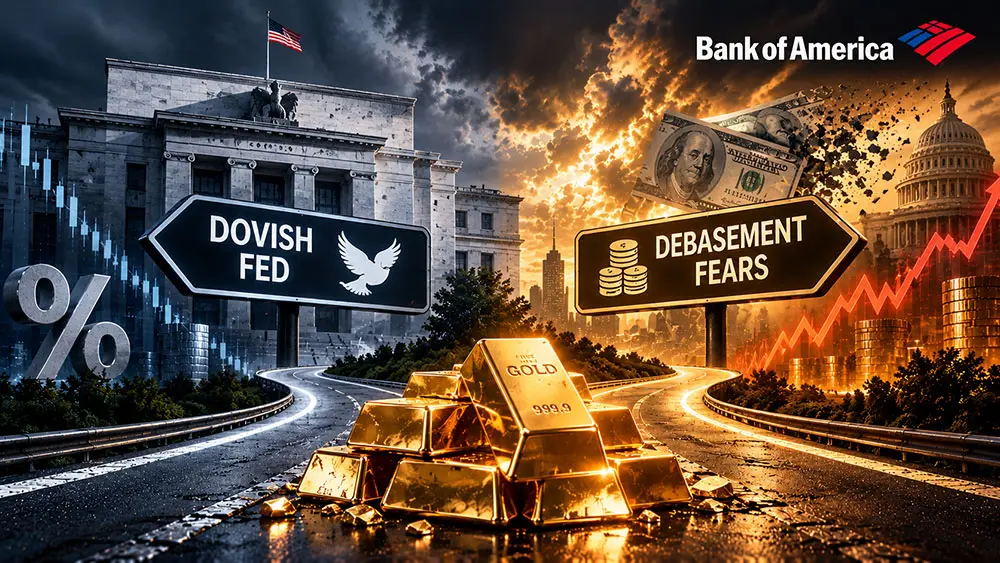
As for what it will take for gold prices to bottom and resume their long-term uptrend, the analysts said that the market needs clearer guidance from the Federal Reserve.
“Looking at correlations, causalities and Principal Component Analysis, gold rallied alongside equities when the market was not concerned about rising rates. Yet, when the Fed turned hawkish, inflation rose and the dollar appreciated, the yellow metal came under substantial pressure. The takeaway: gold will in all likelihood only bottom out once concerns over inflation/the Iran war subside, USD stops appreciating, and the Fed is no longer in a tightening cycle,” the analysts said.
Although a dovish shift in monetary policy would be a more significant driver for gold, BofA said that the precious metal could also attract renewed bullish momentum if currency debasement fears pick up again.
“Even though the US fiscal deficit is much discussed in the gold market, a higher term premia alone has usually not been bullish gold. As such, if fiscal policy does not become more orthodox, we believe an end to the hiking cycle, or even more powerful, a return to concern over fiscal repression would be the more significant drivers. If the Treasury intervened in the bond market, financed that by issuing short-term debt and the Fed then made sure that short-date rates remained low, this would in all likelihood reignite concerns over USD debasement - a very bullish scenario for gold,” the analysts said.
See live precious metals prices for gold, silver, platinum and palladium — in USD, CAD and 12 more currencies.

