
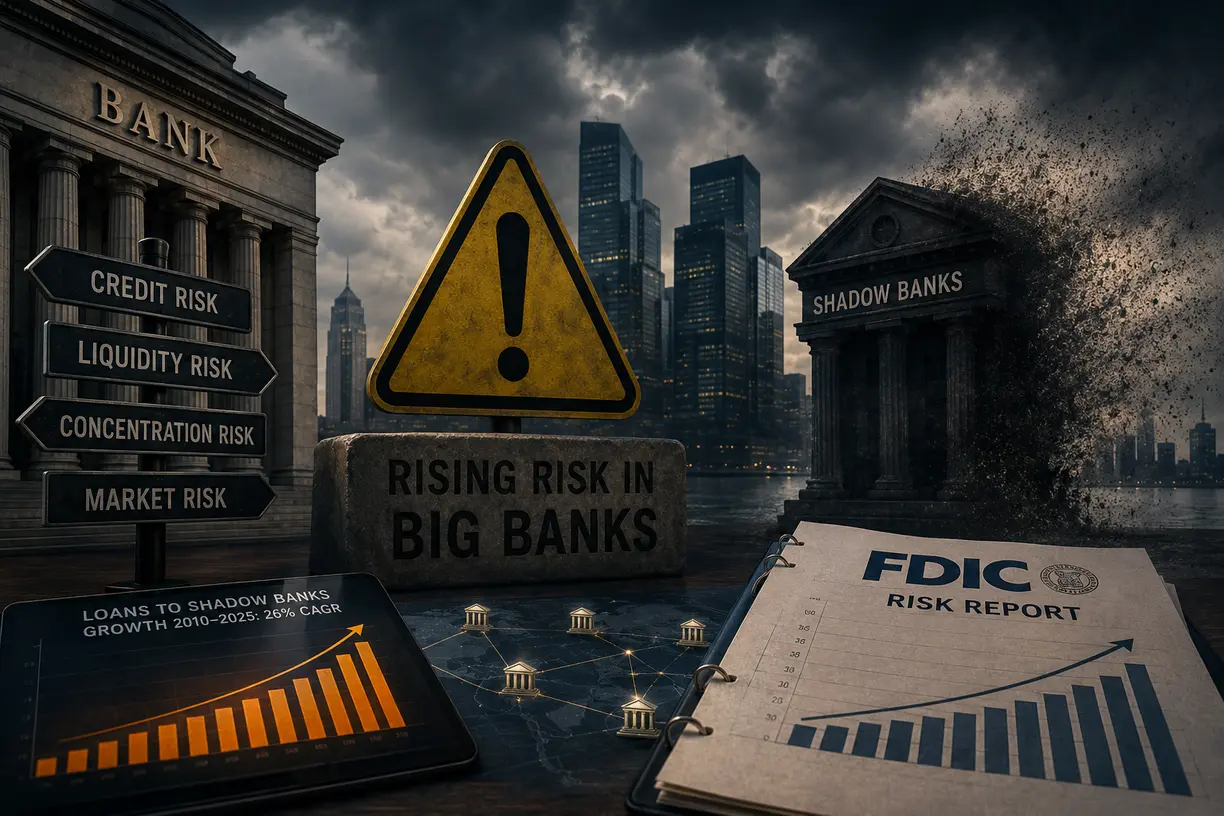
(Kitco Commentary) - Over the past twelve months, the Fed and other regulators have published multiple pieces highlighting major risks to the banking system - often in sharp contrast to what bank CEOs and large-banks analysts are saying.
But, we have clearly seen evidence suggesting that today’s banking environment is more dangerous than it was in 2007, with warnings about potential deposit runs tied to the CRE refinancing wall, very high delinquency rates in student loans, and growing stress in credit-card and auto lending.
The FDIC risk report, which was recently published, has also revealed several interesting findings that we plan to cover in upcoming articles.
In this article, we will discuss what the FDIC risk report says about shadow banks.
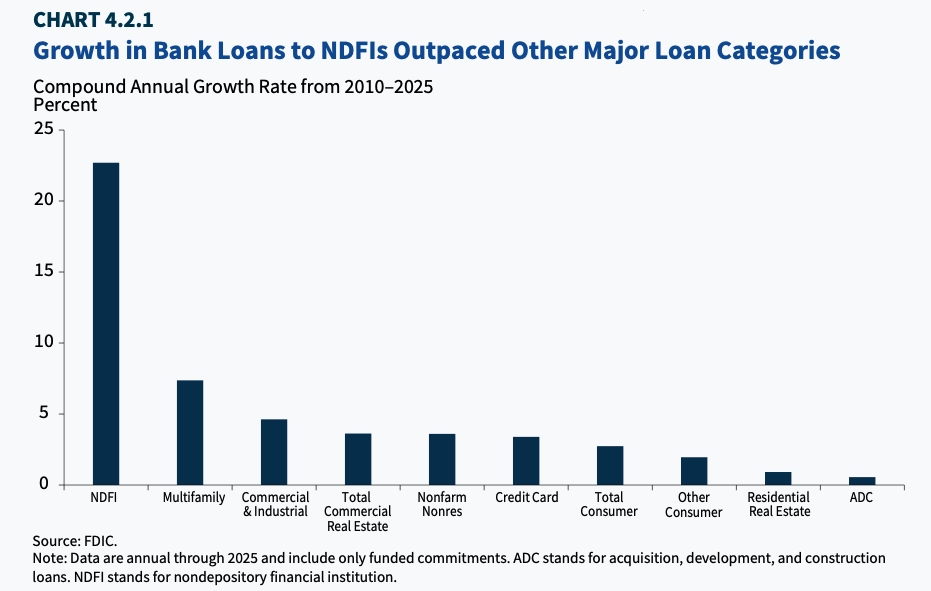
According to the report, bank lending to NDFIs, or shadow banks, has been the fastest-growing loan segment since the GFC, and the banking industry continues to increase its exposure to nonbanks. In 2025, these loans grew by 35% YoY, while the chart below shows the compound annual growth rate from 2010 to 2025. Since 2012, loans to shadow banks have grown by 26% per year, according to the St. Louis Fed. History suggests that such explosive growth has often preceded a crisis.
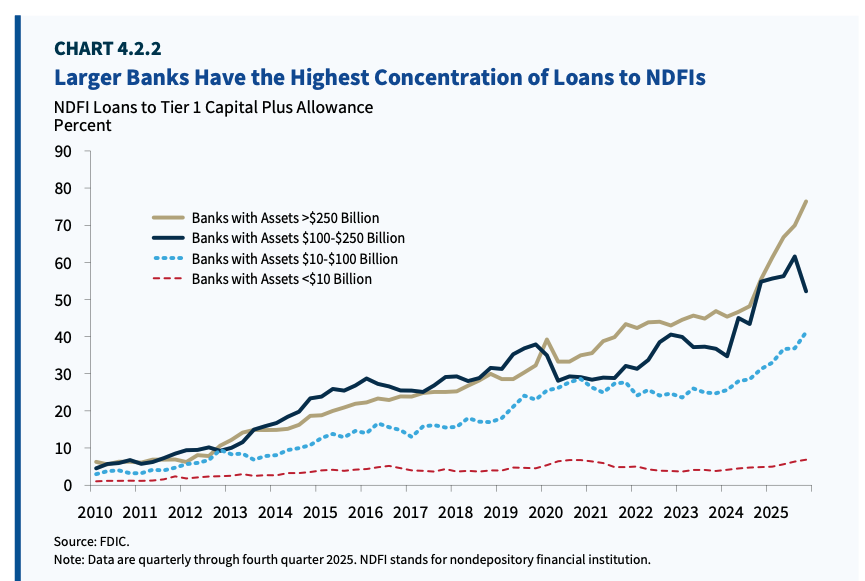
Unsurprisingly, loans to shadow banks are heavily concentrated among the largest banks. At year-end 2025, 86% of this portfolio was held by banks with more than $100B in assets, and ten of those banks held about 66% of all loans to shadow lenders.
The FDIC explicitly highlights the risk, noting that, in an economic downturn, shadow lenders may need to sell assets, putting downward pressure on asset values. This could affect the valuation of assets pledged as collateral or held by other shadow lenders and banks. NDFIs, or shadow banks, that rely on less stable funding sources could also face significant liquidity stress because of margin calls on collateral pledged under their bank facilities. This could increase liquidity demands on banks as NDFIs collectively draw on bank-funded credit lines to safeguard their operations, while individual NDFI borrowers may find themselves without access to funding.
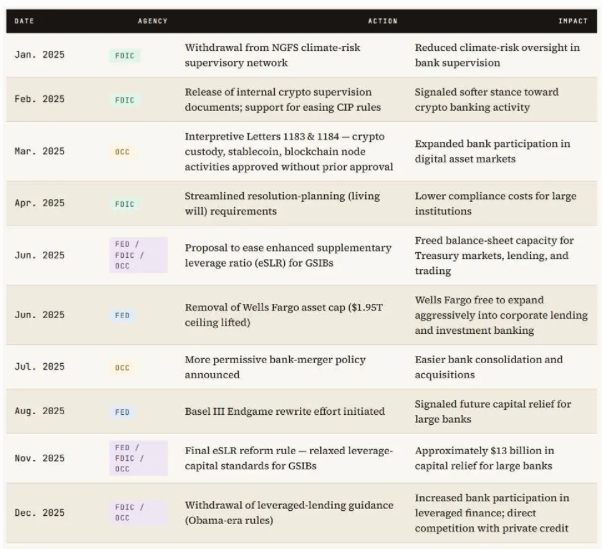
Why, then, is lending to shadow banks growing so rapidly? The most likely answer is that, because of limited regulation, these loans are extremely profitable for banks. Despite repeated warnings from regulators that shadow banking poses a key risk to global financial stability, banks - especially US banks - allocate relatively little capital when extending these loans. In fact, the broad deregulation of the US banking industry in 2025-2026 freed up a substantial amount of capital, much of which appears to have been directed toward shadow banks, as reflected in the 35% YoY growth rate.
Forbes recently published an extensive list of these deregulatory actions.
The rapid growth of bank lending to shadow lenders has created a large and increasingly concentrated source of risk within the financial system. These exposures may appear profitable in normal conditions, but in a downturn they could amplify liquidity stress, collateral losses, and funding pressure across both banks and nonbanks. With regulation becoming less restrictive, this risk deserves much closer attention.
Bottom line
Believe it or not, there are more major issues on the larger bank balance sheets as compared to smaller banks, which we have covered in past articles. Moreover, consider that there was one major issue which caused the GFC back in 2008, whereas today, we currently have many more large issues on bank balance sheets. These risk factors include major issues in commercial real estate, rising risks in consumer debt (approaching 2007 levels), underwater long-term securities, over-the-counter derivatives, high-risk shadow banking (the lending for which has exploded), and elevated default risk in commercial and industrial (C&I) lending. So, in our opinion, the current banking environment presents even greater risks than what we have seen during the 2008 GFC.
Almost all the banks that we have recommended to our clients are community banks, which do not have any of the issues we have been outlining over the last several years. Of course, we're not saying that all community banks are good. There are a lot of small community banks that are much weaker than larger banks. That’s why it's absolutely imperative to engage in a thorough due diligence to find a safer bank for your hard-earned money. And what we have found is that there are still some very solid and safe community banks with conservative business models.
So, I want to take this opportunity to remind you that we have reviewed many larger banks in our public articles. But I must warn you: The substance of that analysis is not looking too good for the future of the larger banks in the United States, and you can read about them in the prior articles we have written.
Moreover, if you believe that the banking issues have been addressed, I think that New York Community Bank is reminding us that we have likely only seen the tip of the iceberg. We were also able to identify the exact reasons in a public article which caused SVB to fail. And I can assure you that they have not been resolved. It's now only a matter of time before the rest of the market begins to take notice. By then, it will likely be too late for many bank deposit holders.
At the end of the day, we're speaking of protecting your hard-earned money. Therefore, it behooves you to engage in due diligence regarding the banks which currently house your money.
You have a responsibility to yourself and your family to make sure your money resides in only the safest of institutions. And if you're relying on the FDIC, I suggest you read our prior articles, which outline why such reliance will not be as prudent as you may believe in the coming years, with one of the main reasons being the banking industry’s desired move towards bail-ins. (And, if you do not know what a bail-in is, I suggest you read our prior articles.)
It's time for you to do a deep dive on the banks that house your hard-earned money in order to determine whether your bank is truly solid or not. You can feel free to review our due diligence methodology here.
Avi Gilburt is founder of ElliottWaveTrader.net and SaferBankingResearch.com.
