
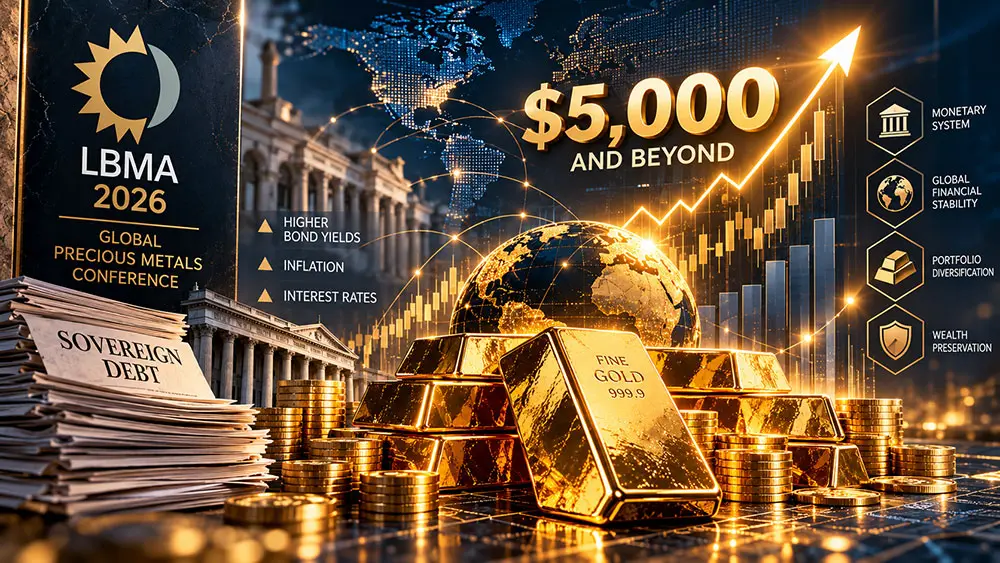
(Kitco News) - There is no denying that since early spring, gold has had a tough run. Rising bond yields and stubborn inflation, driving hawkish interest rate expectations, have made it difficult for the precious metal to attract any consistent momentum.
However, despite the challenges, long-term sentiment has been bullish, and has never wavered. This attitude was on display this week during the London Bullion Market Association’s annual Global Precious Metals Conference in Sorrento, Italy. Delegates and the broader investment community heard a clear message: don't confuse short-term weakness with a weak long-term story.
The conference delegates looking for gold prices to reach $5,000 by this time next year is an indication of just how bullish analysts are in the long term; however, it's not just the price we should be paying attention to. What stood out was the evolving role gold and precious metals continue to p[lay in the global financial system, and this evolution appears to be unfolding in a much faster and bigger way than many investors realize.
For decades, gold has mainly been viewed as a hedge against inflation, currency weakness, or geopolitical turmoil. Those factors still matter, but increasingly, investors are looking at gold through a different lens. It's becoming an asset that offers protection in a world where confidence in government finances and traditional monetary systems is starting to weaken.
One of the recurring themes throughout the conference was debt. Governments around the world continue to borrow heavily, and many investors are starting to question how sustainable this trend really is. Higher bond yields can create headwinds for gold in the short run, but they may also reflect growing concerns about the financial health of the governments issuing that debt.
Central banks in particular appear to be taking that view seriously. Gold has always been part of reserve portfolios, but its appeal today goes beyond its traditional safe-haven status. Unlike many financial assets, gold carries no counterparty risk. It can't default, and physical holdings cannot easily be frozen or restricted by another country.
In a world that is becoming more fragmented politically and economically, those characteristics matter.
Bundesbank President Joachim Nagel noted that gold now accounts for nearly a quarter of global central bank reserves. While much of that increase has come from higher prices rather than new buying, the broader trend is still telling. Central banks are not simply chasing performance. They're reassessing the role gold can play in a more uncertain geopolitical environment.
But it's not just demand that is evolving. The conference also looked at how technology and tokenization are creating more utility for gold as a global financial asset.
Digital platforms can potentially make gold easier to trade, transfer, and use as collateral; the metal would become more accessible and useful to a wider range of investors. There are still legitimate questions around regulation, custody, and trust, but the potential is difficult to ignore.
What the conference highlighted, however, is that gold's future may depend on forces much larger than the Federal Reserve's next rate decision.
Investors can argue about where gold should be priced today. The bigger question is whether the world is moving in a direction that makes gold increasingly valuable tomorrow.
