
JPMorgan cut its silver forecast to $60 to $65 in July, and the rest of Wall Street followed it down, but not one of those banks called the shortage over.
Silver trades near $58.24 an ounce as I write this, with the gold-silver ratio around 69. That ratio is the number of silver ounces it takes to buy one ounce of gold, and near 69 it sits close to the high end of its historical range, a level long-term buyers read as silver being inexpensive against the larger metal. Silver is up more than 50% from where it stood a year ago, yet it remains about 52% below the record of $121.62 set on January 29.
The Federal Reserve held its benchmark rate steady on July 29, its fifth consecutive hold, on a divided 9-to-3 vote. Silver did not rally on the news. It has not opened above $60 since July 8, held down by the same mix of a firm dollar, renewed Middle East tension, and questions about industrial demand that has defined the whole month. Into that soft tape came a run of analyst downgrades, and it would be easy to read a wave of bank price cuts as a sign the professionals had turned against silver.
I write the Silver Catalyst newsletter for Golden Meadow®, and one distinction I come back to constantly is the difference between a price call and a balance call. A price call is a bank's guess about where the quote goes over the next few months. A balance call is a statement about whether the world produces enough metal to meet demand. In July the banks cut the first and left the second essentially untouched, and confusing the two is the easiest way to misread what just happened.
The Cuts Came in a Cluster
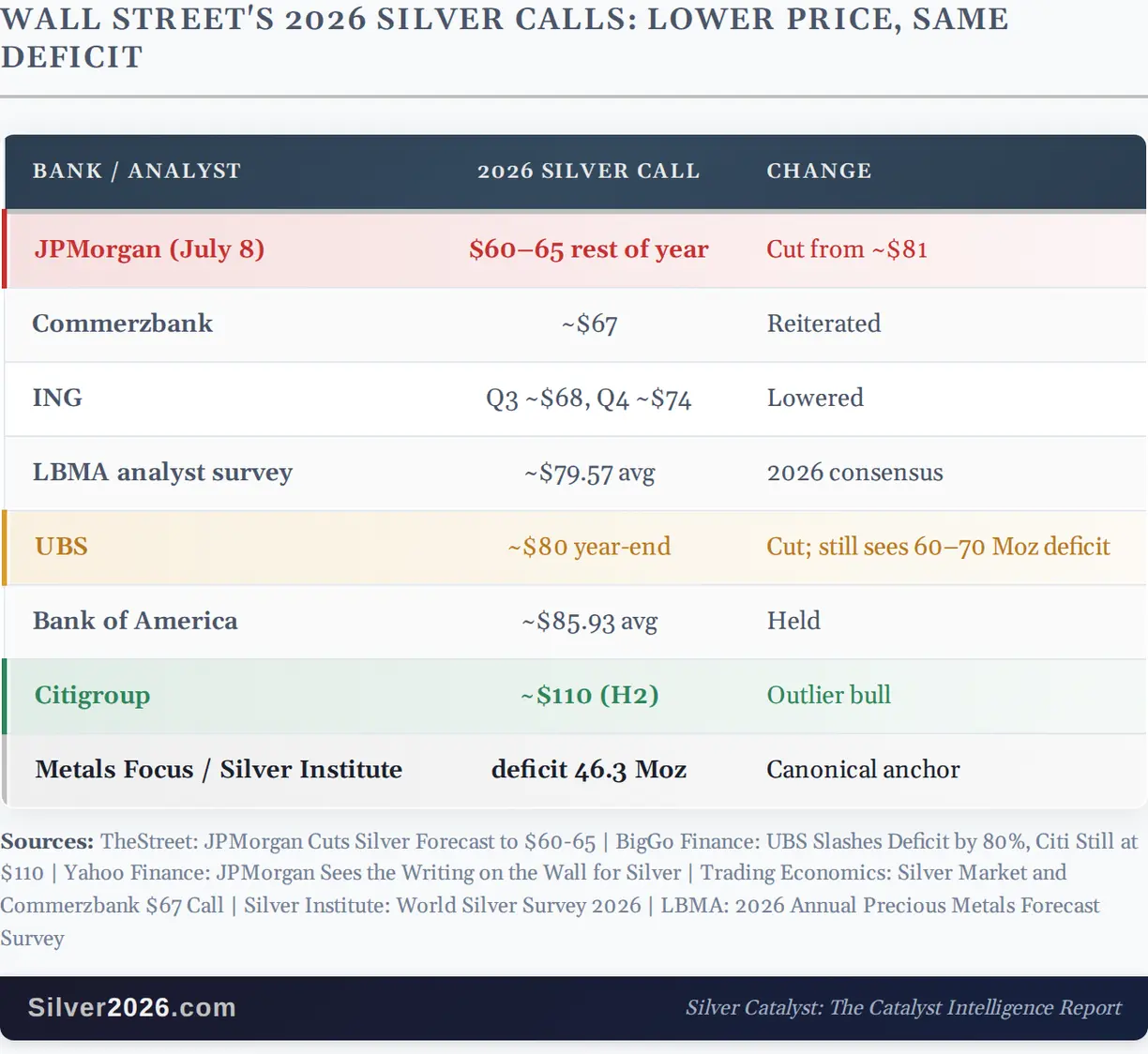
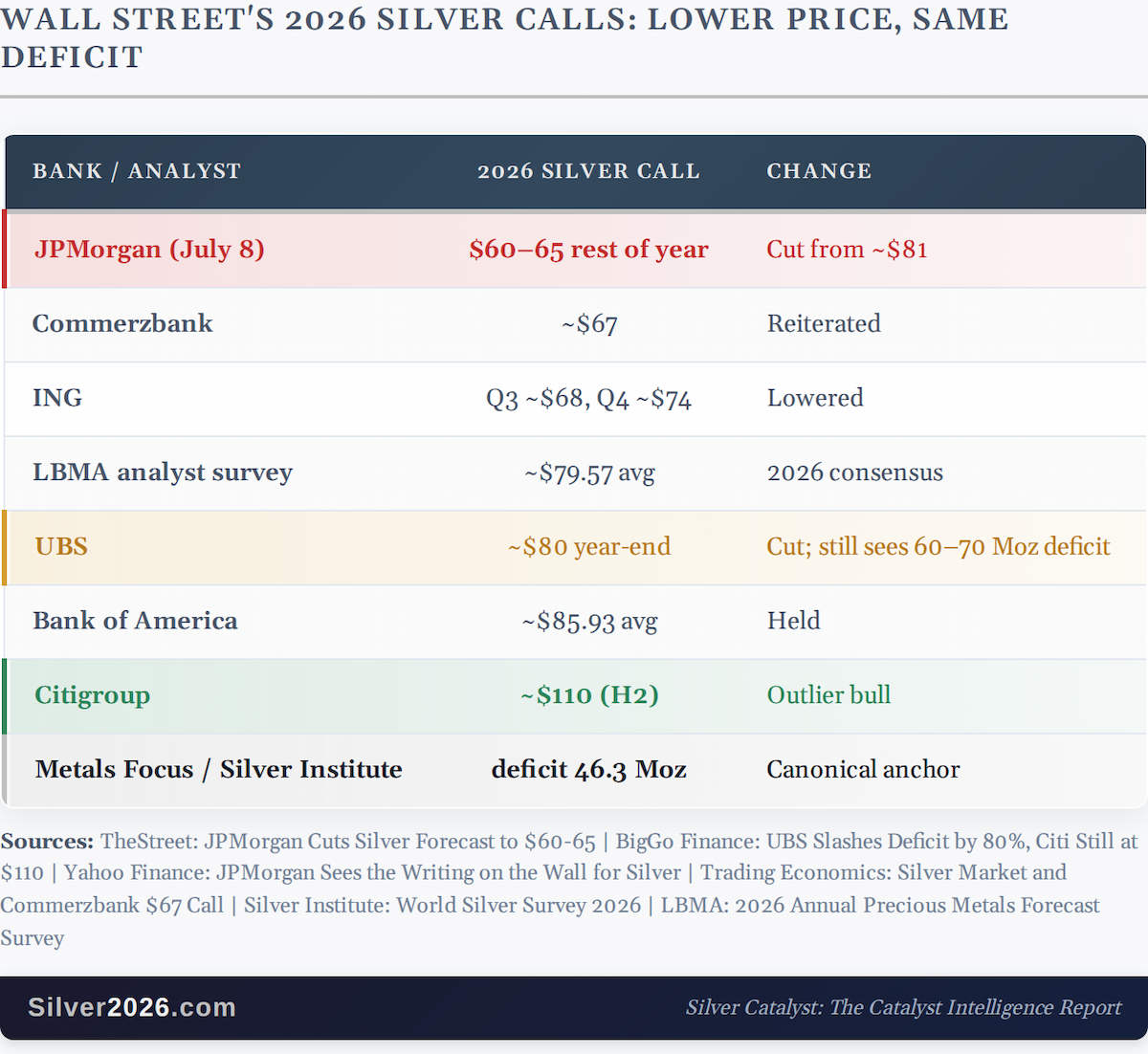
The headline landed on July 8, when JPMorgan cut its rest-of-year silver forecast to $60 to $65, down from an earlier call of about $81. Gregory Shearer, who runs base and precious-metals strategy at the bank, pointed to both engines of silver demand cooling at once: investor appetite had dried up after silver's sharp correction from its January record, and industrial demand was softening as high prices pushed manufacturers to use less. He named silverless solar technology as the largest long-term risk to the metal.
The other desks moved the same way. Earlier in the cycle, UBS had cut its 2026 supply-deficit estimate by about 80%, from roughly 300 million ounces down to 60 to 70 million, and trimmed its price targets across every horizon, settling on a year-end call near $80 and a base case that silver simply trades sideways. ING lowered its third and fourth quarter numbers on slower solar demand, higher yields, and a stronger dollar. Commerzbank, updating its view around the Fed meeting, reiterated a silver target of about $67. Put together, the message from the sell-side, the analysts at banks who publish these forecasts, was unmistakably lower.
Here is what those cuts are, and what they are not. They are reductions in price expectations, and in the UBS case a smaller deficit estimate. They are not a claim that the market has flipped into surplus. This is the detail that gets lost in the headlines. Even after UBS cut its deficit forecast by 80%, the number it landed on, 60 to 70 million ounces, still sits above the official 2026 shortfall of 46.3 million ounces from Metals Focus and the Silver Institute. The banks are converging down toward the official number, not away from it, and none of them has declared the shortage finished.
The dispersion that remains is striking on its own. The gap between the most bearish and most bullish calls on this list is roughly $50 an ounce, close to the current price of the metal itself. Citigroup still carries a second-half target near $110. Bank of America sits at a 2026 average of about $85.93. Goldman Sachs models $85 to $100 if industrial demand holds. The LBMA's annual analyst survey put the 2026 consensus at $79.57. That is the part worth pausing on: even after a month of cuts, the published consensus sits more than $20 above where silver actually trades today, and the current price of about $58 is below every single call in the table below, including the most bearish one.
Sources: TheStreet: JPMorgan Cuts Silver Forecast to $60-65 | BigGo Finance: UBS Slashes Deficit by 80%, Citi Still at $110 | Yahoo Finance: JPMorgan Sees the Writing on the Wall for Silver | Trading Economics: Silver Market and Commerzbank $67 Call | Silver Institute: World Silver Survey 2026 | LBMA: 2026 Annual Precious Metals Forecast Survey
Why a Target Cut Is Not a Thesis Change
The discipline the book insists on is simple: a lower price target is a bank marking its expectation to a market that already corrected, not a verdict on the physical balance.
When JPMorgan moves its number to $60 to $65, it is saying it expects the quote to stay soft for a few months. It is not saying the world will suddenly mine more silver than it consumes. Those are different claims resting on different evidence, and only the second one would actually break the long-term case. The physical balance did not change in July. Mine supply is still forecast essentially flat, demand still exceeds it, and the market still runs its sixth consecutive annual deficit.
There is also history worth remembering here. Banks have spent this cycle chasing silver rather than leading it. The same catalyst that tracks these targets was built around a specific pattern: one major institution carried a $38 silver target for late 2025 and then had to raise it repeatedly as the metal climbed past it. A mid-cycle cut after a sharp correction fits that track record rather than breaking it. Sell-side targets tend to follow the price, lowered after a fall and raised after a rally, which is precisely why they describe where the metal has been better than where it is going.
None of this means the bears have no case. They do, and it deserves stating plainly. Investment demand really did weaken after January, ETF holdings have fallen, and solar manufacturers really are engineering silver out of each panel as fast as they can. UBS trimming its deficit estimate so hard is a genuine narrowing of the scarcity story, not a rounding error. The honest version of the bull case has to carry that weight rather than wave it away.
What This Means to Silver Investors
The practical takeaway is to separate the two claims the way the banks themselves do, even when the headlines blur them.
A price-target cut tells you a bank thinks the next few months look soft. It tells you almost nothing about whether the world is running short of silver, and on that second question the same banks are still, to a firm, describing a deficit. The most bearish 2026 deficit estimate on Wall Street is larger than the official one. The published analyst consensus sits well above the current price. And silver today trades below every target on the list, bearish and bullish alike. Those facts can all be true at once, and together they describe a market where sentiment has turned cautious while the physical shortage the cautious sentiment is reacting to has not gone anywhere.
That gap between mood and metal is the whole point. The longer-term case for silver rests on a supply-and-demand balance that runs a deficit for a sixth consecutive year in 2026, and a deficit means the world consumes more silver than it mines and recycles, covering the difference from stockpiles that are not endless. A round of price-target cuts does not add an ounce to those stockpiles. If you follow how silver has traded in 2026, the pattern is that the price swings on the Fed, the dollar, and oil from week to week, while the shortage grinds on underneath, indifferent to the forecast revisions layered on top of it.
Next week's price will keep taking its cues from the macro headlines, and it may stay soft for a while, exactly as the sell-side now expects. The structural question is the slower one, and on that question the July downgrades changed the mood without changing the math. That is the distinction the framework in Silver Rising is built to hold steady, separating what the banks think the price will do from what the balance sheet says the market actually is.
The sell-side's July capitulation is one dimension of the 100-catalyst framework I analyze in Silver Rising, alongside the five other Deep Dives in this issue of the Silver Catalyst newsletter. If you've at least considered investing in silver, I strongly encourage you to sign up, because it takes just $1 to get both. Get full Silver Catalyst Newsletter and Silver Rising book for $1 today.
Thank you.
