

(Kitco NewsWire) - Spot gold and silver prices were sharply higher in late U.S. trading Monday, supported by a weaker U.S. dollar and a steep decline in crude oil prices as investors responded to renewed hopes for a diplomatic resolution to the U.S.-Iran conflict. The retreat in energy prices eased some inflation concerns ahead of Tuesday's U.S. consumer price index report, although Friday's stronger-than-expected employment figures continued to support expectations for another Federal Reserve interest rate increase in December. A broad recovery in North American and European equity markets also reflected improving investor sentiment following last week's technology-led selloff. Spot gold was trading near $4,140.40 an ounce, up $69.40, or 1.70%, while spot silver was trading near $53.320, up $1.350, or 2.60%.
Gold extended its recovery following last week's sharp fluctuations, when Democrats' victories in the U.S. midterm elections initially drove Treasury yields and the dollar lower before stronger employment data revived expectations for additional Federal Reserve tightening. Monday's decline in crude oil prices helped offset some of those monetary policy concerns, while the softer dollar improved the relative attractiveness of precious metals. Silver outperformed gold as the recovery in broader financial markets encouraged renewed buying interest.
The latest U.S. economic reports continue to indicate resilient labor-market conditions despite elevated borrowing costs and recent volatility in technology shares. Friday's October nonfarm payrolls report showed an increase of 165,000 jobs, substantially exceeding expectations for approximately 65,000. The unemployment rate declined to 4.1% from 4.2%, while average hourly earnings increased 0.4% on the month and 3.1% annually. August and September payroll figures were revised upward by a combined 84,000 jobs, reinforcing evidence that employment conditions remain stronger than previously estimated. The figures increased expectations that the Fed could raise interest rates again in December, even as financial-market volatility and declining energy prices complicate the inflation outlook.
Market positioning remains focused on Tuesday's October consumer price index report and the Federal Reserve's Dec. 8-9 policy meeting. Interest rate futures indicated approximately an 82.2% probability of a 25-basis-point rate increase in December in Monday's afternoon market assessment. That follows Friday's stronger employment figures, which reinforced expectations that the central bank will prioritize persistent inflation over concerns about slowing economic activity. The benchmark 10-year Treasury yield was trading near 4.86% in afternoon dealings, while the more policy-sensitive two-year yield was near 4.55%. Both remained elevated despite the decline in crude oil prices, reflecting continued uncertainty about the inflation outlook and future monetary policy.
The U.S. dollar weakened Monday after Friday's strong rally, providing additional support for gold and silver. The dollar index declined approximately 0.3% toward 101.88 during the session, as improving equity-market sentiment and reduced concerns about an immediate escalation involving Iran encouraged investors to reduce some defensive currency positions. However, the dollar's retreat remained limited by expectations for higher U.S. interest rates. The combination of falling energy prices, elevated Treasury yields and a softer dollar highlights the competing influences shaping precious metals positioning ahead of Tuesday's inflation figures.
The Labor Department will release the October consumer price index Tuesday at 8:30 a.m. EST. Economists expect headline consumer prices to increase approximately 0.3% on the month, following a 0.6% rise in September. Investors will pay particular attention to core inflation, which excludes food and energy, for evidence that underlying price pressures are moderating. A softer-than-expected report could reduce December rate increase expectations and push Treasury yields and the dollar lower, providing additional support for gold. Conversely, stronger inflation would reinforce the implications of Friday's employment surprise and could trigger renewed selling in precious metals as traders increase expectations for further tightening.
The week's remaining economic calendar includes Thursday's weekly initial jobless claims report at 8:30 a.m. EST and Friday's October producer price index at 8:30 a.m. EST. Federal Reserve officials are also expected to provide further commentary on inflation and labor-market developments. U.S. Treasury markets will be closed Wednesday for Veterans Day, while stock markets remain open. Investors will also monitor Treasury auctions and corporate earnings for indications of demand for government debt and the outlook for technology-sector investment. Continued volatility in artificial intelligence-related equities could encourage defensive demand for gold, although higher yields or broader portfolio liquidation remain potential constraints.
The Strait of Hormuz and U.S.-Iran situation remained a major influence on global commodity markets Monday as President Donald Trump downplayed the possibility of renewed large-scale military strikes against Iran while negotiations toward a settlement continue. His comments encouraged traders to reduce the geopolitical risk premium embedded in crude oil prices, extending the steep losses recorded during the previous week. However, the prospect of a diplomatic settlement remains uncertain, with both Washington and Tehran continuing to report attacks involving shipping in or near the strategic waterway.
Crude oil prices plunged Monday as traders increasingly considered the possibility of reduced military tensions and improved petroleum shipments. Brent crude futures settled down $5.75, or 5.85%, at $92.57 a barrel, while Nymex WTI crude futures declined $3.98, or 4.38%, to settle at $86.85. Both benchmarks extended their losses in post-settlement trading, with Brent falling more than $7 a barrel at one point and reaching its lowest level since late August. The decline followed a roughly 16% weekly loss in Brent, reflecting the rapid removal of some of the geopolitical risk premium accumulated during the conflict.
For gold, lower energy prices have reduced some inflation concerns and encouraged expectations that the Federal Reserve may have less reason to maintain an extended tightening cycle. However, the immediate outlook remains complicated by resilient employment, persistent underlying inflation and elevated Treasury yields. The continuing uncertainty surrounding the Strait of Hormuz also supports underlying defensive demand, even as the prospect of diplomatic progress reduces the urgency of geopolitical hedging. Silver has benefited from the broader recovery in precious metals, although its industrial exposure leaves it sensitive to manufacturing demand, financing conditions and the direction of global economic activity.
North American equity markets rallied sharply Monday as falling crude oil prices, improving risk sentiment and renewed buying in technology shares helped markets recover from last week's steep losses. The Dow Jones Industrial Average surged 1,104.02 points, or 2.15%, to close at 52,389.75. The S&P 500 advanced 173.08 points, or 2.35%, to finish at 7,549.94, while the Nasdaq Composite gained 673.71 points, or 2.74%, to close at 25,253.14. The Russell 2000 outperformed the major benchmarks, climbing 86.71 points, or 3.15%, to 2,840.81. Monday's advance marked the strongest overall U.S. equity session since April, as investors reassessed the implications of lower energy costs for inflation, corporate profitability and interest rates.
Canada's S&P/TSX Composite Index also finished sharply higher Monday, advancing approximately 1.84% to around 36,450, supported by gains in mining, financial and industrial shares. Precious metals producers benefited from firmer bullion prices, while banks and other economically sensitive companies participated in the broader North American equity recovery. Energy shares underperformed as crude oil prices declined. Barrick Mining gained approximately 4.5% following its quarterly earnings announcement, while Greenfire Resources surged after Strathcona Resources announced plans to acquire the company. The advance extended Friday's recovery, when the Canadian benchmark gained 0.52% to close at 35,789.09.
European equity markets also closed firmly higher Monday as lower energy prices, stronger bank earnings and renewed buying in technology shares supported a broad-based recovery. The pan-European Stoxx 600 gained 1.26% to close at 656.52, while Germany's DAX advanced 1.73% to 26,267.19. France's CAC 40 rose 1.16% to 8,233.30, and the U.K.'s FTSE 100 climbed 1.02% to 10,782.87. Spain's IBEX 35 increased 1.93% to 19,742.50, while Italy's FTSE MIB led the major European benchmarks with a 2.69% gain to 51,399.88.
The key outside markets see Nymex WTI crude oil futures sharply lower after settling at $86.85 a barrel, while Brent crude futures finished at $92.57 and continued declining after settlement. The benchmark 10-year U.S. Treasury yield was trading near 4.86%, while the two-year yield remained around 4.55%. The U.S. dollar index weakened toward 101.88, providing support for precious metals despite continued expectations for another Federal Reserve interest rate increase in December. (Kitco Global Index shows how much of today's gold move is the dollar versus the gold market itself.)
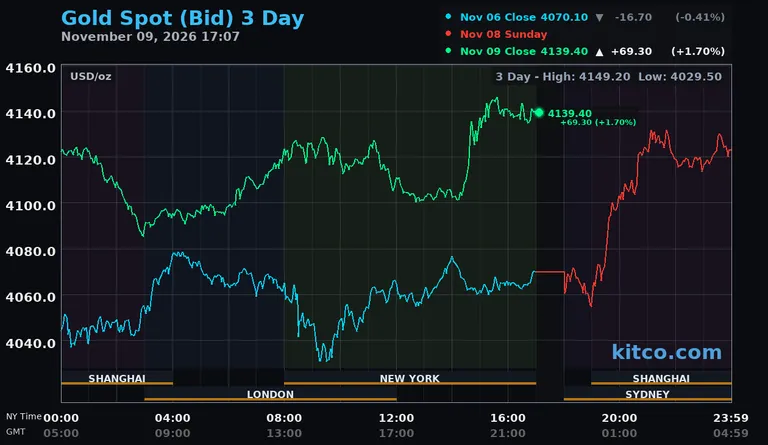
Technically, spot gold bulls' next upside price objective is to push prices through the $4,147.62 resistance level, with a sustained four-hour close above that area and the descending trendline targeting $4,200.09. A successful breakout could bring the broader $4,250.00 resistance area into focus. Bears' next near-term downside price objective is a break below $4,088.51, with deeper downside targets at $4,051.45 and then $4,000.00. First resistance is seen at $4,147.62 and then at $4,200.09. First support is seen at $4,088.51 and then at $4,051.45.
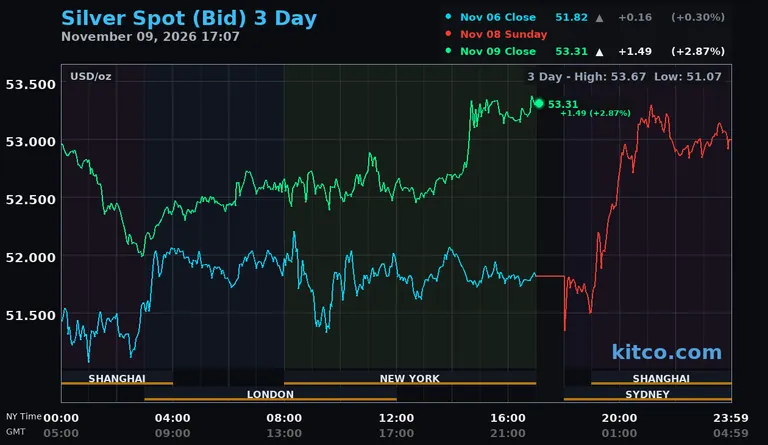
Spot silver bulls' next upside price objective is to sustain the recovery above the previously established $53.107 resistance level and drive prices toward $54.617, with a further breakout targeting $55.000 and then the broader $56.000 to $57.000 resistance area. The next downside price objective for the bears is a break below $51.153, with a deeper downside target at $49.989. First resistance is seen at $54.617 and then at $55.000. Next support is seen at $53.107 and then at $51.153.
See live precious metals prices for gold, silver, platinum and palladium — in USD, CAD and 12 more currencies.

