
Gold has corrected sharply after its best two-year run in decades, but the secular bull market remains in place. To understand where Gold stands today and where it could go next, it helps to focus on the structural forces driving the secular bull market.
The first and most important pillar is the coming secular bear market in stocks. This is the most reliable historical signal, yet it still has transpired yet. Secular trends in stocks and Gold, or hard assets more broadly, can overlap around important turning points, as they did in the late 1940s, the mid to late 1960s, and again today. Even so, history shows that the biggest long-term advances in Gold and hard assets tend to follow the end of secular bull markets in equities.
The pattern is difficult to ignore. The stock market peaked in 1929, while gold stocks peaked eight years later. Stocks peaked again in 1968, and precious metals and hard assets peaked more than 11 years later. Stocks then peaked in 2000, and precious metals and hard assets again peaked roughly 11 years later. The stock market is yet to hit its secular peak which means the secular bull market in Gold and hard assets remains in the early innings.
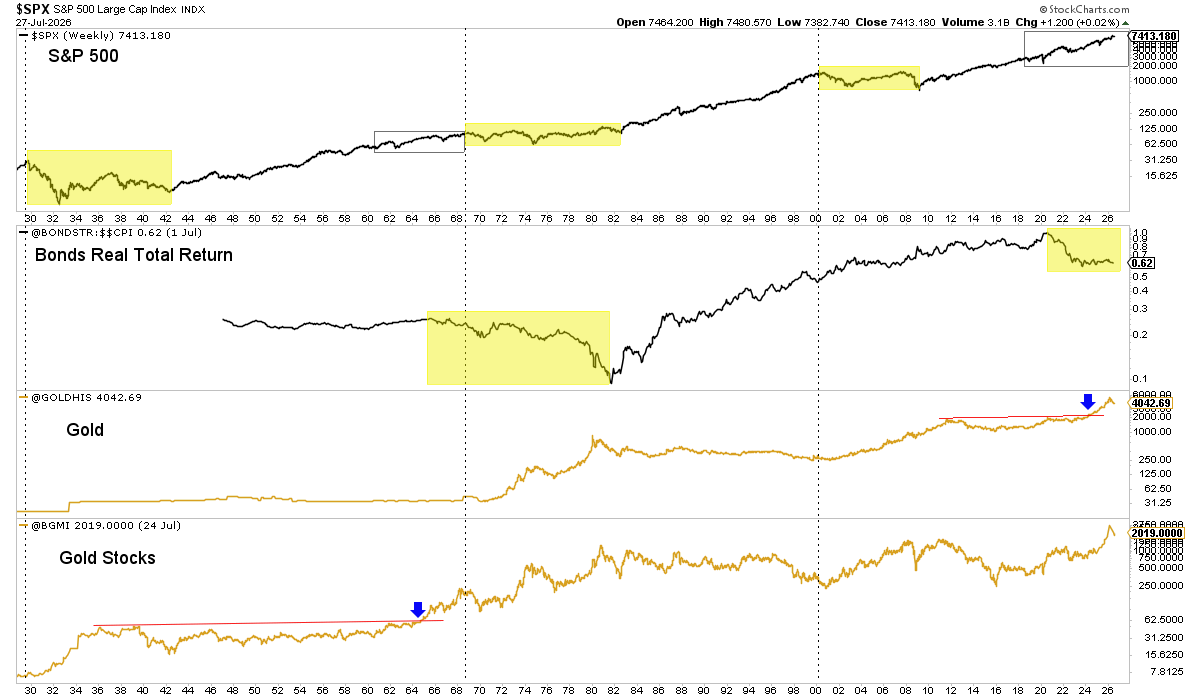
1B to the first pillar is the secular bear market in bonds, which began after Covid and has already started to take shape, much as it did in the mid to late 1960s. A secular bear market in bonds initially pushes capital toward equities, but it also supports Gold and other hard assets. Over time, however, a prolonged bear market in bonds will undermine stocks.
That is what happened at the end of the 1960s, and it could happen again in the near future. This is the key inflection point for Gold. It marks the stage when capital begins to accelerate out of stocks and into Gold and hard assets. That moment is still ahead of us, but it is a critical part of the long-term setup.
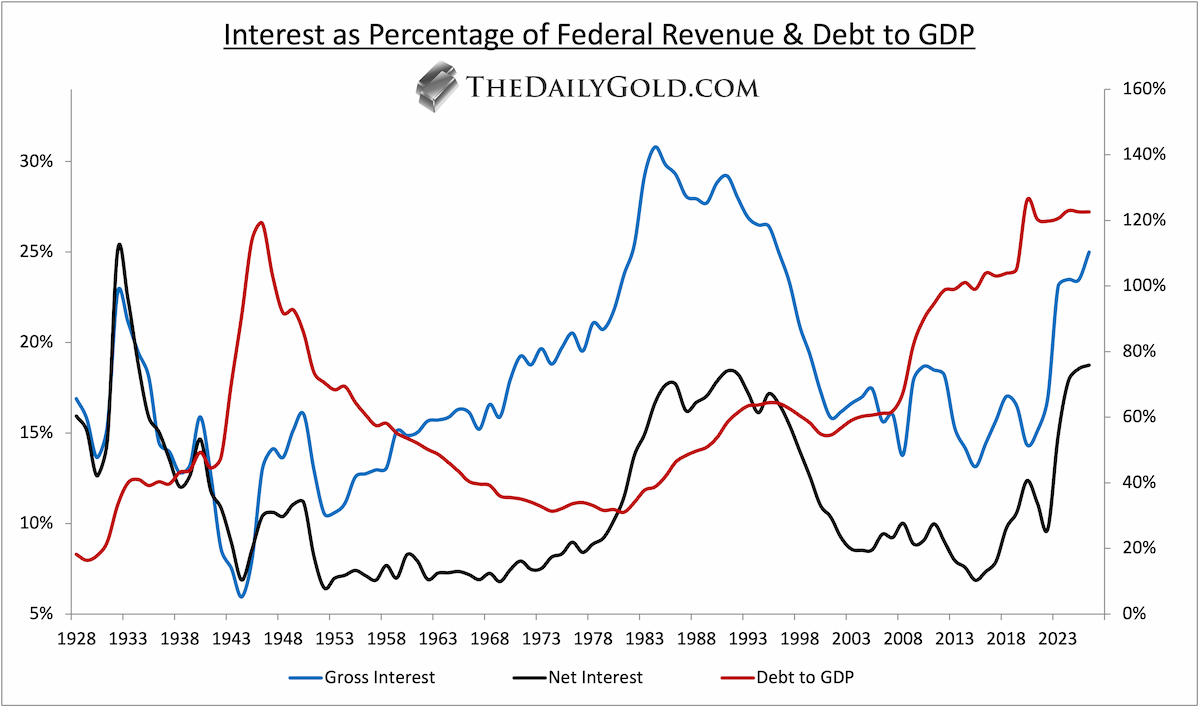
The third pillar is the deterioration of U.S. public finances. The secular bear market in bonds feeds directly into this pillar, because debt problems do not emerge in isolation from the bond market. The central issue is straightforward: Debt to GDP has to come down, and the most likely path is through inflation primarily and growth.
History offers several useful comparisons. In the 1930s, interest payments were high, but Debt to GDP was extremely low. Lower rates helped reduce interest payments and fund the war effort. By the late 1940s, Debt to GDP was high, but interest payments were low. The Fed implemented yield curve control in 1942, and Debt to GDP finally turned lower after 1947. The cost was significant inflation in the 1940s. In the late 1980s and early 1990s, interest payments were extremely high, but Debt to GDP was still very low. A combination of falling interest rates, tighter fiscal policy, and a technology boom helped resolve that imbalance.
Today, the situation is far more difficult. Everything is at an extreme and bonds are in a secular bear market. Debt to GDP is extreme, interest payments are extreme, and interest on the debt is still relatively low, averaging just 3.4 percent. Meaningfully higher rates would push interest payments even higher and add to the debt burden. That is why yield curve control is the most likely policy response, fixing yields at low levels while inflation and nominal growth gradually force Debt to GDP lower.
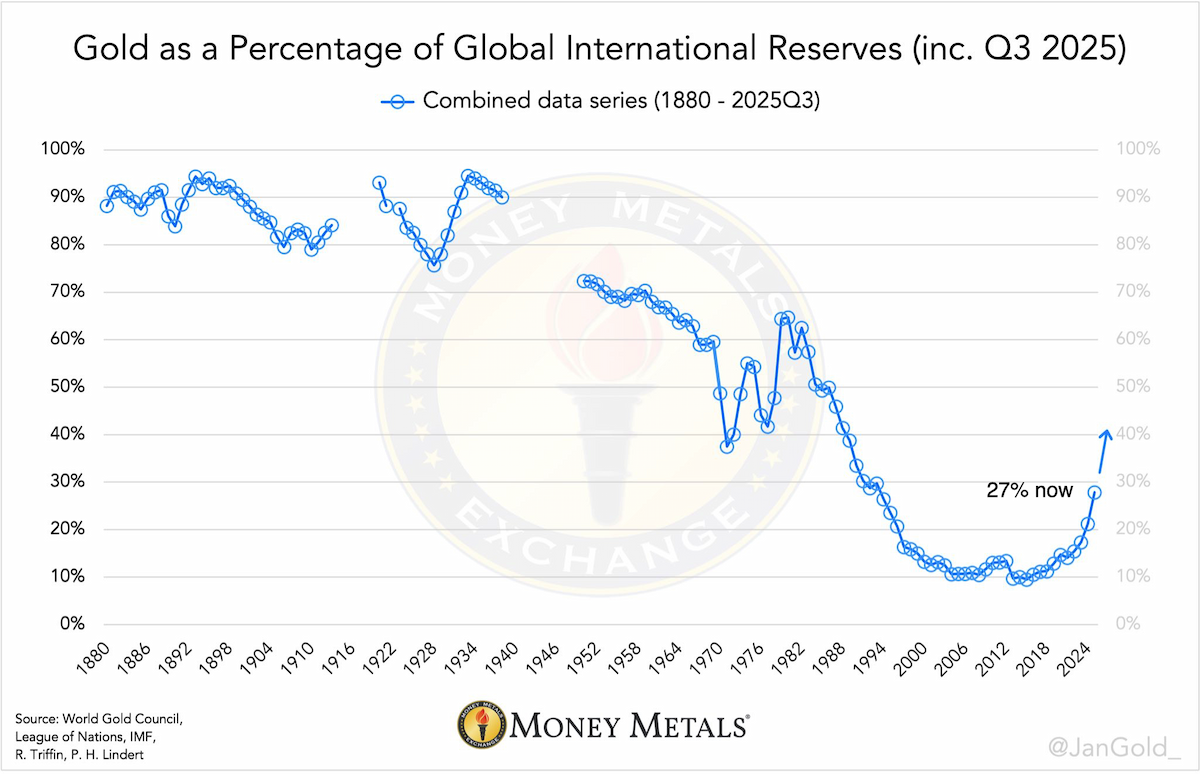
The final pillar is Central Bank demand for Gold. Central Banks see the larger backdrop clearly: rising U.S. debt, a secular bear market in bonds, and a shift toward a more multi-polar world. In response, they are increasing their Gold reserves.
From 1960 to 1990, Gold as a percentage of reserves ranged from 40 percent to 65 percent. Around the 1980 peak, it stood near 65 percent. Based on the latest reporting, that figure is only 27 percent today. Central Bank buying played an important role in the 2018 and 2022 bottoms in Gold. Their continued buying may be helping build a floor under the market now.
These pillars are not isolated. They reinforce one another. The secular bear market in bonds worsens the U.S. fiscal outlook, which in turn encourages more Central Bank demand for Gold. The major big-picture catalyst will come when the bond bear market spills over into equities and triggers a secular bear market in stocks. When that happens, a much larger rotation of capital into Gold is likely to follow. To learn the stocks we own and intend to buy with 5x to 10x potential, consider learning more about our premium service.
