
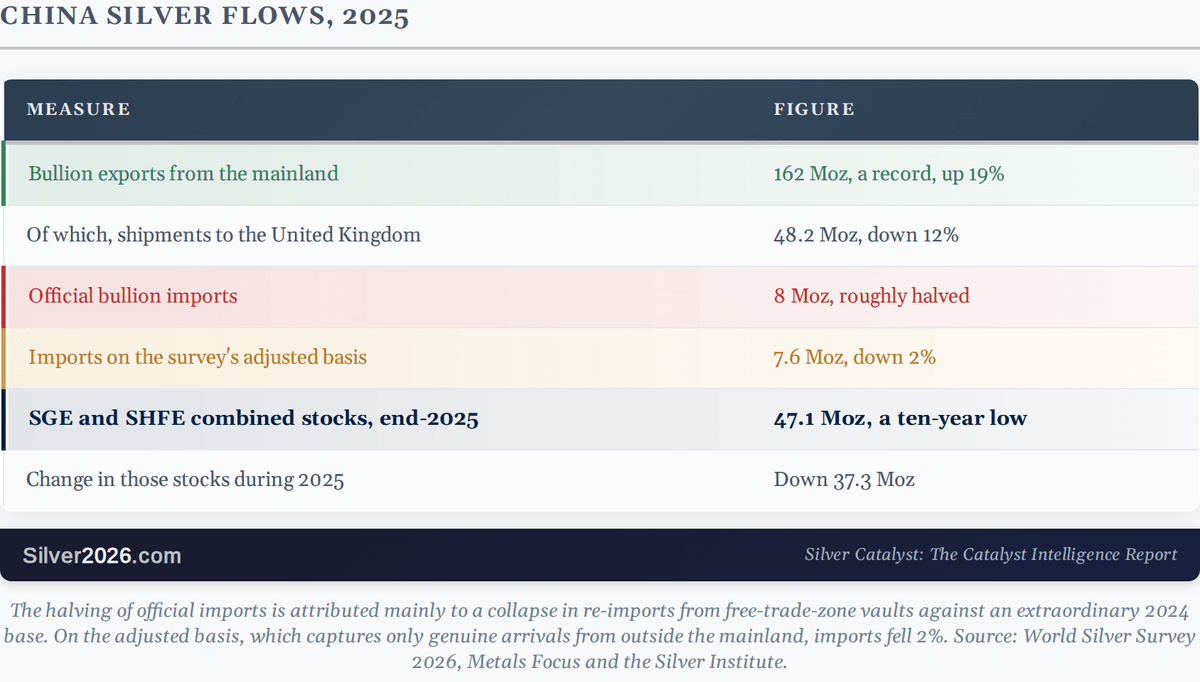
China exported a record 162 million ounces of silver last year while importing almost none, which is not what a country short of metal does.
Both halves of that are true at once, and the reason is a tax. Silver sells for meaningfully more in China than in London or New York, yet the metal moves west. The levy that creates the gap applies to bullion coming in and not to bullion going out. Once you see that, the Shanghai premium stops working as the demand signal it is usually taken for.
Silver traded at $66.10 an ounce on September 9, up 4% over the past month and down 7.3% since the start of the year. That leaves it roughly 46% below the intraday high of $121.58 set on January 29. The metal has spent September taking its cues from the rate outlook, with a September 16 Federal Reserve decision ahead and consumer price data due this week. For the wider market picture, Golden Meadow® publishes ongoing analysis, and you can see how silver has traded this year alongside it.
One metal, three prices
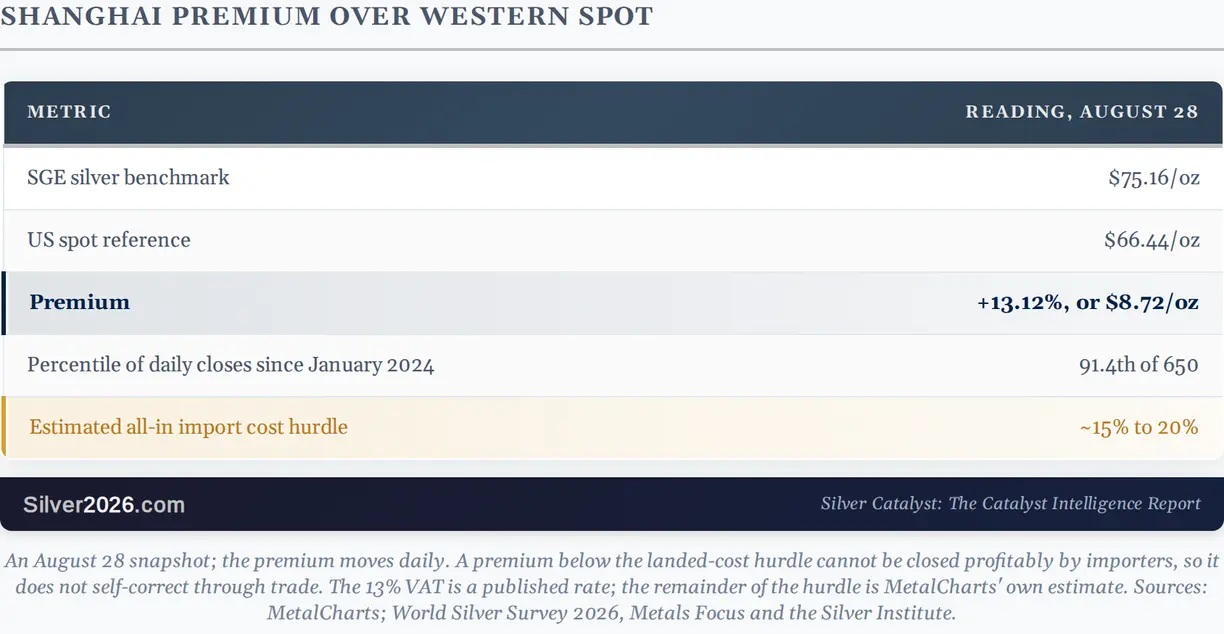
Silver is a global commodity with a single benchmark price, in theory. In practice it trades in three zones. London and New York set the Western reference, which was $66.44 at the end of August. The Shanghai Gold Exchange benchmark closed the same day at $75.16, a gap of $8.72 an ounce. Indian domestic prices sit behind a 15% import duty. Ordinary arbitrage has closed neither gap.
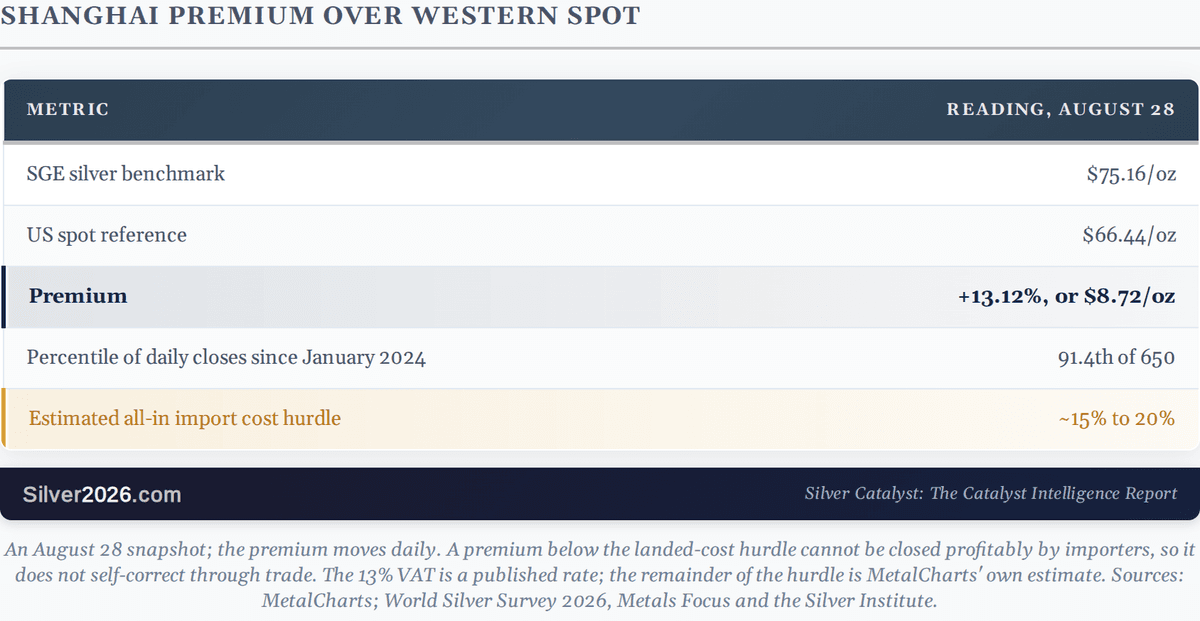
Sources: MetalCharts Shanghai premium, August 28 close | World Silver Survey 2026, Metals Focus and the Silver Institute
Those figures are an August 28 snapshot. The premium moves daily, so the level will have shifted since.
Tax and licensing hold those gaps open, not distance or shipping cost.
Why the premium does not pull metal east
A premium is normally a pull. If a metal is dearer in one place, traders ship it there until the gap closes, and that is how a single world price gets enforced.
The Chinese tax structure blocks that, and it does so in one direction only. Metals Focus and the Silver Institute describe the mechanism: a refinery importing base metal concentrate pays no import value added tax on the silver content, provided the refined bullion is re-exported, while 13% is levied on the total value otherwise.
The consequence follows directly, and it runs both ways. Bringing refined bars into China to sell domestically carries the tax. Bringing ore in and shipping refined bars back out carries none.
So the rule does two things at once. It keeps foreign bullion out of the domestic market, and it rewards sending domestically refined metal abroad. The survey notes that this import activity is often conducted through processing trades precisely to capture the exemption. Metal that would otherwise be available to Chinese buyers is being pulled out of the country by a tax incentive, which leaves less behind and supports a higher local price.
Add licence premiums, freight and insurance to that 13% and the all-in cost of landing bullion in China runs roughly 15% to 20% above pre-VAT global spot, on MetalCharts' stated methodology. The 13% is a published rate. The remaining two to seven points are that provider's estimate rather than a disclosed calculation, and the argument here leans on them.
The headline premium is a clean pre-VAT comparison. At 13.12% it sits below the cost of getting bullion in.
That inverts the usual conclusion. A premium above the import hurdle is self-correcting, because traders close it for profit. A premium below the hurdle can persist for as long as the tax does. What a 13.12% premium describes is a domestic price that imported bullion does not reach, because reaching it loses money. Whether that gap reflects genuine scarcity or mostly the tax itself is the harder question, and the flow data below narrows it.
What China actually does with silver
Sources: World Silver Survey 2026, Metals Focus and the Silver Institute
The survey states that China has traditionally been a net exporter of silver because of structural oversupply at home, fed by refined metal recovered from imported concentrate and by domestic byproduct mines whose silver output ranks second in the world.
So the West can reach Chinese silver. China remains the largest supplier to the United Kingdom. Metal leaves China in quantity, and it leaves under the same tax rule that keeps bullion from coming in.
The headline import figure overstates the change. Official bullion imports halved in 2025 to 8 Moz, but the survey attributes that mainly to a collapse in re-imports from free-trade-zone vaults against an extraordinary 2024 base rather than to a shift in behaviour. Strip those out, as Metals Focus does to capture only genuine arrivals from outside the mainland, and imports fell 2%, to 7.6 Moz.
Imports were already negligible before they halved. Roughly 7.6 million ounces went in last year against 162 million going out, a ratio of about one to twenty.
Meanwhile the domestic pool drained. Combined Shanghai Gold Exchange and Shanghai Futures Exchange holdings fell 37.3 Moz during 2025 to 47.1 Moz, a ten-year low.
The survey attributes that fall partly to the strong outflows rather than to domestic buying. That qualifier limits what the drawdown can be used to show. It is not proof that Chinese demand is running hot. What it does establish is that the visible domestic pool ended the year 44% smaller than it started, in a market where imported bullion is priced out of refilling it. I track that drawdown issue by issue in the Silver Catalyst, because the direction matters more than any single month's reading.
India runs the same play with different plumbing
India built its wall on the import side rather than through a consumption tax. On May 13 it raised bullion import duties from 6% to 15%, and four days later moved silver bars of 99% purity and above into the restricted category, requiring a licence.
The effect was immediate. May imports came in at 46.8 tonnes against 534.3 tonnes in May 2025, a fall of 91.2%, leaving a gap of 487.5 tonnes. That is 15.67 million ounces absent from one of the world's largest physical silver markets in a single month.
Imports have restarted slowly. Roughly 89.81 tonnes arrived in August through the India International Bullion Exchange, against approximately 400 tonnes of approved licences, with year-to-date imports running 16% below last year.
One measurement point recurs here, and I have got it wrong myself in the past. Indian premiums are quoted over official domestic prices, which already embed the 15% duty and a 3% sales levy. They sit on top of the tax, not inside it. The exchange gap of 14.51% sits below an 18.45% compounded tax floor, so on that basis it signals no demand pressure at all. A domestic premium of roughly $4 an ounce in mid-August signals something else entirely. The two are measured against different baselines, so comparing them directly gives a meaningless answer.
What This Means to Silver Investors
Mildly good for silver over a six to twenty-four month horizon, and the good part is narrower than the headline premium suggests.
Nothing here creates an ounce of demand or removes one of supply. What it does is fragment the tradeable pool. Chinese exchange stocks sit at a ten-year low, and imported bullion is priced out of relieving them. So one of the world's largest physical markets is drawing down its own inventory rather than pulling on anyone else's. India's roughly 400 tonnes of approved but unused licences ahead of festival season is demand that has been deferred rather than destroyed, though a licence is permission to import and not an order placed.
The honest limits are two. The India half is a genuine barrier in both directions, and 15.67 Moz of missing monthly imports demonstrates it, but the China half is narrower than a quarantine. Metal leaves China at a record rate, and a London buyer is not cut off from Chinese silver. The second limit is that the premium has more than one explanation, and they are worth keeping apart. One is that the tax diverts metal abroad, thinning domestic supply and lifting the local price, which is a real economic effect. The other is that Chinese industrial demand is genuinely running ahead of what local supply meets at world prices. Both fit the data and both are bullish for the metal, though for different reasons. A third possibility, that the gap is a measurement artefact from comparing a VAT-inclusive Chinese price with a VAT-exclusive world price, is ruled out if MetalCharts strips the tax out as it says it does. Separating the first two needs Shanghai warrant detail showing who is holding and withdrawing metal, and that is not published.
The wider point is simpler. When the argument is about deliverable metal rather than total quantity, where an ounce sits and what it costs to move matter as much as how many ounces exist. That is a slower and less dramatic story than a shortage, and it is the one the data supports.
Market fragmentation is one dimension of the 100-catalyst framework I analyze in Silver Rising, alongside the five other Deep Dives in this issue of the Silver Catalyst newsletter. If you've at least considered investing in silver, I strongly encourage you to sign up, because it takes just $1 to get both. Get full Silver Catalyst Newsletter and Silver Rising book for $1 today.
