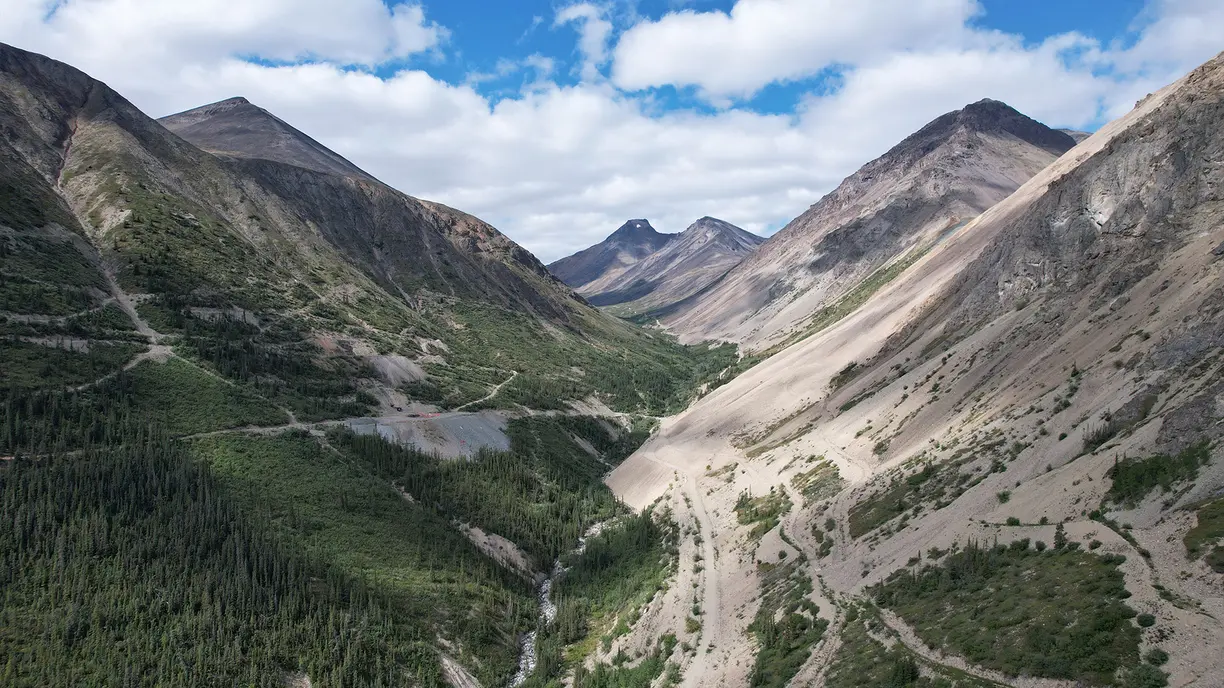
Skukum Creek at the Steller Gold Project in southern Yukon. The 170-square-kilometre property contains a past-producing mine, a high-grade deposit, and an antimony prospect.
- The first assays from Blue Jay's maiden 2026 drill program returned 14.0 metres of 6.15 g/t gold and 124 g/t silver at Skukum Creek, including 10.5 metres of 7.84 g/t gold and 154 g/t silver.5
- Steller holds 400,000 ounces of gold-equivalent in the Indicated category at 9.06 grams per tonne and 450,000 ounces Inferred at 6.45 grams per tonne, figures the company says make Steller the highest-grade undeveloped gold project in the Yukon.1
- The project has a 270 tonne-per-day mill and more than 7.5 kilometres of underground development across the property.
Disseminated on Behalf of: Blue Jay Gold Corp.
Gold is up more than 20% from a year ago, and August was its strongest month since January. Every pullback this year has been bought.
That kind of market pays for ounces it can see. A grassroots explorer asks investors to fund a discovery that may be years away. Ounces already counted, in a jurisdiction nobody has to think twice about, pay off sooner.
The best part of those ounces is that they sit next to infrastructure somebody else already built.
At just over an hour's drive south of Whitehorse, Blue Jay Gold Corp. (TSXV: JAY | OTCQB: JAYGF | FSE: JAY) owns the Steller Gold Project: one of the Yukon's highest-grade undeveloped gold resources.
The Steller Gold Project covers 170 square kilometres and comes with a head start most juniors would need years of exploration and development to reach: a mine that poured gold in the 1980s, a second high-grade deposit that never reached production, an antimony prospect that predates the discoveries entirely, and a processing plant that has operated before. Blue Jay also holds a portfolio of projects in northwestern Ontario.
CEO Geordie Mark spent 17 years as a mining analyst before he ran a company. He is blunt about what that combination is worth.
"If you've already got a resource approaching one million ounces, plus the plant infrastructure, it just catapults you five years ahead of everything else," Mark said. "Not only time, but you actually have to have discovered something in those five years."
From listing day to first results
When Market One last covered Blue Jay in June, the story was a newly listed company with $14.7 million behind it and a drill program of up to 16,000 metres about to get underway.
Three months later, the picture is materially different. Drilling began on the Skukum Creek corridor on June 11, a second rig followed, and the fully funded campaign runs through mid-October. Roughly 70% of the exploration budget is aimed at growing the existing resource rather than chasing new ground.
On September 14, the company released the first assays from that program. They did what the thesis said they would.
The gold does not stop
The headline hole is SC26-003. From 495 metres down, it cut 14.0 metres of 6.15 g/t gold and 124 g/t silver, including 10.5 metres of 7.84 g/t gold and 154 g/t silver, and within that a higher-grade 4.4 metres at 12.0 g/t gold and 258 g/t silver.⁵
What matters is where it sits. That intercept is roughly 32 metres down-plunge of a hole drilled in 2021, SC21-027, which returned 14.8 metres of 5.79 g/t gold and 100.9 g/t silver.1 Same structure, near enough the same width and grade, 32 metres deeper.
For an investor the translation is simple. The gold does not stop. A zone that can be followed is worth more than a scatter of separate hits, because it can be modelled, expanded, and eventually mined.
"That is what continuity looks like," Mark said. "Not just a string of separate hits, but a zone you can follow."
A second hole, SC26-001, returned 4.33 metres of 4.63 g/t gold and 74.0 g/t silver on the same Rainbow Zone structure. A third, SC26-004, deviated from its planned path and the plan is to redrill in that location at a later date.
At Mt. Skukum, the first reported hole, MS-26-01, from the site of the old mine returned 0.5 metres of 57.4 g/t gold and 44.1 g/t silver.5 Narrow, but that ground produced 77,790 ounces before it closed in 1988,2 and the hit says the system is not confined to one deposit.
The head start you cannot buy
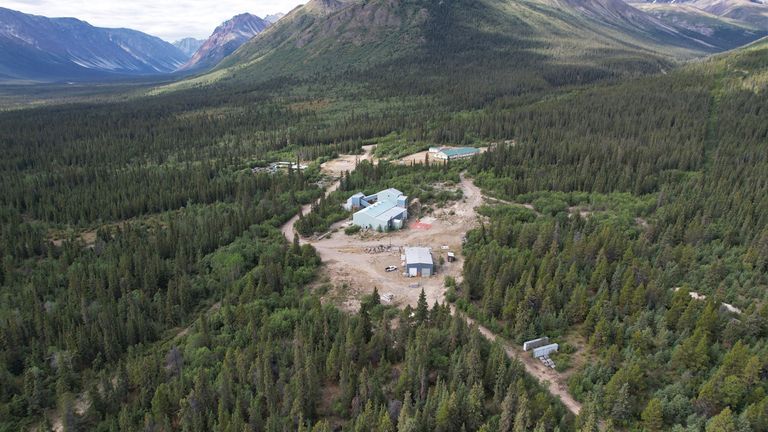
The processing plant and camp at the Steller Gold Project. Blue Jay estimates the infrastructure in place represents tens of millions of dollars and years of permitting and construction it did not have to spend.
Steller's appeal starts with what an investor is not paying for.
The property has a 270 tonne-per-day mill, a 50-person camp, a technical services workshop, and an all-weather access road. Skukum Creek alone holds more than four kilometres of underground drifting, last extended in 2008.
Crews can drive in from Whitehorse in just over an hour, which removes one of the highest and least predictable costs a northern explorer carries: helicopter support.
Eric Negraeff, who handles investor relations for the company, frames it as a balance-sheet argument rather than a geological one.
"We have tens of millions of dollars that we would have had to spend to get here in the first place," Negraeff said. "And then on top of that, it's the time it takes to put all of that infrastructure in, which you can't buy."
Blue Jay went looking in the territory before the current wave of Yukon interest arrived.
"We were looking in the Yukon when nobody was looking," Negraeff said. "If we were to go and try and acquire this asset now for the price that we paid, good luck."
Grade is the argument
Grade is what makes an underground operation work, because a smaller tonnage of higher-value rock carries the cost of mining it.
Steller's current resource estimate, effective October 31, 2025, and prepared by P&E Mining Consultants, contains 400,000 ounces at 9.06 grams per tonne gold-equivalent in the Indicated category, and 450,000 ounces at 6.45 grams per tonne gold-equivalent in the Inferred category.1 Both categories use a gold price of US$2,850 per ounce and silver at US$34.20 per ounce. Silver carries a meaningful share of that equivalency.
On a grade-versus-size plot of Canadian gold assets, Steller already ranks among the higher-grade projects. Growing the resource would move it into a field made up largely of deposits in production.
Between February 1986 and August 1988, the past-producing Mt. Skukum mine processed 233,400 tons of mineralized material, recovering 77,790 ounces of gold. This is historical production by a previous operator and is not indicative of current mineral resources.2
"Grade is king," Mark said. "If you've got grade, you can operate."
Reading the old core with new eyes
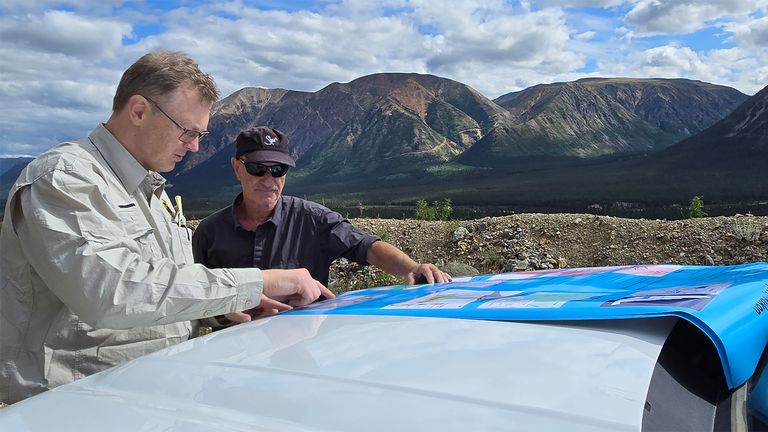
CEO Geordie Mark at the Steller Gold Project, an asset Blue Jay secured before the current wave of Yukon interest arrived, with a resource, a mill, and underground access already in place.
The second half of the thesis is that nobody has ever looked at Steller as a single system.
Ownership was fragmented for most of the property's history, and the group that finally consolidated it in 2000 spent its energy on a single deposit before the financial crisis ended the effort. Work since then has come in short bursts, a season at a time, each focused on different objectives. More than 120,000 metres of historical drilling sits in the record, but it was collected piecemeal, one target at a time, and never assembled into a single connected picture of the property.
"Most exploration programs start with a blank map," Mark said. "Steller handed us one already partly drawn."
Blue Jay has now put roughly 18,000 metres of archived core through hyperspectral scanning using LithologIQ's system. The company is also reading alteration chemistry straight from rock that has already been drilled, ahead of any lab result.
What came back is a targeting tool. A consistent, zoned band of altered rock wraps around the mineralized structures, it repeats from hole to hole, and it can be measured in core already sitting in the yard. It has generated new targets along the corridor.
"Every metre we scan turns rock we already own into data we can use to refine targets," Mark said.
Blue Jay is also reprocessing regional airborne magnetic data in three dimensions, and orienting drill core for structural analysis for the first time on the project. From that work, the company is building the project's first district-scale geological model.
A second endowment on the same ground
Steller also carries something outside the gold story.
At the end of August, Blue Jay began a ten-hole program at Becker-Cochran, an antimony-silver occurrence explored and partly developed underground in the 1960s, where metallurgical test work showed strong recoveries,3 but the project was never carried to production. Those workings reached less than 100 metres below surface, and the company's interpretation of available data suggests the system may run as much as 600 metres down.4
Antimony forms no part of the current resource estimate, and no economic assessment has been done. Blue Jay treats it as strategic optionality, with metallurgical work underway.
"Antimony is a critical mineral the Western world is short of, and we have it right here in our backyard," Mark said.
Why investors are watching
The market is still pricing Blue Jay as a company that listed in June. Steller is not a three-month-old asset.
Blue Jay carries an NI 43-101 resource, existing production history, a mill, and underground access, which is the profile of an advanced explorer. Mark's argument is that continuity of mineralization, the expensive thing most juniors spend years and several financings proving, is already established at Steller, and the current program is extending it.
"Be where the gold is." — Geordie Mark, CEO, Blue Jay Gold Corp. |
What closes the gap is results, and the first batch is in. Five holes have been reported, assays are pending on more, and the rigs run through mid-October. Antimony metallurgical results sit behind that, with drill news expected through to the end of January.
Mark keeps the strategy deliberately unglamorous.
"Be where the gold is," he said.
Most ounces are found around the headframe of existing production, he added, and the discipline is to resist the temptation to look elsewhere. "Don't over-complicate it, and be open to new ideas that new technologies allow you to come in."
Steller has the headframe. The first holes say there is more around it.
The scientific and technical information contained within this article has been reviewed and approved by Freeman Smith, P.Geo., Blue Jay Gold Corp.'s VP Exploration, who is a Qualified Person as defined under National Instrument 43-101.
Notes
- 2026 Technical Report. Technical Report and Updated Mineral Resource Estimate of the Steller Gold Project, Whitehorse Mining District, Yukon Territory, Canada, prepared by P&E Mining Consultants Inc. Effective date: October 31, 2025. Cut-off: 3.0 g/t AuEq. Au: US$2,850 per ounce. Ag: US$34.20 per ounce. Minimum mining width: 1.5 metres. AuEq ratio = ($2,850/$34)/(93%/95%) = 85.6. Available on SEDAR+.
- Historical production by a previous operator. This is not indicative of current mineral resources.
- Historical work at Becker-Cochran, including underground development and metallurgical testing conducted in the 1960s, has not been verified by a Qualified Person and should not be relied upon.
- The potential quantity and grade of this target is conceptual in nature. There has been insufficient exploration to define a mineral resource at Becker-Cochran, and it is uncertain if further exploration will result in the target being delineated as a mineral resource.
- Drill results announced September 14, 2026. Reported intervals are down-hole lengths; true widths are estimated at approximately 60 to 80% of the down-hole interval. Gold-equivalent values for these results are calculated using US$4,300 per ounce gold and US$67.00 per ounce silver, with recoveries of 95% for gold and 93% for silver. These assumptions differ from those used in the October 31, 2025 mineral resource estimate. Composites use a 1.0 g/t AuEq cut-off. AuEq values are provided for comparison only and do not reflect payable metal.
About Blue Jay Gold Corp.
Blue Jay Gold Corp. (TSXV: JAY | OTCQB: JAYGF | FSE: JAY) is a Canadian gold exploration company focused on growing and discovering resources within established gold-producing regions in Canada. The company's flagship asset is the 100%-owned Steller Gold Project in southern Yukon, an infrastructure-supported, past-producing mine with significant exploration upside and clear near-term catalysts. Blue Jay has also built a portfolio of projects in Ontario.
Learn more at bluejaygoldcorp.com.

Market One
Market One is a collaborative content marketing, strategy and creation agency with a stable of award winning journalists and videographers focused on providing robust solutions for Canada's capital markets.
