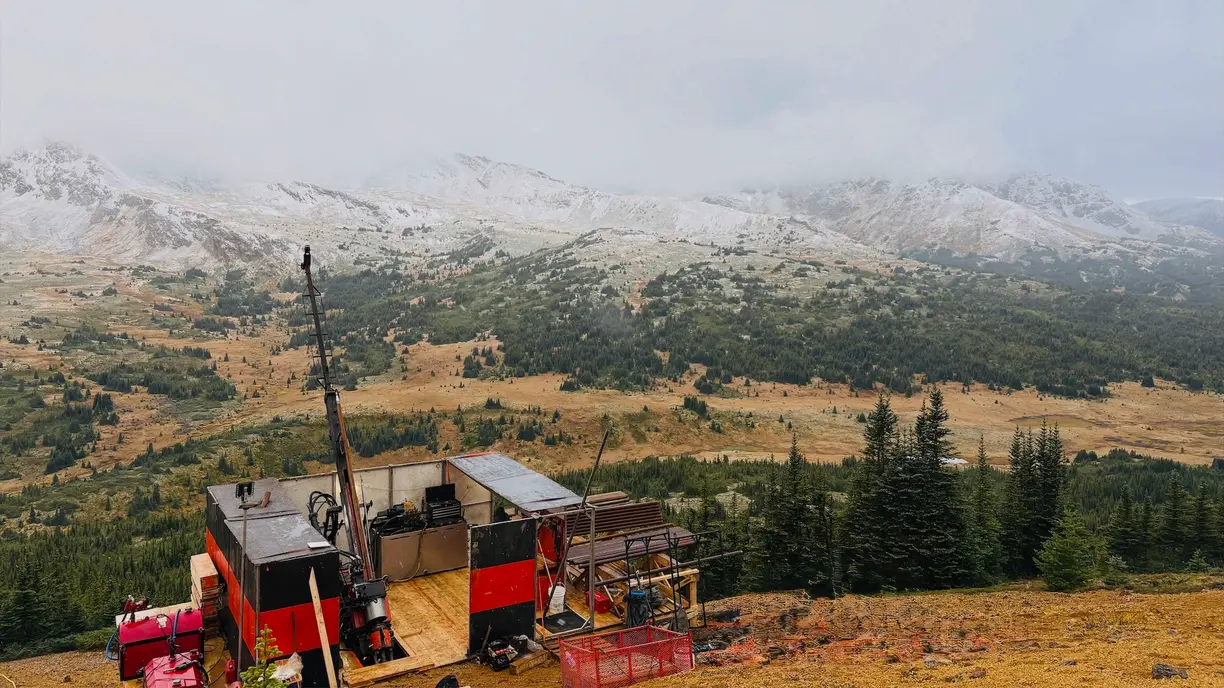
Omega Pacific CEO Jason Leikam at the Park Gossan on the West GIC gold target and the site of the first drill location of the 2026 program, on the Williams Property in British Columbia's Toodoggone District.
- Drilling began September 14 at the West GIC gold target, the first phase of a planned 5,000-metre program and the company's first drilling since a 2024 discovery hole returned 1.69 grams per tonne of gold over 104 metres, including a high-grade zone of 6.22 grams per tonne over 18.98 metres.
- A 2026 sampling program traced anomalous gold in soils, along with mapped alteration, across roughly 5.5 kilometres, from West GIC east to the ROI copper-gold porphyry target.
- Omega Pacific carries a market capitalization near $5.9 million, a fraction of its Toodoggone neighbours, with the initial drill phase due to wrap by mid-October.
Disseminated on Behalf of: Omega Pacific Resources Ltd.
In 2024, four drill holes went into a gold target in British Columbia's Toodoggone District. All four hit. One of them returned 104 metres grading 1.69 grams per tonne of gold.
Then the drills stopped, and the story went quiet for two years.
Omega Pacific Resources Ltd. (CSE: OMGA | OTCQB: OMGPF | FSE: Q0F) started them turning again on September 14.
The Vancouver-based explorer holds the Williams Property, roughly 11,500 hectares on a single ridge in the Toodoggone, with two distinct prospects. West GIC is an orogenic gold target, meaning gold carried up through deep faults during ancient mountain building, a setting that tends to produce large, continuous zones rather than narrow veins. ROI, about two kilometres east, is a copper-gold porphyry target, the style of deposit that supplies most of the world's copper.
It is a small company in a district that has stopped being quiet. Roughly 10 million ounces of gold have been discovered across the Toodoggone in eight years, and majors and mid-tiers have been buying their way in.
"We are entering an exciting juncture in the advancement of this project," said CEO Jason Leikam. "West GIC gold mineralization is open in all directions. This initial program will seek to extend known mineralization and set up for an expanded Phase 2 drill program."
The hole that changed the target
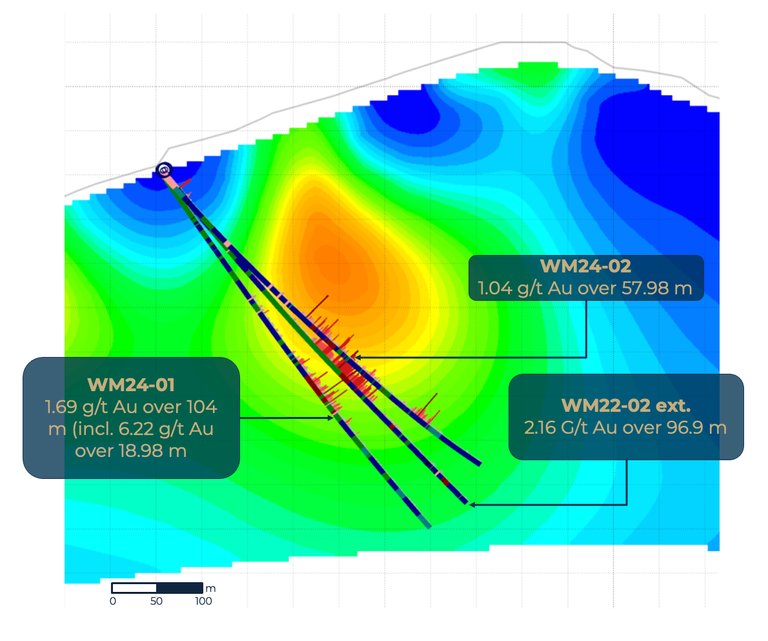
The results of 2024’s exploration program changed the expectations for the Williams Property’s GIC target from a copper-gold porphyry target to an orogenic gold target.
Williams did not start out as a gold story.
Previous owner CopAur Minerals Inc. explored it as a copper-gold porphyry project, and in 2022 drilled the GIC target looking for copper. Hole WM22-02 returned something else: 2.2 g/t Au over 50 metres, including 4.2 g/t Au over 10.5 metres. The drill hole was shut down. But the assay results showed gold mineralization right to the end of the hole. Nobody knew how much further the zone went.
The drill stopped. The gold did not.
Omega Pacific optioned the property from CopAur in early 2024, earned a 51% interest that November, and took full ownership in December 2025. Under the terms, it committed to spending $5 million to explore Williams by the end of 2027.
Its first move was to go back to that unfinished hole.
The 2024 program was four holes, and gold turned up in all four. WM24-01 returned 1.69 g/t Au over 104 metres, including a high-grade core of 6.22 g/t Au over 18.98 metres. The company also re-entered CopAur's hole and pushed it deeper, nearly doubling the mineralized interval to 96.9 metres while the grade held at 2.16 g/t Au (WM22-02 ext.).
For an investor, the significance is not just the grade. It is also the interval. A hundred metres of continuous gold points to a system with real volume behind it, not an isolated pocket.
"You don't get intercepts with consistent mineralization all the way through 100 metres, basically two grams over 100 metres, without being in a broad and robust gold system," Leikam said.
The result also reframed the geology. What had been mapped as a copper target turned out to be an orogenic gold system, sitting in older, deeper rock than the shallow, epithermal gold deposits found elsewhere in the district.
Why the high-grade zones matter
Bulk-tonnage deposits get mined at scale and low cost. High-grade zones inside them lift the economics of the whole operation.
Omega Pacific has both, and Leikam is deliberate about which one investors should focus on.
"6.22 grams over 18.98 metres is high grade anywhere you go, in any jurisdiction," he said.
He is equally insistent that the headline number is not the point. "Please don't discount the bulk tonnage aspect of it," he said. "It just enriches that bulk tonnage."
The distinction he draws is continuity. In many drill holes, a strong interval is followed by 20 or 30 metres of barren rock, then another hit. At West GIC, the 2024 intercepts ran mineralized straight through.
That is what allows a company to talk about volume rather than veins.
"This is consistent mineralization all the way through the whole intercept. That gives us the opportunity to chase that bulk tonnage scenario." — Jason Leikam, CEO, Omega Pacific Resources Ltd. |
Doing the math on a multi-million-ounce target
Surface geochemistry defines a gold anomaly 1,800 metres east to west and roughly 400 metres north to south at West GIC. Drilling has confirmed 750 metres of that strike, and the 2024 core supports extending it to about 400 metres below surface.
Multiply those three dimensions, and the implied volume potential runs to millions of ounces. Mineral deposits are, by nature, not uniform. But the West GIC gold anomaly footprint indicates that there could be real scale to the mineralization.
Management is careful to say that is a target, not a resource. No tonnage has been calculated, and none will be until enough holes are in the ground to support one.
"We're not giving it some sort of tonnage calculation based on two, three, four holes, certainly not," Leikam said. "But it's definitely a multi-million target."
The method is not new to this team. Omega Pacific directors John Williamson and Robert L’Heureux ran the same exercise years ago on another Toodoggone project that went on to become one of Canada's largest undeveloped gold-silver deposits. By Leikam's account, Omega Pacific's first four holes returned better numbers than that project produced at the same stage.
A crowded ridge, and what that is worth
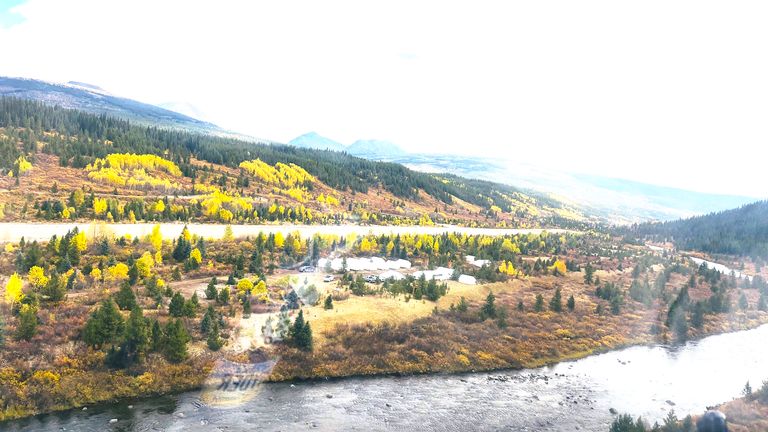
Omega Pacific’s 2026 exploration camp is located at the road-accessible Sturdie Airstrip. Several exploration companies use this location as a hub for supplies, fuel, and personnel transfer, as well as an exploration base camp.
Being small in a busy camp has practical advantages.
The Toodoggone is currently one of the most active exploration districts in British Columbia, with several juniors and mid-tiers drilling within helicopter range of Williams. Omega Pacific shares consulting geologists, a helicopter operator, and a drilling contractor with its neighbours, which pulls down the cost of working in remote terrain.
"It's a very dynamic camp," Leikam said.
The province has also committed to processing exploration permits within 40 to 140 days, shortening the gap between deciding to drill and drilling. Majors have been circling the region, and capital arriving next door tends to lift the ground around it.
"All of that means capital investment; that means infrastructure buildout," Leikam said. "It's all good for the whole region, so that bodes well for us."
Five kilometres of untested ground
The 2026 field season did more than prepare drill pads.
Crews collected 255 rock, 181 soil, and 119 talus samples across a corridor spanning more than five kilometres, from West GIC through ROI and onto claims staked in 2024. Mapping east of ROI found rock types resembling those at West GIC, and anomalous gold in soils together with mapped alteration now stretches roughly 5.5 kilometres between the two prospects.
Whether that represents one continuous mineralized system is exactly what the pending assays will help answer.
ROI is the second prospect, and it looks nothing like the first. Anomalous copper, very high molybdenum, and a three-and-a-half-kilometre geophysical signature point to porphyry potential, alongside the potassic alteration and magnetite veining that typically ring a buried intrusion.
For now, the company is treating it as strategic optionality while gold takes priority.
Why investors are watching
What’s the plan for Omega Pacific for the remainder of 2026?
From advancing the Williams Property to sharing our story with investors worldwide, we’re building momentum into 2027.
Watch the full video to hear the plan. #OMGA #GoldExploration #Toodoggone pic.twitter.com/JImhwiAJv7— Omega Pacific Resources (@OMGAPACIFIC) September 8, 2026
Omega Pacific's investment case rests on a single word management uses repeatedly: validation.
The 2024 program encountered gold mineralization in each drill hole, with results compelling enough to open institutional doors and early enough that those investors asked for more data. The 2026 program is the answer to that request.
"When we confirm and extend mineralization, I believe we will strongly validate this project and position us for a re-rating and an expansive next exploration phase," Leikam said.
The backdrop helps. Central banks bought a net 288.9 tonnes of gold in the second quarter, their strongest quarter in nearly four years, and exchange-traded fund holdings hit an all-time high of 4,189 tonnes in August. Capital has been rotating back toward hard assets even through a volatile year for the gold price.
The gap that creates is unusual. Omega Pacific carries a market capitalization near $5.96 million across 51.80 million shares outstanding. Sun Summit Minerals Corp. and Amarc Resources Ltd., working the same district, were valued at roughly $43 million and $214 million, respectively, earlier this year.
Management holds approximately 35% of the company. Cash of just under $2 million funds the initial phase without the company returning to the market, and any decision to extend toward the full 5,000 metres will be made on results.
The initial phase wraps by mid-October, with assays released as they are received and interpreted.
For a company Leikam describes as having "a largely untold story so far," the next few months are the test.
The scientific and technical information contained within this article has been reviewed and approved by Robert L'Heureux, P.Geol., a Director of Omega Pacific Resources Ltd., who is a Qualified Person as defined under National Instrument 43-101.
About Omega Pacific Resources Ltd.
Omega Pacific Resources Ltd. (CSE: OMGA | OTCQB: OMGPF | FSE: Q0F) is a Canadian mineral exploration company focused on the discovery and development of precious metal projects in British Columbia. The company is advancing the Williams Property, located in BC’s Toodoggone District. In 2024, Omega Pacific made an important gold discovery highlighted by the program’s first drill hole, WM24-01, which returned 1.69 g/t Au over 104 metres, including a high-grade zone of 6.2 g/t Au over 18.98 metres. A follow-up 2026 drill program is underway. The company also continues to evaluate prospective assets domestically and internationally.
Learn more at omegapacific.ca.

Market One
Market One is a collaborative content marketing, strategy and creation agency with a stable of award winning journalists and videographers focused on providing robust solutions for Canada's capital markets.
