
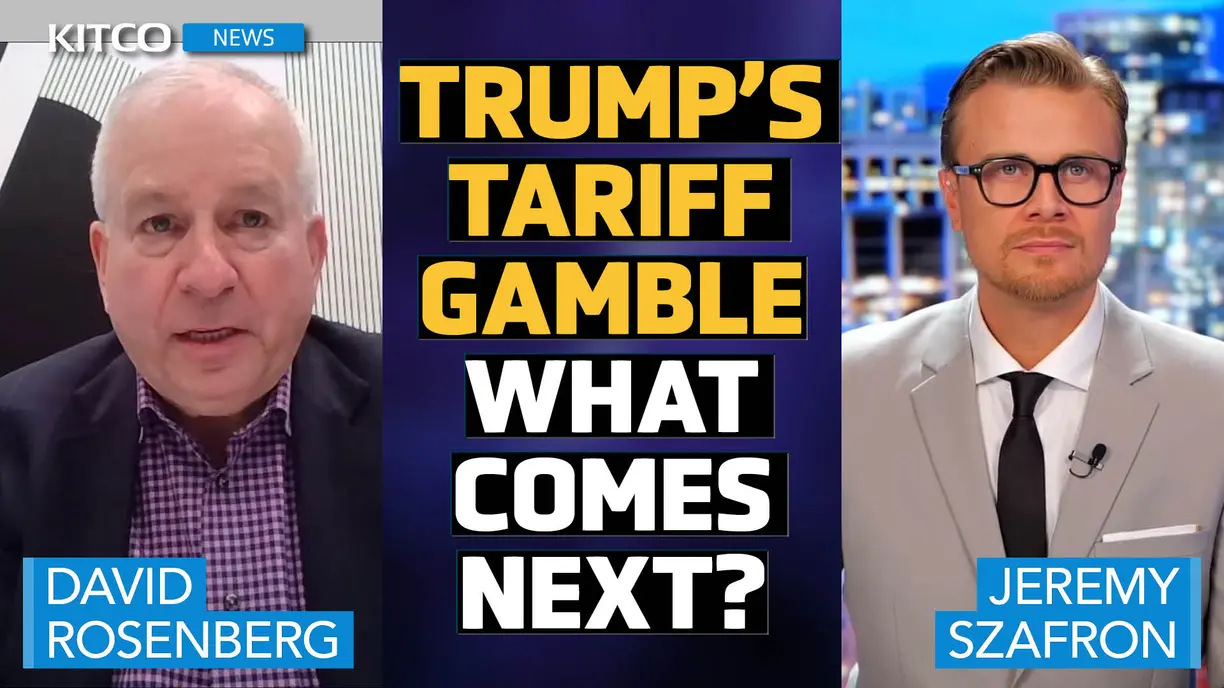
(Kitco News) - President Donald Trump is moving forward with his plan to impose 25% tariffs on imports from Canada and Mexico starting Saturday, the White House confirmed, rejecting earlier reports that the deadline might be pushed back to March 1. The move threatens to disrupt nearly $1.6 trillion in annual trade, impacting businesses, consumers, and financial markets as uncertainty spreads.
Economist David Rosenberg, Chief Strategist at Rosenberg Research, warns that Trump’s aggressive trade policy could lead to severe economic consequences. However, there is still a chance Trump could “wiggle out” of the tariffs.
While Trump insists the tariffs are aimed at pressuring Canada and Mexico to curb illegal immigration and fentanyl trafficking, Rosenberg believes there’s more at play. “It's always hard to know with Donald Trump what's going to happen in the end—he's so unpredictable.”
The tariff threats have already hit the Canadian dollar, with USD/CAD briefly surging past 1.45 before reports of a possible delay sent it lower. Rosenberg pointed out a simple trade opportunity if Trump backs off: “If the threat was fully alleviated, we’d probably rally back to 1.40—right where the loonie was before Trump first mentioned tariffs back in November.”
Oil Tariffs and Inflation Shock
Trump has yet to decide whether to include Canadian and Mexican crude oil in the tariffs. Given that Canada supplies 60% of U.S. crude imports, any action could have immediate inflationary consequences.
While inflation has moderated in recent months, Rosenberg emphasized that tariffs could complicate the Federal Reserve’s policy stance. “Inflation is a process, not a one-time event. If oil is hit with a tariff, you get a price shock, but that’s not necessarily inflationary unless it feeds into wages. That’s what the Fed will be watching.”
Gold’s Surge and the Trade War Hedge
Amid trade tensions, gold has surged past $2,850 an ounce, hitting new all-time highs and looking at its strongest month since March 2024. Rosenberg sees gold’s rally as a direct response to market instability. “Gold is 100% proportionally correlated with uncertainty. And this is the most uncertainty we’ve seen in a long time.”
A new report from the Financial Times also reveals that traders have pulled $82 billion worth of gold from the Bank of England’s vaults, shifting it to New York’s Comex exchange and private U.S. vaults. This has been driven by fears that Trump’s tariff policy could eventually extend to gold. “It’s a wild thought, but nothing is off the table with this administration,” Rosenberg noted.
Trump vs. Powell: The Economic Tug-of-War
Another looming concern is the battle between Trump’s economic policies and the Federal Reserve. Trump wants tariffs, tax cuts, and lower interest rates all at the same time, but Rosenberg says that’s unrealistic. “I don't think you're going to get tariffs, fiscal stimulus, and a weaker dollar and lower interest rates. If you put this in a psychiatrist’s office, two of those pieces don’t fit.”
With the Fed keeping rates on hold, markets are still pricing in cuts by mid-year, but Rosenberg believes Powell will remain cautious. “The labor market looks strong on the surface, but hiring has plummeted. That’s a leading indicator for job losses down the road. We’re walking in a dark room, and Powell doesn’t want to trip over a chair.”
A Global Trade War?
Beyond North America, Rosenberg sees a broader trend forming. “Trump is starting with his best friends—Canada and Mexico—to send a message. But this is just the beginning. Europe, China, Japan… they’re all next.”
As for where investors should be looking, Rosenberg remains bullish on safe-haven assets. “Gold is a no-brainer in this environment. Treasuries will also rally in the second half of the year. And if you’re looking at mining stocks, they’re still undervalued. The biggest opportunities are there.”
With Trump’s tariffs set to take effect in mere hours, markets remain on edge. Will he follow through, or is this just another negotiating tactic? “The only certainty,” Rosenberg said, “is more uncertainty.”
Watch the Full Interview
For Rosenberg’s full analysis, watch the complete interview on Kitco News