
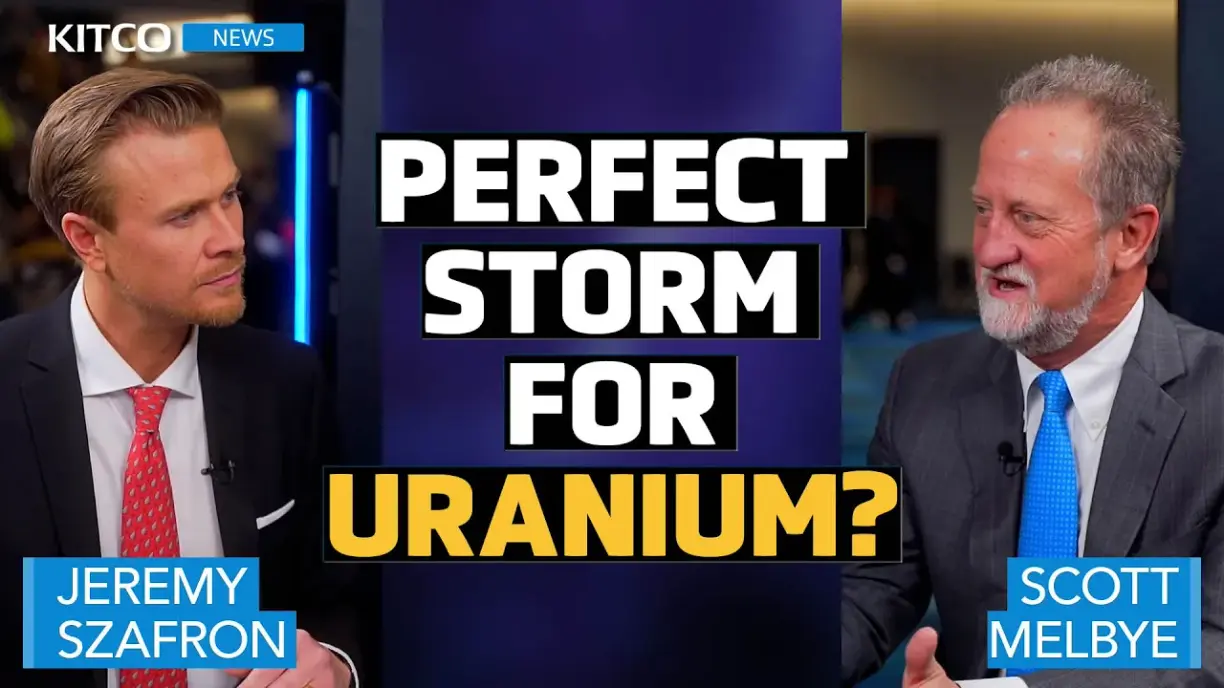
(Kitco News) - The uranium market is at a breaking point, caught between skyrocketing demand for nuclear power and a crippling supply deficit. As data centers, AI, and national security concerns drive unprecedented energy consumption, the need for uranium has never been greater.
At the 2025 PDAC conference in Toronto, Scott Melbye, CEO of Uranium Royalty Corp. and EVP of Uranium Energy Corp., laid out the stakes:
“The last three, four years and currently where we are today, I’ve never seen a better narrative around nuclear power, behind uranium.”
Melbye, a 41-year veteran of the uranium sector, has seen boom-and-bust cycles, but this time is different. “We’re building nuclear power plants and we’re proposing new nuclear power plants faster than we’re bringing on new uranium supply.”
Global uranium demand is surging – but supply isn’t keeping up
The world is rapidly shifting toward nuclear power, with over 30 countries and 160 corporations pledging to triple nuclear power by 2050.
“We now have… we’ve gone from a flat market where nuclear energy wasn’t growing or even declining after Fukushima to a point now where nuclear energy’s looking to double by 2040,” Melbye said.
But supply isn’t keeping up with demand. “We need new mines tomorrow, and the easier mines, if there is such a thing in mining, are the restart of operations,” he said. “The U.S. needs baseload demand growth for electricity again, and data centers are making that an even greater challenge.”
The U.S. ban on Russian uranium: A game-changer
The United States has banned Russian uranium imports, marking a historic shift in nuclear fuel supply chains. For decades, Russia, Kazakhstan, and Uzbekistan supplied nearly 50% of the world’s uranium and 25% of U.S. nuclear enrichment.
“The ban was very important because… 25% of our enrichment, 50% of our uranium today has come from Russia, Kazakhstan, Uzbekistan, and that’s inhibited additional mines in places like Canada and the United States,” Melbye said.
With the ban taking full effect by 2027, the U.S. uranium industry now has an open market but must scale quickly.
“We now know that we can build mines in the U.S. and we won’t be undercut by Russian or Kazakhs going forward,” he said.
Even if tensions ease between Russia and the West, the uranium ban is permanent.
“Some sanctions may go away on Russia, but one thing that won’t be undone is the ban,” Melbye said.
Trump’s energy policy is fast-tracking nuclear power
The Trump administration’s Energy Dominance Council is prioritizing nuclear energy, removing regulatory bottlenecks, and investing in domestic uranium production.
“One of the first things that President Trump did upon being elected was announce the establishment of the Energy Dominance Council in the White House,” Melbye said.
The council, led by Interior Secretary Wright and Energy Secretary Burgum, is focused on cutting through red tape to accelerate nuclear projects.
“If there are any bottlenecks or obstacles—whether in oil, gas, nuclear, or uranium—the council is designed to fix them,” he said.
Trump has declared a national energy crisis, recognizing energy security as a national security issue.
“In a Trump administration, that means natural gas and nuclear,” Melbye said. “And thank God we have an administration that believes in more energy, not less. Because if we didn’t have that, we would fall behind in AI. And frankly, the U.S. would be subject to blackouts.”
AI’s exploding energy demand – and why nuclear is the only solution
The rise of AI-driven data centers is reshaping global energy markets, forcing utilities and governments to rethink power generation.
“Take, for example, the Commonwealth of Virginia—20% of the electricity they’re producing today goes to data centers,” Melbye said. “In two years, it goes to 40%.”
“Magnify that around the country and around the developed world… these data centers use 10 times the computing power of the current average Google search,” he said.
AI’s energy demand can’t be met with intermittent renewables like wind and solar. Nuclear is the only scalable and reliable solution.
“To stay ahead of China and other countries, the U.S. is going to need to build out the power systems that’ll support AI,” he said.
The rise of small modular reactors (SMRs)
The future of nuclear energy isn’t just massive reactors—it’s Small Modular Reactors (SMRs).
“I think in the next generation, SMRs will revolutionize the way electricity is generated and delivered,” Melbye said.
Tech firms Amazon, Microsoft, and Google are already investing in nuclear energy, looking to co-locate reactors with data centers.
“The low-hanging fruit is to try to capture nuclear-powered electricity from existing plants,” he said, pointing to Amazon’s deal with Talen Energy in Pennsylvania and Microsoft’s plan to restart a shuttered reactor.
But new reactor development is also on the horizon.
“Don’t be shocked over the course of 2025 if we have announcements of new large-scale reactors,” he said.
Uranium prices have more room to run
The uranium market has already seen strong price swings, but Melbye believes the biggest moves are still ahead.
“We’re already seeing a premium develop for uranium bought and sold in the United States—about $2 to $3 a pound on a $64 per pound product,” he said.
With tariffs on Canadian uranium looming, this premium could rise even higher.
“I would expect that prices will be higher in the U.S. market for U.S. pounds that are either mined in the U.S. or already located in the U.S. and don’t have to cross a border,” he said.
Melbye sees the nuclear sector at a defining moment.
“We’re playing catch-up suddenly after a long period of flat load demand,” he said.
But with supply tight, demand soaring, and government policies shifting, nuclear energy is set for an unprecedented breakout.
“If the U.S. doesn’t move now, we’ll fall behind,” he warned.
Watch the full interview with Scott Melbye for an inside look at uranium’s future – embedded above.
Special thanks to our sponsors, GoldMining Inc., UEC & URC for making this coverage possible.
To learn more, visit: