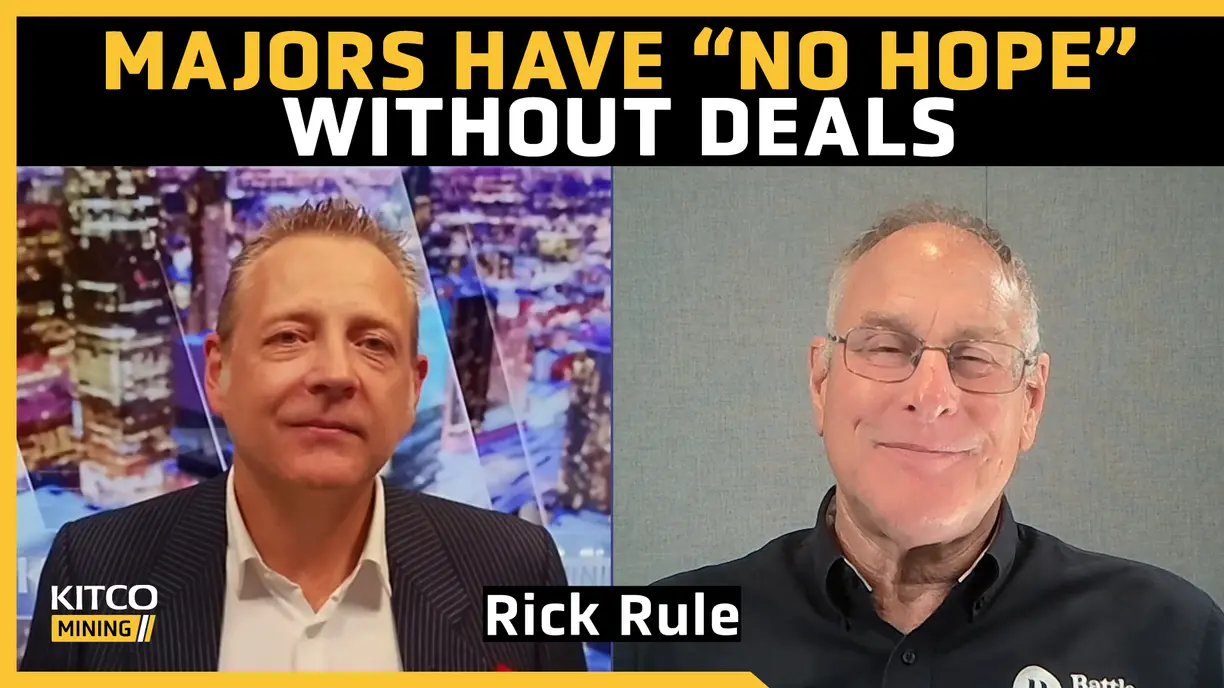
(Kitco News) - Gold’s pullback below $4,500 an ounce has put U.S. interest rates back at the center of the market debate, but Rick Rule believes the more important shift for mining investors is the pressure building on producers to replace ounces through acquisitions.
Speaking with Kitco Mining’s Digging Deep on May 27, the President and CEO of Rule Investment Media said the move lower in gold, which had taken prices below $4,500/oz for the first time since late March, had not changed his long-term view.
Higher U.S. interest rates have strengthened the dollar and made long-dated bonds more attractive relative to gold, Rule said, weighing on the dollar-denominated price. For investors with five- and ten-year horizons, he said, the pullback changes the entry point more than the thesis.
“This price weakness is, for me at least, heaven-sent,” Rule said.
The rate outlook remains central to that view. Higher rates increase the cost of servicing debt across consumers, companies, state and local governments, and the federal government. That pressure, he said, could eventually push policymakers toward lower rates.
If that happens, Rule said, the move in gold “would be dramatic.”
The same macro and policy backdrop is also reshaping mining finance.
The discussion came as the Iran conflict sharpened attention on defense supply chains and strategic minerals. Perpetua Resources said on May 21 that the Export-Import Bank of the United States approved a $2.9 billion senior secured long-term loan for the Stibnite Gold Project in Idaho, which includes antimony.
Rule said the loan reflects a broader effort by Washington to compete with Chinese support for mining and processing, while lowering financing costs for strategic projects.
“The mining industry loves nothing quite so much as dumb money, and there’s no money in the market that’s quite as dumb as government money,” Rule said.
Government-backed capital may help individual projects, but Rule said permitting remains the larger constraint. He said Stibnite had been constrained by U.S. regulators for 15 years and pointed to Resolution Copper in Arizona as another long-delayed project. “The United States needs to overhaul its regulatory regime,” he said.
Policy support is also becoming more visible outside the U.S, with Vizsla Silver announcing that its Mexican subsidiary entered into a MXN$173 million, roughly US$10 million, unsecured working capital facility with Fideicomiso de Fomento Minero, or FIFOMI, for the Panuco silver-gold project in Sinaloa.
Regarding the serious security incident in January at Vizsla’s Panuco project site in Concordia, Sinaloa, Rule said the Mexican government’s backing was symbolically important in that context, with financial support serving as one way to signal support for mining while security risks remain a challenge in parts of Sinaloa.
Those examples point to a broader shift in the sector, with higher metal prices improving the backdrop for miners, though production growth remains difficult to generate organically.
Challenger Gold announced a pre-feasibility study on May 18 for its Hualilan project in San Juan, Argentina, outlining average annual production of about 135,000 oz AuEq over a 14.25-year mine life. The company also said Peter Marrone, chair and CEO of Allied Gold, would join as non-executive chair following Allied Gold’s agreement to be acquired by Zijin Gold International.
Rule said Marrone’s move was less about one company than the broader direction of the market.
“The theme here is not so much Challenger or even Argentina,” Rule said. “The theme is the increasing pace of merger and acquisition activity in the mining business.”
The mining sector spent years emphasizing capital discipline after the excesses of the 2000 to 2010 cycle, when higher gold prices did not translate into stronger free cash flow per share for many producers. Rule said that period is giving way to a different problem, that major miners do not have enough internal projects to maintain production from existing development pipelines.
Exploration can create value, but it takes too long to solve near-term production replacement. That leaves acquisitions as the more immediate route.
“The only way that these companies are going to be able to do this is through M&A,” Rule said.
The case for consolidation is partly operational and partly financial. Larger companies typically benefit from deeper liquidity, broader institutional ownership, greater index weighting, and lower costs of capital. In that environment, scale can carry value even when a deal is driven more by market structure than by direct operating synergies.
Rule pointed to Agnico Eagle’s district-focused strategy and recent consolidation involving Equinox Gold as examples of how producers are adapting. He also cited OceanaGold and B2Gold as companies that could draw attention because of valuation, free cash flow, or asset mix.
The more important opportunity, he said, may be in development-stage assets. At higher metal prices, projects with net asset values several times larger than projected capital costs can become more attractive to major producers with stronger balance sheets. Juniors holding those assets can trade at discounts because investors remain concerned about financing, construction, and execution risk.
“I think that’s going to be the sweet spot in M&A,” Rule said.
Capital markets are also reopening for parts of the silver sector, with Sunshine Silver Mining & Refining filing a registration statement on May 11 for a proposed New York Stock Exchange IPO. Renaissance Capital reported on May 26 that the company planned to offer 20 million shares at $13.50 to $16.50, which would raise up to $330 million at the top of the range. The company is seeking to restart the Sunshine silver mine in Idaho’s Coeur d’Alene district.
Rule said the timing reflects stronger silver prices and a more receptive market for precious metals equities. Still, he cautioned that investors should not compare silver developers by in-situ ounces alone, saying net present value, capital intensity, infrastructure, and permitting are better measures of project quality.
The result is a mining sector being pushed by several forces at once: gold’s sensitivity to interest rates, government support for strategic minerals, permitting pressure in key jurisdictions, and the need for producers to buy growth rather than wait for exploration to replace reserves.
Watch the full video on the Kitco Mining YouTube channel, and click here to register for virtual access to the 2026 Rule Symposium from July 6–10.