

(Kitco News) - Spot gold and silver prices were weaker following the North American equities close, with traders fading part of last week’s jobs-led rebound while keeping Wednesday’s Federal Reserve minutes and Strait of Hormuz headlines in view. At the time of writing, spot gold was trading near $4,161.90 an ounce, down 0.29%, while spot silver was trading at $61.900, down 0.59% on the session.
Gold futures still finished the session at their highest level since June 22, with front-month gold up 1.0% at $4,155.10 a troy ounce and silver up 2.1% at $61.92 a troy ounce, its fourth straight higher close. Rhona O’Connell, market analyst at StoneX, said in a note that “Gold ETFs are still friendless,” keeping the rebound less convincing than the futures settlement alone suggests.
The Federal Reserve’s June 16-17 meeting remains the policy anchor for metals. The FOMC voted to hold the target range at 3.50% to 3.75%, while the statement said inflation remained above the 2% goal and cited energy-linked supply shocks. The market reaction since the meeting has been two-sided for precious metals: weaker U.S. jobs data and lower crude prices have eased near-term hike pricing, but the rate path has not turned dovish enough to force a broad CTA capitulation in gold, silver, platinum or palladium.
Commodity analysts at TD Securities said bearish precious-metals positions have been “hard to shake,” noting that CTAs did not move off net-short positioning even after the bounce into the long weekend, weaker-than-expected jobs data and softer Fed hike pricing. Their read is that the market is still pricing a hike before year-end, which continues to weigh on the complex. Wednesday’s FOMC minutes, due at 2 p.m. ET, are the next policy test for that positioning.
The Strait of Hormuz remains a live risk premium, but not a one-way bullish input for gold. Iran’s military command has told tankers to use approved routes through the waterway or face a forceful response, and also warned against U.S. interference. At the same time, crude futures have been trading closer to pre-conflict levels as resumed flows through the strait, OPEC+ supply increases and Saudi price cuts offset the geopolitical risk. WTI settled down 0.2% at $68.55 a barrel and Brent settled down 0.2% at $71.99 a barrel, while insurance costs and unresolved U.S.-Iran terms kept the all-clear signal out of reach.
The U.S. macro tape was not weak enough to break the dollar-rate headwind. The ISM services PMI registered 54.0 for June, with business activity at 55.4, new orders at 55.1 and employment at 51.2. The U.S. dollar index was near unchanged to slightly firmer, while the yield on the benchmark 10-year U.S. Treasury note was near the 4.5% area, with the Treasury’s July 6 constant-maturity 10-year rate at 4.48%.
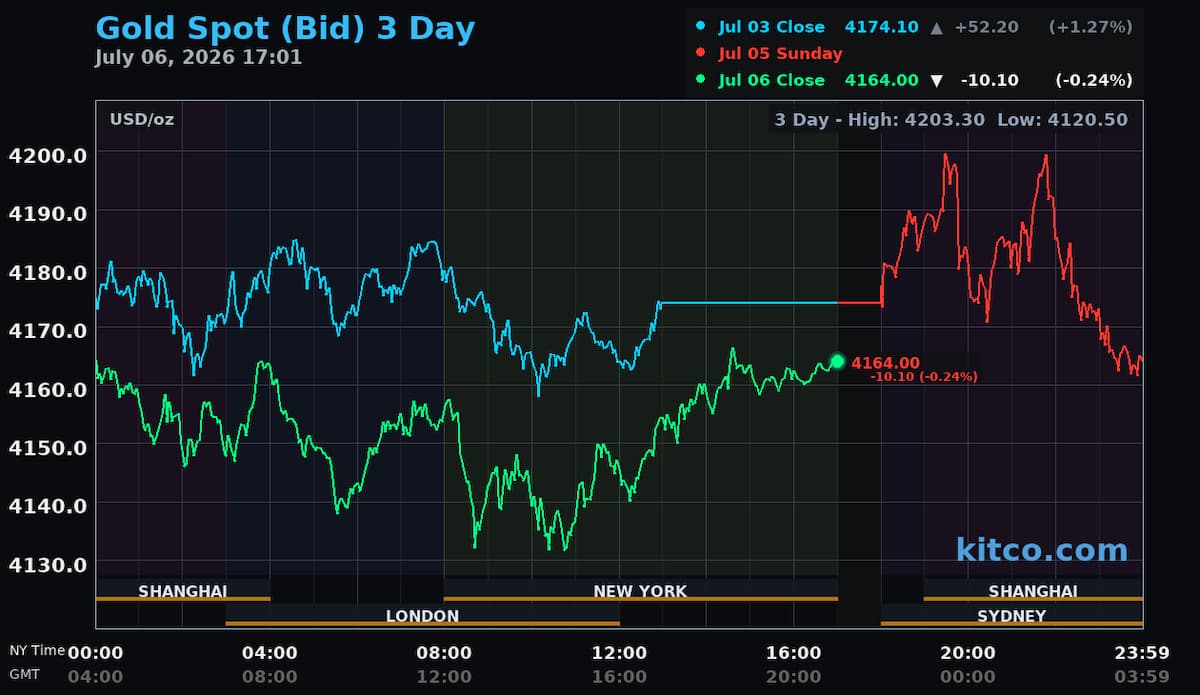
Technically, spot gold bulls' next upside price objective is to push prices back above the $4,260 to $4,400 resistance zone, with a sustained move targeting $4,500 and then $5,000. Bears' next near-term downside price objective is a break below $3,900, with deeper downside targets at $3,800 and then $3,950. First resistance is seen at $4,200 and then at $4,260. First support is seen at $4,091 and then at $4,000.
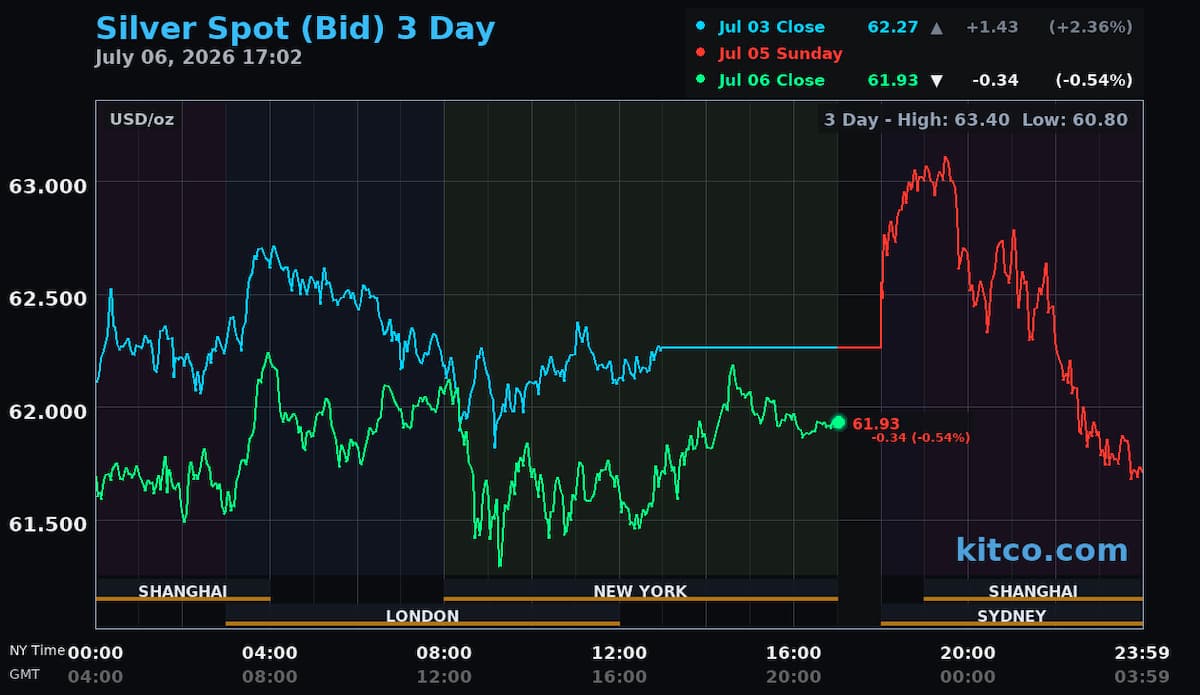
Spot silver bulls' next upside price objective is to drive prices back above the $64.00 to $72.00 area, with a move above that zone targeting $90.00 and then higher. The next downside price objective for the bears is a break below $55.00, with deeper downside targets at $45.00 and then $60.75. First resistance is seen at $62.43 and then at $63.32. Next support is seen at $60.75 and then at $57.12.