

(Kitco NewsWire) - Spot gold and silver prices were weaker in late U.S. trading Thursday, as rising oil prices, firmer Treasury yields and a stronger U.S. dollar prompted investors to take some profits after Wednesday’s breakout rally. At the time of writing, spot gold was trading near $4,243.40 an ounce, down 0.07% on the session, while spot silver was trading near $61.520, down 0.64%.
U.S. equities closed lower as oil rebounded and traders moved back into pre-payroll defensive positioning. The S&P 500 fell 13.59 points, or 0.2%, to 7,709.96, the Dow Jones Industrial Average fell 464.02 points, or 0.9%, to 53,885.10 and the Nasdaq Composite slipped 15.09 points, or 0.1%, to 26,348.35. The Russell 2000 lost 17.64 points, or 0.6%, to 3,001.55. In Europe, the STOXX Europe 600 closed up 0.2% at 658.19, Germany’s DAX gained 0.15%, France’s CAC 40 rose 0.35% and Britain’s FTSE 100 closed down 0.19%, leaving the session mixed after early strength faded.
The latest U.S. data kept the market’s post-Fed positioning centered on resilience rather than recession. Initial jobless claims rose by 1,000 to 199,000 in the week ended Aug. 1, still below consensus, while continuing claims increased to 1.8 million. Second-quarter nonfarm productivity rose at a 1.4% annualized pace, above expectations, after a revised 0.8% rise in the first quarter. The July ISM Services PMI printed at 54.1, below the 54.5 consensus but still in expansion territory, while ADP private payrolls earlier in the week showed only 44,000 jobs added in July, down from 95,000 in June. Taken together, the data left traders leaning toward a still-firm labor market with slower hiring, rather than a clean dovish pivot.
At the same time, global markets continue to feel the effects of the Federal Reserve’s July monetary policy meeting. The Fed held the federal funds target range at 3.50% to 3.75% on July 29 by a 9-3 vote. The statement said economic activity was expanding at a solid pace, job gains had kept pace with the workforce and inflation remained elevated relative to the 2% goal. After the press conference and this week’s data, rate expectations remain sensitive to Friday’s payrolls print. Market-implied odds of a September 25-basis-point rate hike were near 56.9% Thursday afternoon, up from 54.4% Wednesday but below last week’s 63.4%, while the 10-year Treasury yield moved back toward the 4.6% to 4.7% area. That mix kept real-yield pressure in the gold market even as confidence and geopolitical hedges limited the downside.
The Strait of Hormuz remains the central geopolitical risk input for metals, oil and rates. Iran and Oman are said to be close to finalizing an arrangement on shipping routes, but the U.S. position remains the binding constraint if any deal appears to give Tehran formal control over commercial navigation. The Strait handled roughly one-fifth of global oil and gas flows before the war, making even a partial reopening a material deflationary impulse for energy, while a breakdown in talks keeps the risk premium in crude and Treasuries alive. On Thursday, the market traded the second scenario: Brent crude rose 3.8% to $82.49 a barrel, WTI climbed to about $77.29 and higher oil-fed inflation concerns weighed against gold’s safe-haven bid.
Japan’s yen intervention remains part of the gold story because it has shifted the trade from a simple rate-market model to a confidence model. The coordinated yen-buying operation helped pull USD/JPY off four-decade extremes, but the broader read for bullion is that governments are becoming more active in managing currency and bond-market stress. Michele Schneider, chief market strategist at MarketGauge, told Kitco News that gold’s rally reflected a growing lack of investor confidence, with the yen intervention acting as the “real spark” behind the move. She said gold’s appeal can persist even when rates are not moving cleanly in its favor, because the trade is increasingly tied to questions about policy credibility and financial-system stability.
The key outside markets see Nymex WTI crude oil prices higher and trading around $77.29 a barrel, while Brent crude was near $82.49. The U.S. dollar index was firmer. The yield on the benchmark 10-year U.S. Treasury note was trading near the 4.6% to 4.7% area.
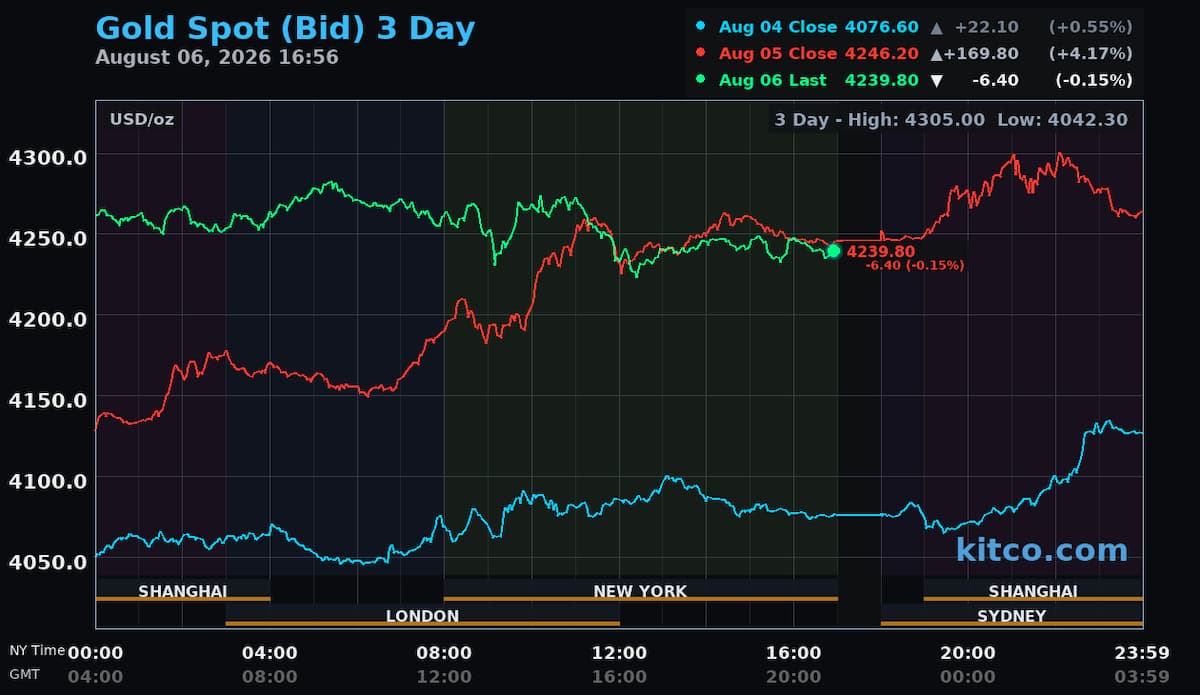
Technically, spot gold bulls' next upside price objective is to push prices back above the $4,300 to $4,380 resistance zone, with a sustained move targeting $4,400. Bears' next near-term downside price objective is a break below $4,180, with deeper downside targets at $4,156 and then the $4,000 breakout area. First resistance is seen at $4,300 and then at $4,360. First support is seen at $4,180 and then at $4,156.
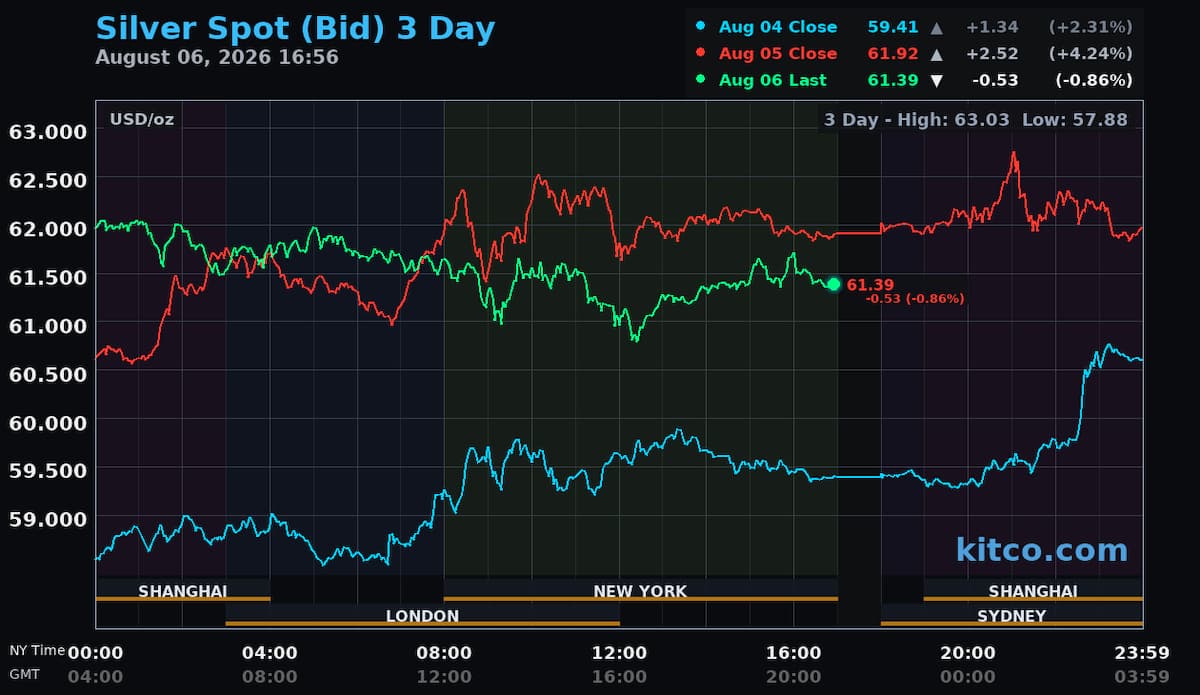
Spot silver bulls' next upside price objective is to drive prices back above the $61.00 to $62.00 area, with a move above that zone targeting $65.00 and then $66.00. The next downside price objective for the bears is a break below $60.00, with deeper downside targets at $57.00 and then $56.00. First resistance is seen at $62.00 and then at $65.00. Next support is seen at $60.00 and then at $57.00.

