
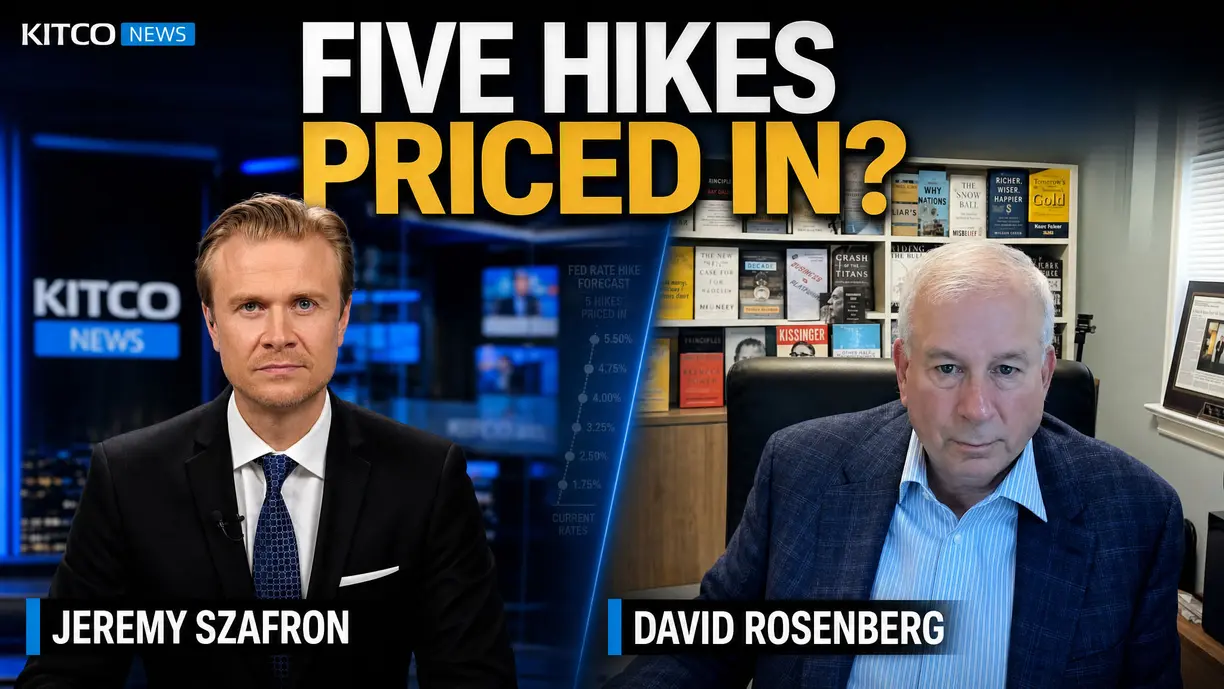
(Kitco News) - At a level not seen since before the 2008 Great Financial Crisis, the U.S. 10-year Treasury yield has broken above 5% as markets prepare for higher interest rates. Looking ahead, famed economist David Rosenberg says the bigger risk isn't Wednesday's expected Federal Reserve rate hike; it's the series of hikes the market has started pricing in beyond it.
Rosenberg added that while he thinks the Fed will move, the economic numbers don’t justify it.
"If you're trading on faulty data, my heart goes out to you," the founder and president of Rosenberg Research told Kitco News. "And if the Fed is gonna respond to faulty data, then they're gonna be on the precipice of a policy misstep."
The CME's FedWatch Tool puts a quarter-point increase at 90.3%, with the odds of a cut at zero. A move that size would take the target range to 3.75% to 4% and mark the first hike since July 2023.
Most of the profession agrees it's coming. After Friday's inflation report, 86 of 101 economists in a Reuters poll said the Fed would raise. A week earlier, most of that same group expected the central bank to sit still.
Rosenberg's argument isn't with the decision. It's with what the decision is built on.
"This is an exercise in flexing its anti-inflation muscles and trying to restore any perceived loss of credibility," he said. "But it's not real in any other sense."
Where the data doesn't line up
Core prices rose 0.3% in August, a tenth hotter than forecast. Only nine of 73 economists in a Bloomberg survey saw it coming. Headline inflation ran 3.4% over the year, according to the Labor Department.
Rosenberg says he took the report apart line by line against industry sources, and several pieces don't match.
Hotel and motel rates were negative in industry data through the first half of August, he said, while the CPI showed a big jump. Telecom services posted a record increase in the consumer index and, by his reading, a negative print in the producer index. He said the Manheim index had used car prices falling while the CPI had them up 0.4%.
"When you actually take the industry data and map it into the BLS numbers, that core number was actually close to being flat," he said.
He expected the pushback. "People will say, well, that's data mining. No, I actually refer to it as data analysis." On the report as a whole: "It looked a little spurious to me, not something as a central banker that I would be raising interest rates on."
By his count, 45% of the index's subcomponents were flat or negative last month, against a historical norm he puts at just over 40%.
He was no kinder to the 162,000 jobs added in August, calling it "a number that has 100% chance of getting revised" and pointing at the seasonal adjustments around back-to-school hiring.

The number nobody's watching
His whole case comes down to wages.
Nominal wage growth has been slowing for a year, he said. Real average hourly earnings fell 0.3% from a year earlier, while a longer average workweek lifted real weekly earnings 0.3%, according to the Bureau of Labor Statistics.
"How do you get sustainable inflation without the labor market playing a role?" Rosenberg said. "Labor is the biggest cost in the overall price structure of the economy. And that's what's gone missing in this particular inflation narrative. Nobody's talking about it."
What is moving prices, he says, is energy arriving as a cost rather than as demand. Diesel crossed $6 a gallon this month for the first time, according to GasBuddy. Brent pushed toward $110 after drone strikes forced Saudi Arabia to shut its East-West pipeline, which can move about 7 million barrels a day around the Strait of Hormuz. The Associated Press reported the line could be down for weeks.
"It is a tax hike on the private sector," Rosenberg said. "This is not a source of inflation. This is a cost squeeze."
The history backs the shape of his argument. When oil roughly doubled from $20 to $40 after Iraq invaded Kuwait in 1990, Alan Greenspan's Fed cut five times that year, taking the funds rate from 8.25% toward 6.75% by the start of Desert Storm. Oil climbed toward $150 a barrel by mid-2008, and Ben Bernanke's Fed did not raise rates during that final surge.
The other side of it
The Fed isn't acting on nothing.
Inflation measured by the personal consumption expenditures index, the gauge the central bank actually targets, has run above the 2% goal for much of the past five years. At Jackson Hole on Aug. 28, Chair Kevin Warsh said inflation wasn't slowing convincingly, called the 2% target firm and fixed, and said financial conditions were not restrictive. Three officials dissented in July because they wanted a hike then.
There's also the bond market itself. Treasury offered to buy back as much as $6 billion of longer-dated debt this month and yields went to 5% anyway. The widely held view going into Wednesday is that a hold now pushes long yields higher rather than lower, because what's being tested is whether the Fed does what it says it will do.
Households aren't waiting for the argument to settle. Michigan's preliminary September sentiment reading came in at 47.8, below every forecast in a Bloomberg survey, with consumers expecting 4.6% inflation over the next year, up from 4%.
Where he says the trade is
Rosenberg was clear that one hike, on its own, is survivable.
"I don't think one rate hike will be a policy mistake," he said. "But if they raise their dots and they ratify what the market's priced in, and then we're not talking about just one rate hike but four or five, I don't think the economy can withstand it."
By his reading, the market has already swung that far. "Back when we were below 4% on the 10-year note in late February, we were priced for two rate cuts," he said. "Now we're priced for five rate hikes."
That swing is the opening he sees. The 10-year touched 5.01% on Monday before easing back to 4.93%. The 30-year sits at 5.31%, with a real yield of roughly 3%, a level Rosenberg called extraordinary.
"You ought to block your nose and buy it," he said. "These are really juicy yields. You have a lot of yield cushion right now in the Treasury market, and nobody seems to wanna own it."
He expects bonds to outperform stocks within months. He also notes that net speculative short positions are near a record, which is fuel for a covering rally if the trade turns.
And he says the wrong building is getting the attention. The Fed moves demand for bonds through its balance sheet. Treasury sets the supply. In the last quarter of 2023, after the department leaned into bills and away from long maturities, the 10-year fell from above 5% to 3.9%. Federal Reserve researchers later attributed the earlier surge largely to term premium, driven by quantitative tightening, heavier issuance and economic uncertainty.
"If you were long duration in the last quarter of 2023, you made your year," Rosenberg said.
Gold
Gold fell as low as $4,253 an ounce on Monday before climbing back above $4,300, on a day the dollar had its best session since June.
Rosenberg called the low "a rock-solid bottom" and said gold has now built what looks to him like a triple bottom near $4,000. He'd rather frame the day as a question.
"The question isn't what happened to gold," he said, "but why didn't it go even lower?"
He is "fundamentally bearish on the U.S. dollar," and calls gold one of the better hedges against a long slide in it. (Kitco Global Index shows how much of today's gold move is the dollar versus the gold market itself.)
What actually settles it
Wednesday answers the easy question. The dot plot answers the real one.
If the committee signals the path the market has already priced, the argument stops being about whether this week was justified and becomes whether the economy can carry four more.
The other date is Nov. 4, when Treasury's next refunding announcement will show whether it intends to keep shifting issuance away from longer maturities. Rosenberg calls that the one that matters. "The real impact will come November 4."
See live precious metals prices for gold, silver, platinum and palladium — in USD, CAD and 12 more currencies.